Ch. 3 - Probability
Larson - Elementary Statistics: Picturing the World 8th Edition
Larson8th EditionElementary Statistics: Picturing the WorldISBN: 9780137493470Not the one you use?Change textbook
Chapter 3, Problem 3.RE.11

In Exercises 7-12, classify the statement as an example of classical probability, empirical probability, or subjective probability. Explain your reasoning.
11. The probability of rolling 2 six-sided dice and getting a sum of 9 is 1/9.

Verified step by step guidance
1
Step 1: Understand the three types of probability: Classical probability is based on theoretical reasoning and assumes equally likely outcomes. Empirical probability is based on observed data or experiments. Subjective probability is based on personal judgment or opinion.
Step 2: Analyze the given statement. The problem states that the probability of rolling two six-sided dice and getting a sum of 9 is 1/9. This probability is derived from theoretical reasoning about the possible outcomes of rolling two dice.
Step 3: Recall that classical probability is calculated using the formula: favorable outcomestotal outcomes. In this case, the favorable outcomes are the combinations of dice rolls that result in a sum of 9, and the total outcomes are all possible combinations of rolling two dice.
Step 4: Determine whether the probability is based on theoretical reasoning or observed data. Since the probability is calculated using the theoretical number of favorable outcomes divided by the total number of outcomes, it is an example of classical probability.
Step 5: Conclude that the statement is an example of classical probability because it is derived from theoretical calculations rather than experimental data or personal judgment.

Verified video answer for a similar problem:

This video solution was recommended by our tutors as helpful for the problem above.
Video duration:
4m
Was this helpful?

Key Concepts

Here are the essential concepts you must grasp in order to answer the question correctly.

Classical Probability

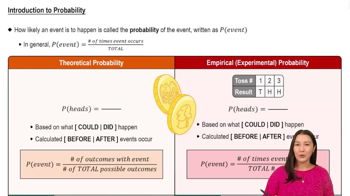
Classical probability is based on the assumption that all outcomes in a sample space are equally likely. It is calculated by dividing the number of favorable outcomes by the total number of possible outcomes. For example, when rolling two six-sided dice, the total number of outcomes is 36, and the number of ways to achieve a sum of 9 can be counted, leading to a probability calculation.
Recommended video:
5:37
Introduction to Probability

Empirical Probability

Empirical probability is determined through experimentation or observation rather than theoretical calculations. It is calculated by taking the ratio of the number of times an event occurs to the total number of trials conducted. This type of probability is useful when theoretical probabilities are difficult to ascertain or when real-world data is available.
Recommended video:
5:37
Introduction to Probability

Subjective Probability

Subjective probability is based on personal judgment, intuition, or experience rather than on exact calculations or empirical data. It reflects an individual's belief about the likelihood of an event occurring. This type of probability can vary significantly between individuals and is often used in situations where statistical data is limited or unavailable.
Recommended video:
5:37
Introduction to Probability
Related Practice
Textbook Question

Your dorm enters 15 out of 65 plastic numbered ducks in a duck race. The ducks are all dumped into a stream and drift to the finish line. What is the probability that three of your dorm's ducks finish first, second, and third?

66
views
Textbook Question

In Exercises 19-22, determine whether the events are independent or dependent. Explain your reasoning.

22. Getting high grades and being awarded an academic scholarship

136
views
Textbook Question

You work in the security department of a bank’s website. To access their accounts, customers of the bank must create an 8-digit password. It is your job to determine the password requirements for these accounts. Security guidelines state that for the website to be secure, the probability that an 8-digit password is guessed on one try must be less than 1/60^8, assuming all passwords are equally likely.

Your job is to use the probability techniques you have learned in this chapter to decide what requirements a customer must meet when choosing a password, including what sets of characters are allowed, so that the website is secure according to the security guidelines.

3. For additional security, each customer creates a 5-digit PIN (personal identification number). The table on the right shows the 10 most commonly chosen 5-digit PINs. From the table, you can see that more than a third of all 5-digit PINs could be guessed by trying these 10 numbers. To discourage customers from using predictable PINs, you consider prohibiting PINs that use the same digit more than once.

b. Would you decide to prohibit PINs that use the same digit more than once? Explain.

87
views
Textbook Question

You work in the security department of a bank’s website. To access their accounts, customers of the bank must create an 8-digit password. It is your job to determine the password requirements for these accounts. Security guidelines state that for the website to be secure, the probability that an 8-digit password is guessed on one try must be less than 1/60^8, assuming all passwords are equally likely.

Your job is to use the probability techniques you have learned in this chapter to decide what requirements a customer must meet when choosing a password, including what sets of characters are allowed, so that the website is secure according to the security guidelines.

2. Answering the Question

a. What password requirements would you set? What characters would be allowed?

134
views
Textbook Question

In Exercises 29-32, find the probability.

31. A 12-sided die, numbered 1 to 12, is rolled. Find the probability that the roll results in an odd number or a number less than 4.

81
views
Textbook Question

In Exercises 35–38, the bar graph shows the results of a survey in which 8806 undergraduate students were asked how many hours they spend on studying and other academic activities outside of class in a typical week. (Source: American College Health Association)

" style="" width="480">

37. Find the probability of randomly selecting an undergraduate who does not study from 6 to 10 hours per week.

113
views