Ch. 4 - Probability
Triola - Elementary Statistics 14th Edition
Triola14th EditionElementary StatisticsISBN: 9780137366446Not the one you use?Change textbook
Chapter 4, Problem 4.3.26

Unseen Coins A statistics professor tosses two coins that cannot be seen by any students. One student asks this question: “Did one of the coins turn up heads?” Given that the professor’s response is “yes,” find the probability that both coins turned up heads.

Verified step by step guidance
1
Define the sample space for tossing two coins. The possible outcomes are: HH (both heads), HT (head and tail), TH (tail and head), and TT (both tails).
Identify the event of interest: 'both coins turned up heads' (HH). This is the event we want to calculate the probability for, given the professor's response.
Determine the condition provided in the problem: The professor answered 'yes' to the question 'Did one of the coins turn up heads?' This means the outcomes TT (both tails) are excluded from consideration, leaving the reduced sample space: HH, HT, and TH.
Use the formula for conditional probability: P(A|B) = P(A ∩ B) / P(B), where A is the event 'both coins turned up heads' and B is the event 'at least one coin is heads.'
Calculate the probabilities: P(A ∩ B) is the probability of HH (since HH satisfies both A and B), and P(B) is the probability of the reduced sample space (HH, HT, TH). Divide P(A ∩ B) by P(B) to find the conditional probability.

Verified video answer for a similar problem:

This video solution was recommended by our tutors as helpful for the problem above.
Video duration:
6m
Was this helpful?

Key Concepts

Here are the essential concepts you must grasp in order to answer the question correctly.

Conditional Probability

Conditional probability refers to the likelihood of an event occurring given that another event has already occurred. In this scenario, we need to calculate the probability of both coins showing heads, given that at least one coin shows heads. This concept is crucial for understanding how the initial information (the professor's 'yes' response) affects the overall probability.
Recommended video:
5:37
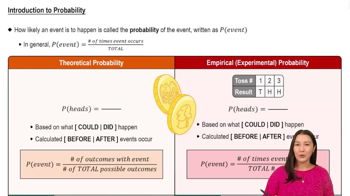
Introduction to Probability

Sample Space

The sample space is the set of all possible outcomes of a random experiment. For the two coins, the sample space consists of four outcomes: HH (both heads), HT (first head, second tail), TH (first tail, second head), and TT (both tails). Understanding the sample space helps in determining the relevant outcomes when calculating probabilities.
Recommended video:
05:11
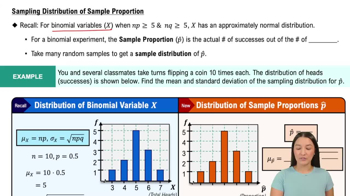
Sampling Distribution of Sample Proportion

Bayes' Theorem

Bayes' Theorem provides a way to update the probability of a hypothesis based on new evidence. In this case, it can be used to revise the probability of both coins being heads after receiving the information that at least one coin is heads. This theorem is essential for making informed conclusions in situations involving conditional probabilities.
Related Practice
Textbook Question

Shared Birthdays Find the probability that of 25 randomly selected people, at least 2 share the same birthday.

187
views

Textbook Question

California Lottery Let A denote the event of placing a \$1 straight bet on the California Daily 4 lottery and winning. There are 10,000 different ways that you can select the four digits (with repetition allowed) in this lottery, and only one of those four-digit numbers will be the winner. What is the value of P(A)? What is the value of P(Abar)?

238
views
Textbook Question

In Exercises 21-28, find the probability and answer the questions.


YSORT Gender Selection MicroSort’s YSORT gender selection technique is designed to increase the likelihood that a baby will be a boy. At one point before clinical trials of the YSORT gender selection technique were discontinued, 291 births consisted of 239 baby boys and 52 baby girls (based on data from the Genetics & IVF Institute). Based on these results, what is the probability of a boy born to a couple using MicroSort’s YSORT method? Does it appear that the technique is effective in increasing the likelihood that a baby will be a boy?

181
views
Textbook Question

Laundry Symbols Based on a New Generation of Stains survey, 13% of U.S. adults know that the care-instruction symbol on clothing means that any bleach can be used. Find the probability of randomly selecting an adult in the U.S. who does not know that.

158
views
Textbook Question

Language: Complement of “At Least One” Let A=the event of getting at least one defective calculator when four are randomly selected with replacement from a batch. Write a statement describing event A

195
views
Textbook Question

Jumble Many newspapers carry “Jumble,” a puzzle in which the reader must unscramble letters to form words. The letters MHRHTY were included in newspapers on the day this exercise was written. How many ways can those letters be arranged? Identify the correct unscrambling, then determine the probability of getting that result by randomly selecting one arrangement of the given letters.

206
views