Ch. 4 - Probability
Triola - Elementary Statistics 14th Edition
Triola14th EditionElementary StatisticsISBN: 9780137366446Not the one you use?Change textbook
Chapter 4, Problem 4.2.16a

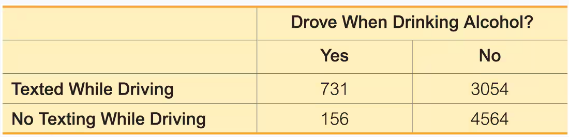
In Exercises 9–20, use the data in the following table, which lists survey results from high school drivers at least 16 years of age (based on data from “Texting While Driving and Other Risky Motor Vehicle Behaviors Among U.S. High School Students,” by O’Malley, Shults, and Eaton, Pediatrics, Vol. 131, No. 6). Assume that subjects are randomly selected from those included in the table. Hint: Be very careful to read the question correctly.
Survey table of high school drivers: texting vs. drinking and driving behavior.
Texting and Alcohol If three of the high school drivers are randomly selected from the 4720 subjects who did not text while driving, find the probability that all three drove when drinking.


a. Assume that the selections are made with replacement. Are the events independent?

Verified step by step guidance
1
Step 1: Identify the relevant data from the table. The problem focuses on high school drivers who did not text while driving. From the table, we see that 156 drivers drove when drinking alcohol, and 4564 drivers did not. The total number of drivers who did not text while driving is 4720.
Step 2: Calculate the probability of selecting one driver who drove when drinking alcohol. This is given by dividing the number of drivers who drove when drinking alcohol (156) by the total number of drivers who did not text while driving (4720). The formula is: 1564720
Step 3: Since the selections are made with replacement, the probability of selecting the same type of driver remains constant for each selection. To find the probability that all three drivers drove when drinking alcohol, multiply the probability of selecting one such driver by itself three times. The formula is: 15647203
Step 4: Determine whether the events are independent. In this case, because the selections are made with replacement, the outcome of one selection does not affect the outcome of another. Therefore, the events are independent.
Step 5: Conclude the process by noting that the probability calculation involves raising the single-event probability to the power of three, and the independence of events is confirmed by the 'with replacement' condition.

Verified video answer for a similar problem:

This video solution was recommended by our tutors as helpful for the problem above.
Video duration:
3m
Was this helpful?

Key Concepts

Here are the essential concepts you must grasp in order to answer the question correctly.

Probability

Probability is a measure of the likelihood that a particular event will occur, expressed as a number between 0 and 1. In this context, it involves calculating the chance that all three randomly selected high school drivers who do not text while driving also drove after drinking alcohol. Understanding how to compute probabilities is essential for answering the question accurately.
Recommended video:
5:37
Introduction to Probability

Independent Events

Two events are considered independent if the occurrence of one does not affect the occurrence of the other. In this scenario, if selections are made with replacement, the probability of selecting a driver who drove after drinking remains constant across selections, indicating that the events are independent. This concept is crucial for determining how to calculate the overall probability of multiple events occurring.
Recommended video:
05:54
Probability of Multiple Independent Events

Sampling with Replacement

Sampling with replacement means that after an individual is selected from a population, they are returned to the population before the next selection. This method ensures that each selection is made from the same total number of subjects, maintaining the same probabilities for each draw. Understanding this concept is vital for correctly applying probability rules in the given scenario.
Recommended video:
05:11
Sampling Distribution of Sample Proportion
Related Practice
Textbook Question

Identity Theft with Credit Cards Credit card numbers typically have 16 digits, but not all of them are random.


a. What is the probability of randomly generating 16 digits and getting your MasterCard number?


155
views
Textbook Question

Kentucky Derby Odds When the horse Justify won the 144th Kentucky Derby, a \$2 bet on a Justify win resulted in a winning ticket worth \(7.80.


a. How much net profit was made from a \)2 win bet on Justify?

160
views
Textbook Question

In Exercises 21–24, use these results from the “1-Panel-THC” test for marijuana use, which is provided by the company Drug Test Success: Among 143 subjects with positive test results, there are 24 false positive (incorrect) results; among 157 negative results, there are 3 false negative (incorrect) results. (Hint: Construct a table similar to Table 4-1.)


Testing for Marijuana Use


a. How many subjects are included in the study?

134
views
Textbook Question

Denomination Effect

In Exercises 13–16, use the data in the following table. In an experiment to study the effects of using four quarters versus a \$1 bill, some college students were given four quarters and others were given a \$1 bill, and they could either keep the money or spend it on gum. The results are summarized in the table (based on data from “The Denomination Effect,” by Priya Raghubir and Joydeep Srivastava, Journal of Consumer Research, Vol. 36).


Denomination Effect


a. Find the probability of randomly selecting a student who kept the money, given that the student was given four quarters.

125
views
Textbook Question

Is the Researcher Cheating? You become suspicious when a genetics researcher “randomly” selects numerous groups of 20 newborn babies and seems to consistently get 10 girls and 10 boys. The researcher claims that it is common to get 10 girls and 10 boys in such cases.


a. If 20 newborn babies are randomly selected, how many different gender sequences are possible?


154
views
Textbook Question

Finding Odds in Roulette A roulette wheel has 38 slots. One slot is 0, another is 00, and the others are numbered 1 through 36, respectively. You place a bet that the outcome is an odd number.


a. What is your probability of winning?

226
views