Ch. 4 - Probability
Triola - Elementary Statistics 14th Edition
Triola14th EditionElementary StatisticsISBN: 9780137366446Not the one you use?Change textbook
Chapter 4, Problem 4.2.29b

In Exercises 29 and 30, find the probabilities and indicate when the “5% guideline for cumbersome calculations” is used.


Medical Helicopters In a study of helicopter usage and patient survival, results were obtained from 47,637 patients transported by helicopter and 111,874 patients transported by ground (based on data from “Association Between Helicopter vs Ground Emergency Medical Services and Survival for Adults with Major Trauma,” by Galvagno et al., Journal of the American Medical Association, Vol. 307, No. 15).


b. If 5 of the subjects in the study are randomly selected without replacement, what is the probability that all of them were transported by helicopter?

Verified step by step guidance
1
Step 1: Understand the problem. We are tasked with finding the probability that all 5 randomly selected subjects were transported by helicopter, given that the selection is made without replacement. This involves calculating probabilities from a finite population.
Step 2: Identify the total population and the subset of interest. The total population consists of 47,637 patients transported by helicopter and 111,874 patients transported by ground, making the total population size 47,637 + 111,874 = 159,511. The subset of interest is the 47,637 patients transported by helicopter.
Step 3: Use the formula for probability without replacement. The probability of selecting 5 helicopter patients consecutively without replacement is calculated as the product of conditional probabilities: \( P = \frac{47,637}{159,511} \times \frac{47,636}{159,510} \times \frac{47,635}{159,509} \times \frac{47,634}{159,508} \times \frac{47,633}{159,507} \).
Step 4: Apply the '5% guideline for cumbersome calculations' if applicable. The guideline states that if the sample size is less than 5% of the population, we can treat the selections as independent (i.e., with replacement) to simplify calculations. Here, the sample size (5) is much smaller than 5% of the population (159,511), so the guideline can be applied.
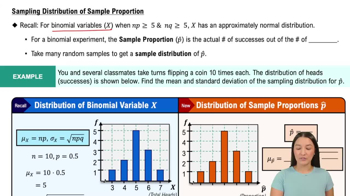
Step 5: If applying the guideline, approximate the probability using the binomial distribution. Treat the probability of selecting a helicopter patient as \( p = \frac{47,637}{159,511} \), and calculate \( P = p^5 \). This simplifies the calculation significantly compared to the exact method.

Verified video answer for a similar problem:

This video solution was recommended by our tutors as helpful for the problem above.
Video duration:
4m
Was this helpful?

Key Concepts

Here are the essential concepts you must grasp in order to answer the question correctly.

Probability

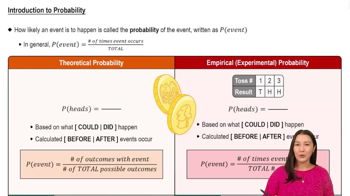
Probability is a measure of the likelihood that a particular event will occur, expressed as a number between 0 and 1. In this context, it involves calculating the chance that all selected subjects were transported by helicopter. Understanding basic probability principles, such as the multiplication rule for independent events and the concept of combinations, is essential for solving the problem.
Recommended video:
5:37
Introduction to Probability

Sampling Without Replacement

Sampling without replacement means that once an item is selected from a population, it cannot be selected again. This affects the probabilities of subsequent selections, as the total number of items decreases with each selection. In the given question, this concept is crucial because the probability of selecting all helicopter patients changes as each patient is chosen.
Recommended video:
05:11
Sampling Distribution of Sample Proportion

5% Guideline for Cumbersome Calculations

The 5% guideline is a rule of thumb used in statistics to simplify calculations when dealing with large populations. It suggests that if the sample size is less than 5% of the population, the probabilities can be approximated as if sampling were done with replacement. This guideline can help determine whether the complexity of calculations can be reduced in the context of the helicopter and ground transport study.
Recommended video:
Guided course
04:51
Find 5-Number Summary - TI-84 Calculator
Related Practice
Textbook Question

High Fives


b. If n mathletes shake hands with each other exactly once, what is the total number of handshakes?


179
views

Textbook Question

In Exercises 21-28, find the probability and answer the questions.


Genetics: Eye Color Each of two parents has the genotype brown/blue, which consists of the pair of alleles that determine eye color, and each parent contributes one of those alleles to a child. Assume that if the child has at least one brown allele, that color will dominate and the eyes will be brown. (The actual determination of eye color is more complicated than that.)


b. What is the probability that a child of these parents will have the blue/blue genotype?

155
views
Textbook Question

Alarm Clock Life Hack Each of us must sometimes wake up early for something really important, such as a final exam, job interview, or an early flight. (Professional golfer Jim Furyk was disqualified from a tournament when his cellphone lost power and he overslept.) Assume that a battery-powered alarm clock has a 0.005 probability of failure, a smartphone alarm clock has a 0.052 probability of failure, and an electric alarm clock has a 0.001 probability of failure.


b. If you use a battery-powered alarm clock and a smartphone alarm clock, what is the probability that they both fail? What is the probability that both of them do not fail?

210
views
Textbook Question

Denomination Effect

In Exercises 13–16, use the data in the following table. In an experiment to study the effects of using four quarters versus a \$1 bill, some college students were given four quarters and others were given a \(1 bill, and they could either keep the money or spend it on gum. The results are summarized in the table (based on data from “The Denomination Effect,” by Priya Raghubir and Joydeep Srivastava, Journal of Consumer Research, Vol. 36).


Denomination Effect


a. Find the probability of randomly selecting a student who spent the money, given that the student was given a \)1 bill.


159
views
Textbook Question

In Exercises 9–20, use the data in the following table, which lists survey results from high school drivers at least 16 years of age (based on data from “Texting While Driving and Other Risky Motor Vehicle Behaviors Among U.S. High School Students,” by O’Malley, Shults, and Eaton, Pediatrics, Vol. 131, No. 6). Assume that subjects are randomly selected from those included in the table. Hint: Be very careful to read the question correctly.

Drinking and Driving If two of the high school drivers are randomly selected, find the probability that they both drove when drinking alcohol.

b. Assume that the selections are made without replacement. Are the events independent?

124
views
Textbook Question

In Exercises 21–24, use these results from the “1-Panel-THC” test for marijuana use, which is provided by the company Drug Test Success: Among 143 subjects with positive test results, there are 24 false positive (incorrect) results; among 157 negative results, there are 3 false negative (incorrect) results. (Hint: Construct a table similar to Table 4-1.)


Testing for Marijuana Use


b. How many of the subjects had a true negative result?

132
views