Nut Mix Michael and Kevin return to the candy store, but this time they want to purchase nuts. They can’t decide among peanuts, cashews, or almonds. They again agree to create a mix. They bought 2.5 pounds of peanuts for \$1.30 per pound, 4 pounds of cashews for \$4.50 per pound, and 2 pounds of almonds for \$3.75 per pound. Determine the price per pound of the mix.
Table of contents
- 1. Intro to Stats and Collecting Data1h 14m
- 2. Describing Data with Tables and Graphs1h 55m
- 3. Describing Data Numerically2h 5m
- 4. Probability2h 16m
- 5. Binomial Distribution & Discrete Random Variables3h 6m
- 6. Normal Distribution and Continuous Random Variables2h 11m
- 7. Sampling Distributions & Confidence Intervals: Mean3h 23m
- Sampling Distribution of the Sample Mean and Central Limit Theorem19m
- Distribution of Sample Mean - Excel23m
- Introduction to Confidence Intervals15m
- Confidence Intervals for Population Mean1h 18m
- Determining the Minimum Sample Size Required12m
- Finding Probabilities and T Critical Values - Excel28m
- Confidence Intervals for Population Means - Excel25m
- 8. Sampling Distributions & Confidence Intervals: Proportion1h 25m
- 9. Hypothesis Testing for One Sample3h 29m
- 10. Hypothesis Testing for Two Samples4h 50m
- Two Proportions1h 13m
- Two Proportions Hypothesis Test - Excel28m
- Two Means - Unknown, Unequal Variance1h 3m
- Two Means - Unknown Variances Hypothesis Test - Excel12m
- Two Means - Unknown, Equal Variance15m
- Two Means - Unknown, Equal Variances Hypothesis Test - Excel9m
- Two Means - Known Variance12m
- Two Means - Sigma Known Hypothesis Test - Excel21m
- Two Means - Matched Pairs (Dependent Samples)42m
- Matched Pairs Hypothesis Test - Excel12m
- 11. Correlation1h 24m
- 12. Regression1h 50m
- 13. Chi-Square Tests & Goodness of Fit2h 21m
- 14. ANOVA1h 57m
3. Describing Data Numerically
Mean
Problem 3.1.23
Textbook Question
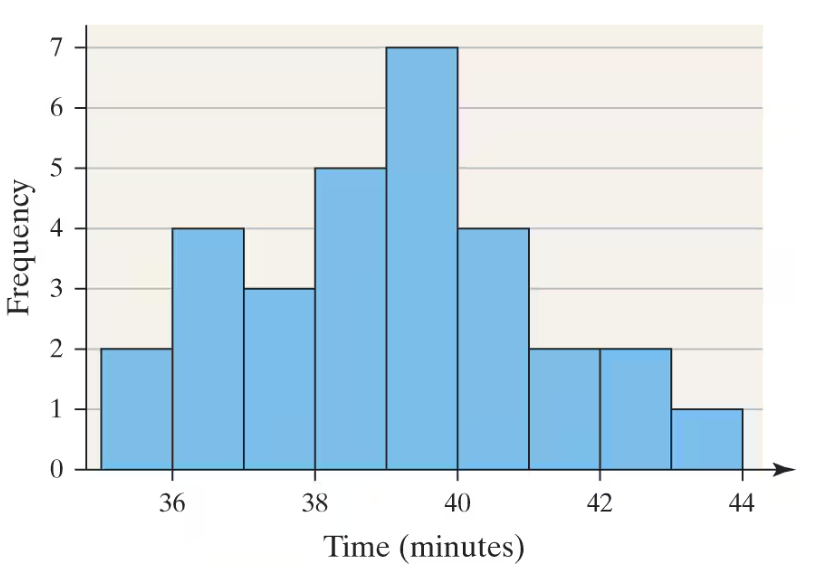
Download Time A histogram of the download time of a movie, in minutes, for 30 randomly selected movies is shown. The mean download time is 39.007 minutes and the median download time is 39.065 minutes. Identify the shape of the distribution. Which measure of central tendency better describes the “center” of the distribution?

Verified step by step guidance1
Step 1: Examine the histogram to understand the shape of the distribution. Look at the symmetry of the bars around the center. In this histogram, the frequencies rise to a peak near the middle and then decrease roughly evenly on both sides, indicating a roughly symmetric distribution.
Step 2: Compare the mean and median values given: the mean download time is 39.007 minutes and the median download time is 39.065 minutes. Since these two measures of central tendency are very close to each other, this supports the observation that the distribution is symmetric.
Step 3: Recall that for symmetric distributions, the mean and median are approximately equal, and either can be used to describe the center. For skewed distributions, the median is usually preferred because it is less affected by extreme values.
Step 4: Based on the histogram's shape and the closeness of the mean and median, conclude that the distribution is roughly symmetric.
Step 5: Since the distribution is symmetric, the mean is a suitable measure of central tendency to describe the center of the distribution, but the median is also appropriate. In practice, the mean is often preferred for symmetric data.
Verified video answer for a similar problem:This video solution was recommended by our tutors as helpful for the problem above
Video duration:
1mPlay a video:
Was this helpful?
Key Concepts
Here are the essential concepts you must grasp in order to answer the question correctly.
Shape of the Distribution
The shape of a distribution describes how data values are spread and can be symmetric, skewed left, or skewed right. A symmetric distribution has roughly equal frequencies on both sides of the center, while skewed distributions have a longer tail on one side. The histogram shows a roughly symmetric shape, indicating balanced data around the center.
Recommended video:
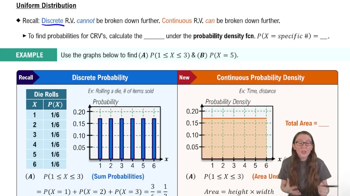
Uniform Distribution
Mean and Median as Measures of Central Tendency
Mean is the average of all data points, while median is the middle value when data is ordered. In symmetric distributions, mean and median are close or equal, making either a good measure of center. In skewed distributions, the median better represents the center as it is less affected by extreme values.
Recommended video:
Guided course
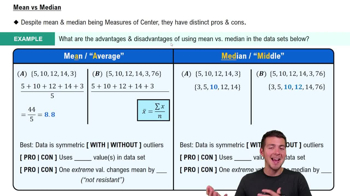
Comparing Mean vs. Median
Interpreting Histograms
Histograms display data frequency across intervals, helping visualize distribution shape, spread, and central tendency. By examining bar heights and their arrangement, one can identify patterns like symmetry or skewness, which guide the choice of appropriate statistical measures.
Recommended video:
Guided course
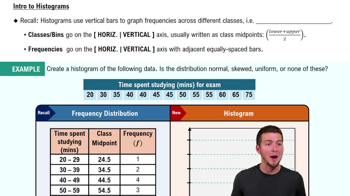
Intro to Histograms
Watch next
Master Calculating the Mean with a bite sized video explanation from Patrick
Start learningRelated Videos
Related Practice
Textbook Question
8
views