A researcher with the Department of Energy wants to determine the mean natural gas bill of households throughout the United States. He knows the mean natural gas bill of households for each state, so he adds together these 50 values and divides by 50 to arrive at his estimate. Is this a valid approach? Why or why not?
Table of contents
- 1. Intro to Stats and Collecting Data1h 14m
- 2. Describing Data with Tables and Graphs1h 55m
- 3. Describing Data Numerically2h 5m
- 4. Probability2h 16m
- 5. Binomial Distribution & Discrete Random Variables3h 6m
- 6. Normal Distribution and Continuous Random Variables2h 11m
- 7. Sampling Distributions & Confidence Intervals: Mean3h 23m
- Sampling Distribution of the Sample Mean and Central Limit Theorem19m
- Distribution of Sample Mean - Excel23m
- Introduction to Confidence Intervals15m
- Confidence Intervals for Population Mean1h 18m
- Determining the Minimum Sample Size Required12m
- Finding Probabilities and T Critical Values - Excel28m
- Confidence Intervals for Population Means - Excel25m
- 8. Sampling Distributions & Confidence Intervals: Proportion1h 25m
- 9. Hypothesis Testing for One Sample3h 29m
- 10. Hypothesis Testing for Two Samples4h 50m
- Two Proportions1h 13m
- Two Proportions Hypothesis Test - Excel28m
- Two Means - Unknown, Unequal Variance1h 3m
- Two Means - Unknown Variances Hypothesis Test - Excel12m
- Two Means - Unknown, Equal Variance15m
- Two Means - Unknown, Equal Variances Hypothesis Test - Excel9m
- Two Means - Known Variance12m
- Two Means - Sigma Known Hypothesis Test - Excel21m
- Two Means - Matched Pairs (Dependent Samples)42m
- Matched Pairs Hypothesis Test - Excel12m
- 11. Correlation1h 24m
- 12. Regression1h 50m
- 13. Chi-Square Tests & Goodness of Fit2h 21m
- 14. ANOVA1h 57m
3. Describing Data Numerically
Mean
Problem 3.T.7
Textbook Question
Yolanda wishes to develop a new type of meatloaf to sell at her restaurant. She decides to combine 2 pounds of ground sirloin (cost \$2.70 per pound), 1 pound of ground turkey (cost \$1.30 per pound), and 12\frac{1}{2}21 pound of ground pork (cost \$1.80 per pound). What is the cost per pound of the meatloaf?
Verified step by step guidance1
First, identify the weight and cost per pound of each type of meat: 2 pounds of ground sirloin at \$2.70 per pound, 1 pound of ground turkey at \$1.30 per pound, and 1.5 pounds (since 12\frac{1}{2}21 is interpreted as 1\frac{1}{2} or 1.5 pounds) of ground pork at \$1.80 per pound.
Calculate the total weight of the meatloaf by adding the weights of all the meats: \$2 + 1 + 1.5$ pounds.
Calculate the total cost for each type of meat by multiplying the weight by the cost per pound: for sirloin, \$2 \times 2.70\(; for turkey, \)1 \times 1.30\(; and for pork, \)1.5 \times 1.80$.
Add the total costs of all the meats to find the overall cost of the meatloaf.
Finally, find the cost per pound of the meatloaf by dividing the total cost by the total weight: \(\text{Cost per pound} = \frac{\text{Total cost}}{\text{Total weight}}\).
Verified video answer for a similar problem:This video solution was recommended by our tutors as helpful for the problem above
Video duration:
1mPlay a video:
Was this helpful?
Key Concepts
Here are the essential concepts you must grasp in order to answer the question correctly.
Weighted Average Cost
Weighted average cost calculates the overall cost per unit when combining items with different costs and quantities. It is found by multiplying each item's cost by its quantity, summing these products, and dividing by the total quantity. This concept helps determine the average price per pound of the combined meatloaf.
Recommended video:
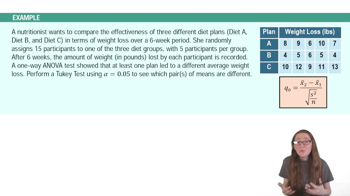
Tukey Test Example 1
Unit Cost
Unit cost refers to the cost per single unit of measure, such as per pound in this problem. Understanding unit cost allows comparison and combination of different ingredients priced differently, facilitating the calculation of total and average costs.
Recommended video:
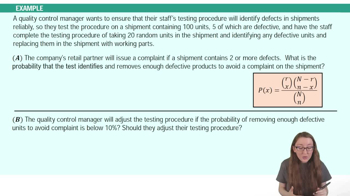
Introduction to the Hypergeometric Distribution
Fractional Quantities
Fractional quantities involve parts of a whole unit, such as 1.5 pounds of meat. Properly handling fractions or decimals in quantities is essential for accurate calculations of total weight and cost in mixture problems.
Recommended video:
Guided course
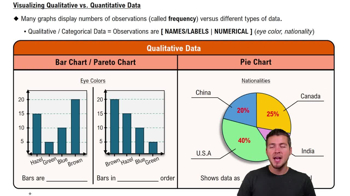
Visualizing Qualitative vs. Quantitative Data
Watch next
Master Calculating the Mean with a bite sized video explanation from Patrick
Start learningRelated Videos
Related Practice
Textbook Question
9
views