
Ch. 11 - Goodness-of-Fit and Contingency Tables
Triola - Elementary Statistics 14th Edition
Triola14th EditionElementary StatisticsISBN: 9780137366446Not the one you use?Change textbook
Chapter 11, Problem 11.q.8

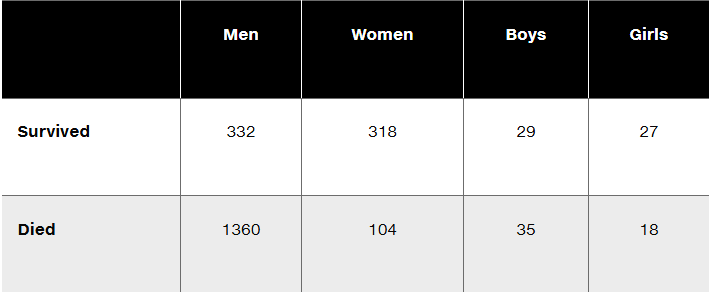
Questions 6–10 refer to the sample data in the following table, which describes the fate of the passengers and crew aboard the Titanic when it sank on April 15, 1912. Assume that the data are a sample from a large population and we want to use a 0.05 significance level to test the claim that surviving is independent of whether the person is a man, woman, boy, or girl.


"Table showing Titanic survival data: Men 332, Women 318, Boys 29, Girls 27; Died: Men 1360, Women 104, Boys 35, Girls 18."


Is the hypothesis test left-tailed, right-tailed, or two-tailed?

Verified step by step guidance
1
Step 1: Understand the hypothesis test. The claim is that surviving is independent of whether the person is a man, woman, boy, or girl. This means we are testing for independence between two categorical variables: survival status (survived or died) and gender/age group (men, women, boys, girls).
Step 2: Determine the type of test. Since we are testing for independence between two categorical variables, a Chi-Square Test for Independence is appropriate.
Step 3: Identify the significance level. The problem specifies a significance level of 0.05, which will be used to compare the p-value obtained from the test.
Step 4: Decide the tail of the test. A Chi-Square Test for Independence is inherently a two-tailed test because it evaluates whether there is any association (positive or negative) between the variables, not just one direction.
Step 5: Prepare the contingency table. The table provided in the image already serves as the contingency table, showing the observed frequencies for each combination of survival status and gender/age group. These values will be used to calculate the expected frequencies and the Chi-Square statistic.

Verified video answer for a similar problem:

This video solution was recommended by our tutors as helpful for the problem above.
Video duration:
4m
Was this helpful?

Key Concepts

Here are the essential concepts you must grasp in order to answer the question correctly.

Hypothesis Testing

Hypothesis testing is a statistical method used to make decisions about a population based on sample data. It involves formulating a null hypothesis (H0) and an alternative hypothesis (H1), then using sample data to determine whether to reject H0. In this context, the null hypothesis would state that survival is independent of gender, while the alternative would suggest a dependence.
Recommended video:
Guided course
06:21
Step 1: Write Hypotheses

Significance Level

The significance level, denoted as alpha (α), is the threshold for determining whether to reject the null hypothesis. A common significance level is 0.05, which indicates a 5% risk of concluding that a difference exists when there is none. In this case, it means that if the p-value is less than 0.05, we would reject the null hypothesis regarding survival independence.
Recommended video:
Guided course
04:46
Step 4: State Conclusion Example 4

Types of Hypothesis Tests

Hypothesis tests can be classified as left-tailed, right-tailed, or two-tailed based on the nature of the alternative hypothesis. A left-tailed test checks for a decrease in a parameter, a right-tailed test checks for an increase, and a two-tailed test checks for any difference. In this scenario, since we are testing for independence without a specific direction, it would typically be a two-tailed test.
Recommended video:
Guided course
06:21
Step 1: Write Hypotheses
Related Practice
Textbook Question

Exercises 1–5 refer to the sample data in the following table, which summarizes the frequencies of 500 digits randomly generated by Statdisk. Assume that we want to use a 0.05 significance level to test the claim that Statdisk generates the digits in a way that they are equally likely.


Is the hypothesis test left-tailed, right-tailed, or two-tailed?


85
views
Textbook Question

Testing Goodness-of-Fit with a Normal Distribution Refer to Data Set 1 “Body Data” in Appendix B for the heights of females.


" style="max-width: 100%; white-space-collapse: preserve;" width="600">


c. Using the probabilities found in part (b), find the expected frequency for each category.

121
views
Textbook Question

Questions 6–10 refer to the sample data in the following table, which describes the fate of the passengers and crew aboard the Titanic when it sank on April 15, 1912. Assume that the data are a sample from a large population and we want to use a 0.05 significance level to test the claim that surviving is independent of whether the person is a man, woman, boy, or girl.


Identify the null and alternative hypotheses corresponding to the stated claim.

102
views
Textbook Question

Questions 6–10 refer to the sample data in the following table, which describes the fate of the passengers and crew aboard the Titanic when it sank on April 15, 1912. Assume that the data are a sample from a large population and we want to use a 0.05 significance level to test the claim that surviving is independent of whether the person is a man, woman, boy, or girl.


What distribution is used to test the stated claim (normal, t, F, chi-square, uniform)?

126
views
Textbook Question

Exercises 1–5 refer to the sample data in the following table, which summarizes the frequencies of 500 digits randomly generated by Statdisk. Assume that we want to use a 0.05 significance level to test the claim that Statdisk generates the digits in a way that they are equally likely.


What are the null and alternative hypotheses corresponding to the stated claim?

113
views
Textbook Question

Cybersecurity The table below lists the frequency of leading digits of Internet traffic interarrival times for a computer, along with the percentages of each leading digit expected with Benford’s law.


c. Use the results from part (b) to find the contribution to the x2 test statistic from the category representing the leading digit of 2.


" style="max-width: 100%; white-space-collapse: preserve;" width="650">

116
views