Flipping a Coin What is the probability of obtaining five heads in a row when flipping a fair coin? Interpret this probability.
Table of contents
- 1. Intro to Stats and Collecting Data1h 14m
- 2. Describing Data with Tables and Graphs1h 55m
- 3. Describing Data Numerically2h 5m
- 4. Probability2h 16m
- 5. Binomial Distribution & Discrete Random Variables3h 6m
- 6. Normal Distribution and Continuous Random Variables2h 11m
- 7. Sampling Distributions & Confidence Intervals: Mean3h 23m
- Sampling Distribution of the Sample Mean and Central Limit Theorem19m
- Distribution of Sample Mean - Excel23m
- Introduction to Confidence Intervals15m
- Confidence Intervals for Population Mean1h 18m
- Determining the Minimum Sample Size Required12m
- Finding Probabilities and T Critical Values - Excel28m
- Confidence Intervals for Population Means - Excel25m
- 8. Sampling Distributions & Confidence Intervals: Proportion1h 25m
- 9. Hypothesis Testing for One Sample3h 29m
- 10. Hypothesis Testing for Two Samples4h 50m
- Two Proportions1h 13m
- Two Proportions Hypothesis Test - Excel28m
- Two Means - Unknown, Unequal Variance1h 3m
- Two Means - Unknown Variances Hypothesis Test - Excel12m
- Two Means - Unknown, Equal Variance15m
- Two Means - Unknown, Equal Variances Hypothesis Test - Excel9m
- Two Means - Known Variance12m
- Two Means - Sigma Known Hypothesis Test - Excel21m
- Two Means - Matched Pairs (Dependent Samples)42m
- Matched Pairs Hypothesis Test - Excel12m
- 11. Correlation1h 24m
- 12. Regression1h 50m
- 13. Chi-Square Tests & Goodness of Fit2h 21m
- 14. ANOVA1h 57m
4. Probability
Basic Concepts of Probability
Problem 5.4.43a
Textbook Question
"Putting It Together: Success Sequence
Is there a ""path"" to success? Brookings scholars Ron Haskins and Isabel Sawhill suggest the path to success is: education, followed by work, followed by marriage, followed by children. Sociologists Wendy Wang and W. Bradford Wilcox tracked a cohort of young millennial adults from their teenage years to early adulthood (ages 28 to 34) and recorded information about their education, marital status, child-rearing, and income.
a. Why is this a cohort study?
"
Verified step by step guidance1
Step 1: Understand what a cohort study is. A cohort study is a type of observational study where a group of people (a cohort) sharing a common characteristic or experience within a defined period is followed over time to observe outcomes.
Step 2: Identify the cohort in the problem. Here, the cohort consists of young millennial adults who were tracked from their teenage years to early adulthood (ages 28 to 34).
Step 3: Recognize the longitudinal nature of the study. The researchers collected data on the same group of individuals over a period of time, observing changes in education, marital status, child-rearing, and income.
Step 4: Explain why this qualifies as a cohort study. Because the study follows a specific group of people over time to observe how their experiences and outcomes develop, it fits the definition of a cohort study.
Step 5: Summarize that the key features making this a cohort study are the selection of a defined group based on a shared characteristic (millennials) and the tracking of this group over multiple time points to study changes and outcomes.
Verified video answer for a similar problem:This video solution was recommended by our tutors as helpful for the problem above
Video duration:
5mPlay a video:
Was this helpful?
Key Concepts
Here are the essential concepts you must grasp in order to answer the question correctly.
Cohort Study
A cohort study follows a specific group of individuals who share a common characteristic, such as age or experience, over a period of time to observe outcomes. It tracks changes and developments within this group, allowing researchers to study temporal sequences and causal relationships.
Recommended video:
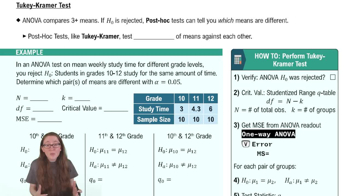
Tukey-Kramer Test
Longitudinal Data
Longitudinal data involves repeated observations of the same subjects over time. This type of data is essential in cohort studies to analyze how variables like education, marriage, and income evolve and influence each other across different life stages.
Recommended video:
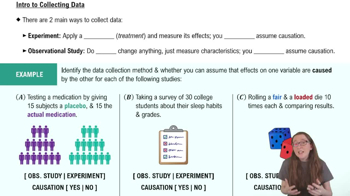
Introduction to Collecting Data
Temporal Sequence in Research
Temporal sequence refers to the order in which events or variables occur, which is crucial for understanding cause-and-effect relationships. In this study, tracking education, work, marriage, and children in sequence helps identify patterns linked to success.
Recommended video:
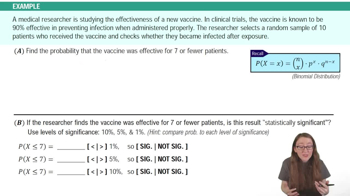
Finding Binomial Probabilities Using TI-84 Example 1
Watch next
Master Introduction to Probability with a bite sized video explanation from Patrick
Start learningRelated Videos
Related Practice
Textbook Question
14
views