
Ch. 6 - Normal Probability Distributions
Triola - Elementary Statistics 14th Edition
Triola14th EditionElementary StatisticsISBN: 9780137366446Not the one you use?Change textbook
Chapter 6, Problem 6.4.15d

Ergonomics. Exercises 9–16 involve applications to ergonomics, as described in the Chapter Problem.


Doorway Height The Boeing 757-200 ER airliner carries 200 passengers and has doors with a height of 72 in. Heights of men are normally distributed with a mean of 68.6 in. and a standard deviation of 2.8 in. (based on Data Set 1 “Body Data” in Appendix B).


d. When considering the comfort and safety of passengers, why are women ignored in this case?

Verified step by step guidance
1
Step 1: Understand the context of the problem. The problem is about doorway height in a Boeing 757-200 ER airliner and how it relates to the heights of passengers. The focus is on men’s heights, which are normally distributed with a mean of 68.6 inches and a standard deviation of 2.8 inches.
Step 2: Recognize the statistical reasoning behind ignoring women in this case. The problem specifically mentions men’s heights, so we need to consider why women’s heights are excluded. This could be due to the fact that men, on average, are taller than women, and the doorway height of 72 inches is more likely to pose a challenge for taller individuals.
Step 3: Recall that the normal distribution is used to model the heights of men. The mean (68.6 inches) and standard deviation (2.8 inches) provide a way to calculate probabilities or proportions of men who might find the doorway height uncomfortable or unsafe.
Step 4: Consider the practical implications. Since men are generally taller than women, the likelihood of a man hitting his head on the doorway is higher than that of a woman. Therefore, focusing on men’s heights ensures that the doorway accommodates the tallest group of passengers effectively.
Step 5: Conclude that women are ignored in this case because their average height is significantly lower than men’s, making it less likely for them to encounter issues with the doorway height. This allows the analysis to focus on the group most at risk of discomfort or safety concerns.

Verified video answer for a similar problem:

This video solution was recommended by our tutors as helpful for the problem above.
Video duration:
4m
Was this helpful?

Key Concepts

Here are the essential concepts you must grasp in order to answer the question correctly.

Normal Distribution

Normal distribution is a probability distribution that is symmetric about the mean, indicating that data near the mean are more frequent in occurrence than data far from the mean. In this context, men's heights are normally distributed, which allows for statistical analysis of how many men would fit comfortably through a doorway of a given height.
Recommended video:
Guided course
09:47
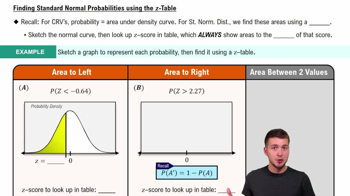
Finding Standard Normal Probabilities using z-Table

Mean and Standard Deviation

The mean is the average value of a data set, while the standard deviation measures the amount of variation or dispersion from the mean. In this scenario, the mean height of men is 68.6 inches with a standard deviation of 2.8 inches, which helps in understanding the range of heights that can be expected among the male passengers.
Recommended video:
Guided course
08:45
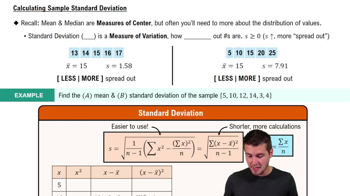
Calculating Standard Deviation

Ergonomics and Gender Considerations

Ergonomics is the study of people's efficiency in their working environment, often focusing on design that accommodates the physical characteristics of users. In this case, the question raises a critical point about gender considerations in design, as ignoring women's heights may lead to safety and comfort issues for a significant portion of the population, highlighting the importance of inclusive design.
Related Practice
Textbook Question

Continuity Correction In testing the assumption that the probability of a baby boy is 0.512, a geneticist obtains a random sample of 1000 births and finds that 502 of them are boys. Using the continuity correction, describe the area under the graph of a normal distribution corresponding to the following. (For example, the area corresponding to “the probability of at least 502 boys” is this: the area to the right of 501.5.)


c. The probability of more than 502 boys

154
views
Textbook Question

Hershey Kisses Based on Data Set 38 “Candies” in Appendix B, weights of the chocolate in Hershey Kisses are normally distributed with a mean of 4.5338 g and a standard deviation of 0.1039 g


d. What is the value of the variance?

173
views
Textbook Question

Bone Density Test. In Exercises 1–4, assume that scores on a bone mineral density test are normally distributed with a mean of 0 and a standard deviation of 1.


Bone Density For a randomly selected subject, find the probability of a bone density score between and 2.00.

100
views
Textbook Question

Significance For bone density scores that are normally distributed with a mean of 0 and a standard deviation of 1, find the percentage of scores that are


c. not significant (or less than 2 standard deviations away from the mean).

165
views
Textbook Question

Bone Density Test. In Exercises 1–4, assume that scores on a bone mineral density test are normally distributed with a mean of 0 and a standard deviation of 1.


Bone Density Find the bone density score that is the 90th percentile, which is the score separating the lowest 90% from the top 10%.

101
views
Textbook Question

Ergonomics. Exercises 9–16 involve applications to ergonomics, as described in the Chapter Problem.


Water Taxi Safety Passengers died when a water taxi sank in Baltimore’s Inner Harbor. Men are typically heavier than women and children, so when loading a water taxi, assume a worst-case scenario in which all passengers are men. Assume that weights of men are normally distributed with a mean of 189 lb and a standard deviation of 39 lb (based on Data Set 1 “Body Data” in Appendix B). The water taxi that sank had a stated capacity of 25 passengers, and the boat was rated for a load limit of 3500 lb.


d. Is the new capacity of 20 passengers safe?

111
views