Using the sample data below, create a confidence interval for to see if there is evidence that there is a positive correlation between and with .
Table of contents
- 1. Intro to Stats and Collecting Data1h 14m
- 2. Describing Data with Tables and Graphs1h 55m
- 3. Describing Data Numerically2h 5m
- 4. Probability2h 16m
- 5. Binomial Distribution & Discrete Random Variables3h 6m
- 6. Normal Distribution and Continuous Random Variables2h 11m
- 7. Sampling Distributions & Confidence Intervals: Mean3h 23m
- Sampling Distribution of the Sample Mean and Central Limit Theorem19m
- Distribution of Sample Mean - Excel23m
- Introduction to Confidence Intervals15m
- Confidence Intervals for Population Mean1h 18m
- Determining the Minimum Sample Size Required12m
- Finding Probabilities and T Critical Values - Excel28m
- Confidence Intervals for Population Means - Excel25m
- 8. Sampling Distributions & Confidence Intervals: Proportion2h 10m
- 9. Hypothesis Testing for One Sample5h 9m
- Steps in Hypothesis Testing1h 6m
- Performing Hypothesis Tests: Means1h 4m
- Hypothesis Testing: Means - Excel42m
- Performing Hypothesis Tests: Proportions37m
- Hypothesis Testing: Proportions - Excel27m
- Performing Hypothesis Tests: Variance12m
- Critical Values and Rejection Regions28m
- Link Between Confidence Intervals and Hypothesis Testing12m
- Type I & Type II Errors17m
- 10. Hypothesis Testing for Two Samples5h 37m
- Two Proportions1h 13m
- Two Proportions Hypothesis Test - Excel28m
- Two Means - Unknown, Unequal Variance1h 3m
- Two Means - Unknown Variances Hypothesis Test - Excel12m
- Two Means - Unknown, Equal Variance15m
- Two Means - Unknown, Equal Variances Hypothesis Test - Excel9m
- Two Means - Known Variance12m
- Two Means - Sigma Known Hypothesis Test - Excel21m
- Two Means - Matched Pairs (Dependent Samples)42m
- Matched Pairs Hypothesis Test - Excel12m
- Two Variances and F Distribution29m
- Two Variances - Graphing Calculator16m
- 11. Correlation1h 24m
- 12. Regression3h 33m
- Linear Regression & Least Squares Method26m
- Residuals12m
- Coefficient of Determination12m
- Regression Line Equation and Coefficient of Determination - Excel8m
- Finding Residuals and Creating Residual Plots - Excel11m
- Inferences for Slope31m
- Enabling Data Analysis Toolpak1m
- Regression Readout of the Data Analysis Toolpak - Excel21m
- Prediction Intervals13m
- Prediction Intervals - Excel19m
- Multiple Regression - Excel29m
- Quadratic Regression15m
- Quadratic Regression - Excel10m
- 13. Chi-Square Tests & Goodness of Fit2h 21m
- 14. ANOVA1h 57m
12. Regression
Inferences for Slope
Problem 4.2.15a
Textbook Question
Age Gap at Marriage
Is there a relation between the age difference between husband and wife and the percent of a country that is literate? Researchers found the least-squares regression between age difference (husband age minus wife age), y, and literacy rate (percent of the population that is literate), x, is
ŷ = -0.0527x + 7.1
The model applied for 18 ≤ x ≤ 100.
Source: Xu Zhang and Solomon W. Polachek, State University of New York at Binghamton “The Husband-Wife Age Gap at First Marriage: A Cross-Country Analysis.”
a. Interpret the slope.
Verified step by step guidance1
Identify the variables in the regression equation: \(y\) represents the age difference between husband and wife, and \(x\) represents the literacy rate (percent of the population that is literate).
Recall that the slope in a linear regression equation \(\hat{y} = b x + a\) represents the change in the predicted value of \(y\) for a one-unit increase in \(x\).
Look at the slope value in the equation \(\hat{y} = -0.0527x + 7.1\), which is \(-0.0527\).
Interpret the slope as: For each 1% increase in the literacy rate, the predicted age difference between husband and wife decreases by 0.0527 years.
Explain the meaning in context: This suggests that countries with higher literacy rates tend to have smaller age gaps at marriage, according to the model.
Verified video answer for a similar problem:This video solution was recommended by our tutors as helpful for the problem above
Video duration:
2mPlay a video:
Was this helpful?
Key Concepts
Here are the essential concepts you must grasp in order to answer the question correctly.
Least-Squares Regression Line
A least-squares regression line models the relationship between two variables by minimizing the sum of the squared differences between observed and predicted values. It is expressed as ŷ = b₀ + b₁x, where ŷ is the predicted response, x is the explanatory variable, b₁ is the slope, and b₀ is the intercept.
Recommended video:
Guided course
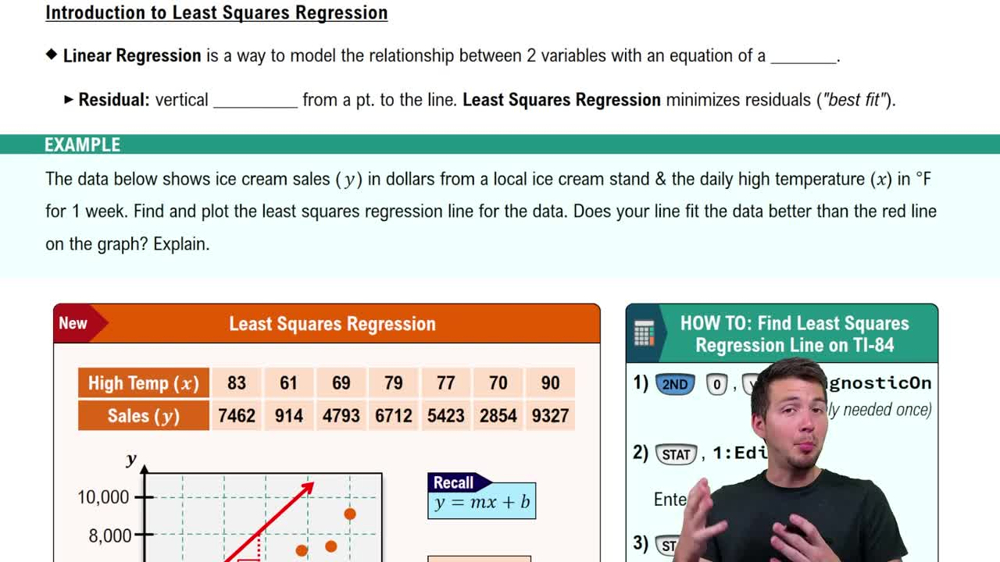
Intro to Least Squares Regression
Slope Interpretation in Regression
The slope in a regression line represents the average change in the response variable (y) for each one-unit increase in the explanatory variable (x). A negative slope indicates a decrease in y as x increases, while a positive slope indicates an increase.
Recommended video:
Guided course
Intro to Least Squares Regression
Contextual Understanding of Variables
Interpreting regression results requires understanding the real-world meaning of variables. Here, x is literacy rate (%) and y is the age difference between husband and wife. This context helps explain what a change in literacy rate implies for the age gap at marriage.
Recommended video:
Guided course
Expected Value (Mean) of Random Variables
Watch next
Master Hypothesis Test for the Slope of a Regression Line with a bite sized video explanation from Patrick
Start learningRelated Videos
Related Practice
Multiple Choice
18
views