Complete each statement: An event with a probability of is ____, and an event with a probability of is ____.
Table of contents
- 1. Intro to Stats and Collecting Data1h 14m
- 2. Describing Data with Tables and Graphs1h 55m
- 3. Describing Data Numerically2h 5m
- 4. Probability2h 16m
- 5. Binomial Distribution & Discrete Random Variables3h 6m
- 6. Normal Distribution and Continuous Random Variables2h 11m
- 7. Sampling Distributions & Confidence Intervals: Mean3h 23m
- Sampling Distribution of the Sample Mean and Central Limit Theorem19m
- Distribution of Sample Mean - Excel23m
- Introduction to Confidence Intervals15m
- Confidence Intervals for Population Mean1h 18m
- Determining the Minimum Sample Size Required12m
- Finding Probabilities and T Critical Values - Excel28m
- Confidence Intervals for Population Means - Excel25m
- 8. Sampling Distributions & Confidence Intervals: Proportion1h 25m
- 9. Hypothesis Testing for One Sample3h 29m
- 10. Hypothesis Testing for Two Samples4h 50m
- Two Proportions1h 13m
- Two Proportions Hypothesis Test - Excel28m
- Two Means - Unknown, Unequal Variance1h 3m
- Two Means - Unknown Variances Hypothesis Test - Excel12m
- Two Means - Unknown, Equal Variance15m
- Two Means - Unknown, Equal Variances Hypothesis Test - Excel9m
- Two Means - Known Variance12m
- Two Means - Sigma Known Hypothesis Test - Excel21m
- Two Means - Matched Pairs (Dependent Samples)42m
- Matched Pairs Hypothesis Test - Excel12m
- 11. Correlation1h 24m
- 12. Regression1h 50m
- 13. Chi-Square Tests & Goodness of Fit2h 21m
- 14. ANOVA1h 57m
4. Probability
Basic Concepts of Probability
Problem 4.1.23
Textbook Question
In Exercises 21-28, find the probability and answer the questions.
Mendelian Genetics When Mendel conducted his famous genetics experiments with peas, one sample of offspring consisted of 428 green peas and 152 yellow peas. Based on those results, estimate the probability of getting an offspring pea that is green. Is the result reasonably close to the expected value of as Mendel claimed?
Verified step by step guidance1
Step 1: Understand the problem. We are tasked with estimating the probability of getting a green pea based on the given data and comparing it to Mendel's expected value. The data provided includes 428 green peas and 152 yellow peas.
Step 2: Calculate the total number of peas. Add the number of green peas and yellow peas: Total peas = 428 + 152.
Step 3: Estimate the probability of getting a green pea. Use the formula for probability: P(green pea) = (Number of green peas) / (Total number of peas). Substitute the values from the problem into this formula.
Step 4: Compare the estimated probability to Mendel's expected value. Mendel's expected probability for green peas is typically 3/4 (based on Mendelian genetics for dominant traits). Check if the estimated probability is reasonably close to 3/4.
Step 5: Interpret the result. Discuss whether the estimated probability aligns with Mendel's claim and consider any potential reasons for discrepancies, such as sample size or experimental error.
Verified video answer for a similar problem:This video solution was recommended by our tutors as helpful for the problem above
Video duration:
2mPlay a video:
Was this helpful?
Key Concepts
Here are the essential concepts you must grasp in order to answer the question correctly.
Probability
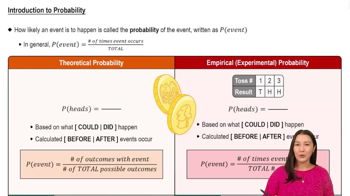
Probability is a measure of the likelihood that a particular event will occur, expressed as a number between 0 and 1. In this context, it is calculated by dividing the number of favorable outcomes (green peas) by the total number of outcomes (green and yellow peas combined). Understanding probability is essential for estimating the chances of obtaining a green pea from the given sample.
Recommended video:
Introduction to Probability
Expected Value
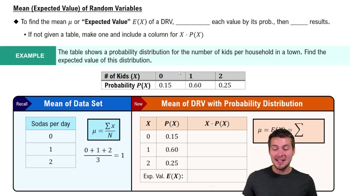
The expected value is a theoretical average of all possible outcomes of a random variable, weighted by their probabilities. In Mendelian genetics, the expected ratio of green to yellow peas can be derived from Mendel's laws of inheritance. Comparing the calculated probability of green peas to the expected value helps assess the validity of Mendel's claims regarding inheritance patterns.
Recommended video:
Guided course
Expected Value (Mean) of Random Variables
Mendelian Genetics
Mendelian genetics is the study of how traits are inherited through generations, based on the principles established by Gregor Mendel. His experiments with pea plants led to the formulation of laws of segregation and independent assortment, which predict the distribution of traits. Understanding these principles is crucial for interpreting the results of Mendel's experiments and the probabilities associated with different phenotypes.
Watch next
Master Introduction to Probability with a bite sized video explanation from Patrick
Start learningRelated Videos
Related Practice
Multiple Choice
17
views