Boxplots. In Exercises 29–32, use the given data to construct a boxplot and identify the 5-number summary.
Blood Pressure Measurements Fourteen different second-year medical students at Bellevue Hospital measured the blood pressure of the same person. The systolic readings (mm Hg) are listed below.
Step 1: Organize the data in ascending order. Arrange the given systolic blood pressure readings in increasing order: 120, 120, 125, 130, 130, 130, 130, 135, 138, 140, 140, 143, 144, 150.
Step 2: Identify the minimum and maximum values. The minimum value is the smallest number in the ordered data (120), and the maximum value is the largest number (150).
Step 3: Find the median (Q2). The median is the middle value of the ordered data. Since there are 14 data points (an even number), the median is the average of the 7th and 8th values in the ordered list.
Step 4: Determine the first quartile (Q1) and third quartile (Q3). Q1 is the median of the lower half of the data (values below the overall median), and Q3 is the median of the upper half of the data (values above the overall median).
Step 5: Construct the boxplot. Use the 5-number summary (minimum, Q1, median, Q3, maximum) to draw the boxplot. The box represents the interquartile range (IQR = Q3 - Q1), and the whiskers extend to the minimum and maximum values. Mark any outliers if applicable.
Verified video answer for a similar problem:
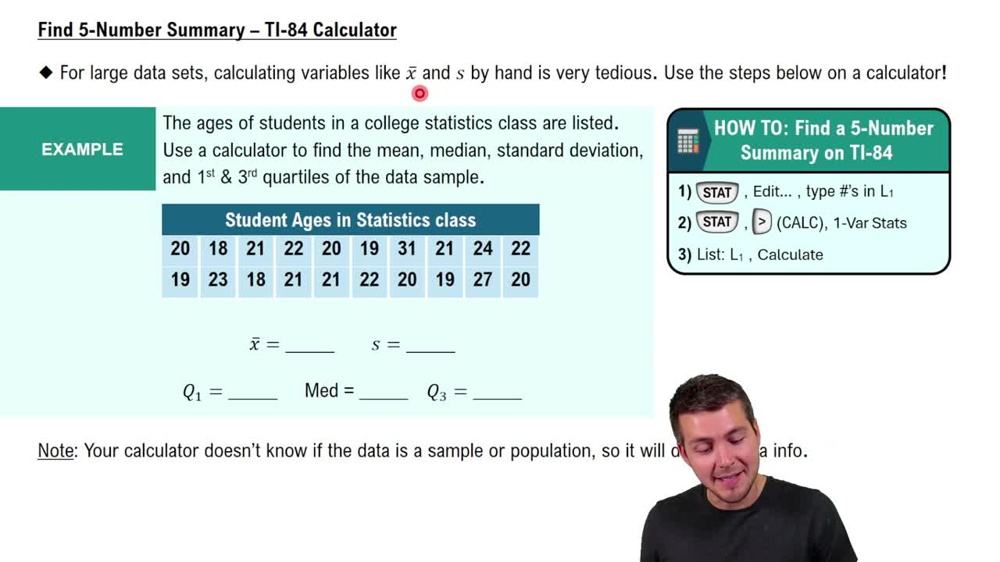
This video solution was recommended by our tutors as helpful for the problem above
Video duration:
4m
Play a video:
0 Comments
Key Concepts
Here are the essential concepts you must grasp in order to answer the question correctly.
Boxplot
A boxplot, or box-and-whisker plot, is a graphical representation of a dataset that displays its central tendency and variability. It summarizes data using five key statistics: the minimum, first quartile (Q1), median (Q2), third quartile (Q3), and maximum. The box represents the interquartile range (IQR), which contains the middle 50% of the data, while the 'whiskers' extend to the minimum and maximum values, providing a visual overview of the distribution.
Five-number summary
The five-number summary is a descriptive statistic that provides a quick overview of a dataset's distribution. It consists of the minimum value, first quartile (Q1), median (Q2), third quartile (Q3), and maximum value. This summary helps in understanding the spread and center of the data, making it easier to identify outliers and the overall range of the dataset.
Quartiles are values that divide a dataset into four equal parts, each containing 25% of the data points. The first quartile (Q1) is the median of the lower half of the data, the second quartile (Q2) is the overall median, and the third quartile (Q3) is the median of the upper half. Quartiles are essential for constructing boxplots and understanding the distribution and spread of the data.