Heights of Presidents Theories have been developed about the heights of winning candidates for the U.S. presidency and the heights of candidates who were runners up. Listed below are heights (cm) from recent presidential elections. Construct a graph suitable for exploring an association between heights of presidents and the heights of the presidential candidates who were runners-up. What does the graph suggest about that association?
Table of contents
- 1. Intro to Stats and Collecting Data1h 14m
- 2. Describing Data with Tables and Graphs1h 55m
- 3. Describing Data Numerically2h 5m
- 4. Probability2h 16m
- 5. Binomial Distribution & Discrete Random Variables3h 6m
- 6. Normal Distribution and Continuous Random Variables2h 11m
- 7. Sampling Distributions & Confidence Intervals: Mean3h 23m
- Sampling Distribution of the Sample Mean and Central Limit Theorem19m
- Distribution of Sample Mean - Excel23m
- Introduction to Confidence Intervals15m
- Confidence Intervals for Population Mean1h 18m
- Determining the Minimum Sample Size Required12m
- Finding Probabilities and T Critical Values - Excel28m
- Confidence Intervals for Population Means - Excel25m
- 8. Sampling Distributions & Confidence Intervals: Proportion1h 25m
- 9. Hypothesis Testing for One Sample3h 29m
- 10. Hypothesis Testing for Two Samples4h 50m
- Two Proportions1h 13m
- Two Proportions Hypothesis Test - Excel28m
- Two Means - Unknown, Unequal Variance1h 3m
- Two Means - Unknown Variances Hypothesis Test - Excel12m
- Two Means - Unknown, Equal Variance15m
- Two Means - Unknown, Equal Variances Hypothesis Test - Excel9m
- Two Means - Known Variance12m
- Two Means - Sigma Known Hypothesis Test - Excel21m
- Two Means - Matched Pairs (Dependent Samples)42m
- Matched Pairs Hypothesis Test - Excel12m
- 11. Correlation1h 24m
- 12. Regression1h 50m
- 13. Chi-Square Tests & Goodness of Fit2h 21m
- 14. ANOVA1h 57m
2. Describing Data with Tables and Graphs
Visualizing Qualitative vs. Quantitative Data
Problem 2.T.7
Textbook Question
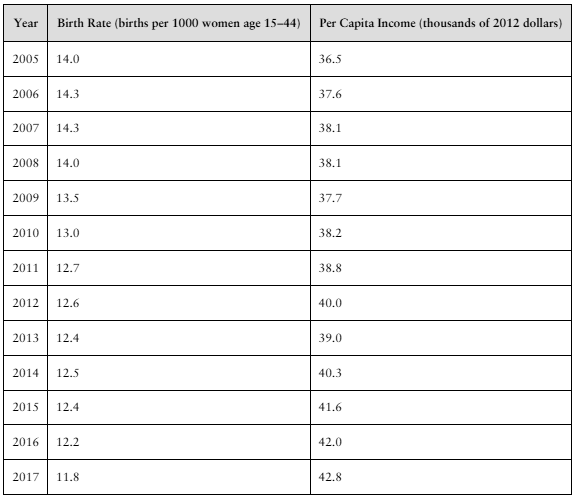
The data in the next column shows birth rate and per capita income (in thousands of 2012 dollars) from 2005 through 2017. Draw a time-series plot for both birth rate and per capita income. Comment on any trends.

Verified step by step guidance1
Step 1: Organize the data by listing the years on the horizontal axis (x-axis) of your plot. This will represent the time component from 2005 to 2017.
Step 2: For the birth rate, plot the values (births per 1000 women age 15–44) on the vertical axis (y-axis) on the left side or use one scale. Mark each year's birth rate as a point and connect these points with a line to form the birth rate time series.
Step 3: For the per capita income, plot the values (in thousands of 2012 dollars) on the same graph but using a second vertical axis on the right side or a different scale to avoid confusion. Mark each year's income value as a point and connect these points with a line to form the income time series.
Step 4: Label both vertical axes clearly, indicating which axis corresponds to birth rate and which corresponds to per capita income. Also, add a legend to distinguish the two lines on the plot.
Step 5: Analyze the trends by observing the plotted lines: note whether the birth rate is increasing, decreasing, or stable over time, and do the same for per capita income. Comment on any inverse or direct relationships you observe between the two variables over the years.
Verified video answer for a similar problem:This video solution was recommended by our tutors as helpful for the problem above
Video duration:
2mPlay a video:
Was this helpful?
Key Concepts
Here are the essential concepts you must grasp in order to answer the question correctly.
Time-Series Plot
A time-series plot displays data points collected or recorded at successive time intervals. It helps visualize trends, patterns, and fluctuations over time. In this question, plotting birth rate and per capita income against years reveals how these variables change from 2005 to 2017.
Recommended video:
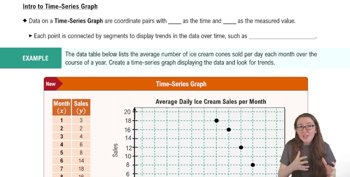
Creating Time-Series Graphs
Trend Analysis
Trend analysis involves identifying the general direction in which data points move over time, such as increasing, decreasing, or stable trends. Recognizing trends in birth rate and income helps interpret social and economic changes during the period.
Recommended video:
Introduction to ANOVA
Dual-Axis Plot Interpretation
When plotting two variables with different units on the same graph, a dual-axis plot is used to compare their trends simultaneously. Understanding how to read and interpret such plots is essential to analyze relationships or contrasts between birth rate and per capita income.
Recommended video:
Guided course
Residuals and Residual Plots
Watch next
Master Visualizing Qualitative vs. Quantitative Data with a bite sized video explanation from Patrick
Start learningRelated Videos
Related Practice
Textbook Question
65
views