Are Nuclear Plants Safe? Using the survey results from Exercise 2 and ignoring those respondents with no opinion, is the following graph somehow misleading? If so, how?
Table of contents
- 1. Intro to Stats and Collecting Data1h 14m
- 2. Describing Data with Tables and Graphs1h 56m
- 3. Describing Data Numerically2h 5m
- 4. Probability2h 17m
- 5. Binomial Distribution & Discrete Random Variables3h 6m
- 6. Normal Distribution and Continuous Random Variables2h 11m
- 7. Sampling Distributions & Confidence Intervals: Mean3h 23m
- Sampling Distribution of the Sample Mean and Central Limit Theorem19m
- Distribution of Sample Mean - ExcelBonus23m
- Introduction to Confidence Intervals15m
- Confidence Intervals for Population Mean1h 18m
- Determining the Minimum Sample Size Required12m
- Finding Probabilities and T Critical Values - ExcelBonus28m
- Confidence Intervals for Population Means - ExcelBonus25m
- 8. Sampling Distributions & Confidence Intervals: Proportion2h 10m
- 9. Hypothesis Testing for One Sample5h 8m
- Steps in Hypothesis Testing1h 6m
- Performing Hypothesis Tests: Means1h 4m
- Hypothesis Testing: Means - ExcelBonus42m
- Performing Hypothesis Tests: Proportions37m
- Hypothesis Testing: Proportions - ExcelBonus27m
- Performing Hypothesis Tests: Variance12m
- Critical Values and Rejection Regions28m
- Link Between Confidence Intervals and Hypothesis Testing12m
- Type I & Type II Errors16m
- 10. Hypothesis Testing for Two Samples5h 37m
- Two Proportions1h 13m
- Two Proportions Hypothesis Test - ExcelBonus28m
- Two Means - Unknown, Unequal Variance1h 3m
- Two Means - Unknown Variances Hypothesis Test - ExcelBonus12m
- Two Means - Unknown, Equal Variance15m
- Two Means - Unknown, Equal Variances Hypothesis Test - ExcelBonus9m
- Two Means - Known Variance12m
- Two Means - Sigma Known Hypothesis Test - ExcelBonus21m
- Two Means - Matched Pairs (Dependent Samples)42m
- Matched Pairs Hypothesis Test - ExcelBonus12m
- Two Variances and F Distribution29m
- Two Variances - Graphing CalculatorBonus16m
- 11. Correlation1h 24m
- 12. Regression3h 33m
- Linear Regression & Least Squares Method26m
- Residuals12m
- Coefficient of Determination12m
- Regression Line Equation and Coefficient of Determination - ExcelBonus8m
- Finding Residuals and Creating Residual Plots - ExcelBonus11m
- Inferences for Slope31m
- Enabling Data Analysis ToolpakBonus1m
- Regression Readout of the Data Analysis Toolpak - ExcelBonus21m
- Prediction Intervals13m
- Prediction Intervals - ExcelBonus19m
- Multiple Regression - ExcelBonus29m
- Quadratic Regression15m
- Quadratic Regression - ExcelBonus10m
- 13. Chi-Square Tests & Goodness of Fit2h 21m
- 14. ANOVA2h 29m
2. Describing Data with Tables and Graphs
Visualizing Qualitative vs. Quantitative Data
Problem 2.2.47
Textbook Question
Is there such a thing as the correct choice for a class width? Is there such a thing as a poor choice for a class width? Explain your reasoning.
Verified step by step guidance1
Understand that class width refers to the size of the intervals (or bins) used when grouping data in a frequency distribution or histogram.
Recognize that the choice of class width affects how the data is summarized and visualized: too wide a class width can oversimplify the data, hiding important details, while too narrow a class width can overcomplicate the data, making patterns hard to see.
Consider that a 'correct' class width is one that balances detail and clarity, allowing meaningful interpretation of the data without losing important information or creating noise.
Note that a poor choice of class width can lead to misleading conclusions, such as masking variability or creating artificial patterns.
Therefore, selecting an appropriate class width often involves considering the range of the data, the number of classes desired, and the purpose of the analysis, sometimes guided by formulas like Sturges' Rule or the Square-root Choice.
Verified video answer for a similar problem:This video solution was recommended by our tutors as helpful for the problem above
Video duration:
5mPlay a video:
0 Comments
Key Concepts
Here are the essential concepts you must grasp in order to answer the question correctly.
Class Width in Frequency Distributions
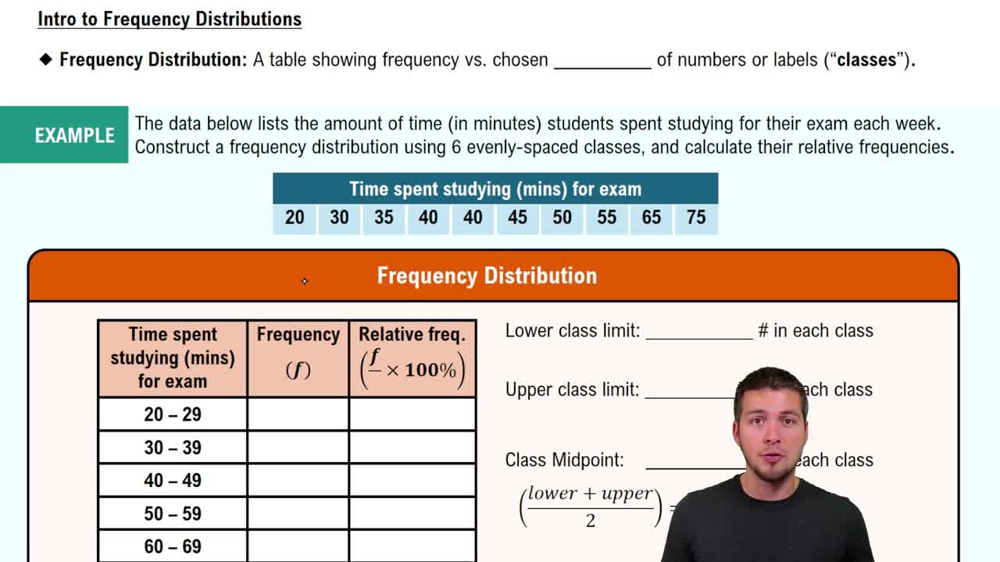
Class width is the interval size used to group data values in a frequency distribution. Choosing an appropriate class width helps summarize data effectively by balancing detail and clarity. Too wide a class width can oversimplify data, while too narrow can overcomplicate it.
Recommended video:
Guided course
Intro to Frequency Distributions
Impact of Class Width on Data Interpretation
The choice of class width affects how patterns and trends in data are perceived. A poor choice can obscure important details or create misleading impressions, such as hiding variability or exaggerating differences. Proper class width ensures meaningful and accurate data representation.
Recommended video:
Empirical Rule of Standard Deviation and Range Rule of Thumb
Guidelines for Selecting Class Width
Selecting class width often involves considering the data range and the number of classes desired, typically between 5 and 20 classes. Using formulas like Sturges' rule or the square-root choice can guide selection. The goal is to choose a width that provides a clear, informative summary without distortion.
Recommended video:
Guided course
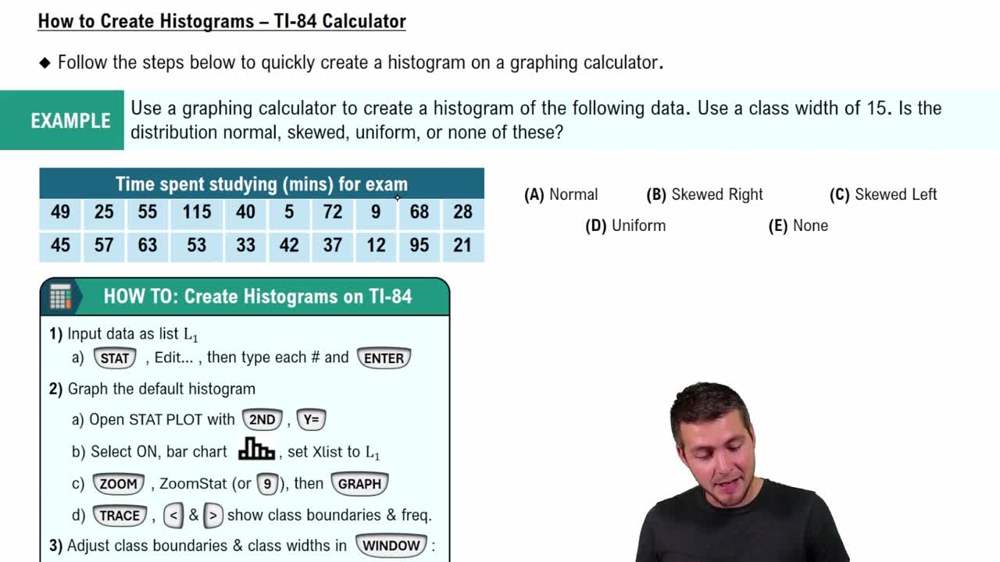
How to Create Histogram - TI-84 Calculator
Related Videos
Related Practice
Textbook Question
79
views