Stocks Suppose your financial advisor recommends three stocks to you. He claims the likelihood that the first stock will increase in value at least 10% within the next year is 0.7, the likelihood the second stock will increase in value at least 10% within the next year is 0.55, and the likelihood the third stock will increase at least 10% within the next year is 0.20. Would it be unusual for all three stocks to increase at least 10%, assuming the stocks behave independently of each other?
Table of contents
- 1. Intro to Stats and Collecting Data1h 14m
- 2. Describing Data with Tables and Graphs1h 55m
- 3. Describing Data Numerically2h 5m
- 4. Probability2h 16m
- 5. Binomial Distribution & Discrete Random Variables3h 6m
- 6. Normal Distribution and Continuous Random Variables2h 11m
- 7. Sampling Distributions & Confidence Intervals: Mean3h 23m
- Sampling Distribution of the Sample Mean and Central Limit Theorem19m
- Distribution of Sample Mean - Excel23m
- Introduction to Confidence Intervals15m
- Confidence Intervals for Population Mean1h 18m
- Determining the Minimum Sample Size Required12m
- Finding Probabilities and T Critical Values - Excel28m
- Confidence Intervals for Population Means - Excel25m
- 8. Sampling Distributions & Confidence Intervals: Proportion1h 25m
- 9. Hypothesis Testing for One Sample3h 29m
- 10. Hypothesis Testing for Two Samples4h 50m
- Two Proportions1h 13m
- Two Proportions Hypothesis Test - Excel28m
- Two Means - Unknown, Unequal Variance1h 3m
- Two Means - Unknown Variances Hypothesis Test - Excel12m
- Two Means - Unknown, Equal Variance15m
- Two Means - Unknown, Equal Variances Hypothesis Test - Excel9m
- Two Means - Known Variance12m
- Two Means - Sigma Known Hypothesis Test - Excel21m
- Two Means - Matched Pairs (Dependent Samples)42m
- Matched Pairs Hypothesis Test - Excel12m
- 11. Correlation1h 24m
- 12. Regression1h 50m
- 13. Chi-Square Tests & Goodness of Fit2h 21m
- 14. ANOVA1h 57m
4. Probability
Complements
Problem 4.2.7
Textbook Question
Laundry Symbols Based on a New Generation of Stains survey, 13% of U.S. adults know that the care-instruction symbol on clothing means that any bleach can be used. Find the probability of randomly selecting an adult in the U.S. who does not know that.
Verified step by step guidance1
Step 1: Understand the problem. The problem states that 13% of U.S. adults know the care-instruction symbol for any bleach. This means the probability of knowing is 0.13. We are tasked with finding the probability of not knowing this symbol.
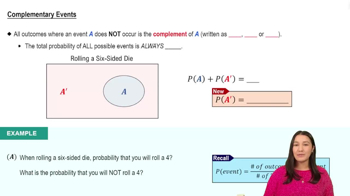
Step 2: Recall the complement rule in probability. The complement rule states that the probability of an event not occurring is equal to 1 minus the probability of the event occurring. Mathematically, this is expressed as: P(not A) = 1 - P(A).
Step 3: Substitute the given probability into the complement formula. Here, P(A) = 0.13, so P(not A) = 1 - 0.13.
Step 4: Perform the subtraction to find the probability of not knowing the symbol. This will give you the value of P(not A).
Step 5: Interpret the result. The final value represents the probability of randomly selecting an adult in the U.S. who does not know the care-instruction symbol for any bleach.
Verified video answer for a similar problem:This video solution was recommended by our tutors as helpful for the problem above
Video duration:
1mPlay a video:
Was this helpful?
Key Concepts
Here are the essential concepts you must grasp in order to answer the question correctly.
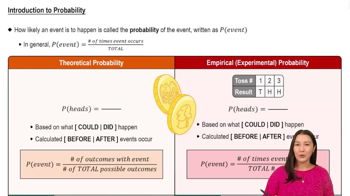
Probability
Probability is a measure of the likelihood that a particular event will occur, expressed as a number between 0 and 1. In this context, it helps determine the chance of randomly selecting an adult who does not know the care-instruction symbol for bleach usage. The probability can be calculated by subtracting the known percentage from 100%.
Recommended video:
Introduction to Probability
Complementary Events
Complementary events are pairs of outcomes in a probability scenario where one event occurs if and only if the other does not. In this case, knowing the percentage of adults who understand the symbol allows us to find the complementary percentage of those who do not, which is essential for calculating the desired probability.
Recommended video:
Complementary Events
Random Sampling
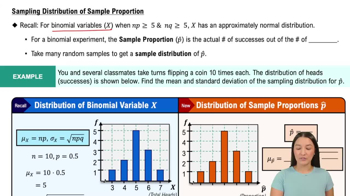
Random sampling is a technique used to select a subset of individuals from a larger population, ensuring that each member has an equal chance of being chosen. This concept is crucial for the question as it assumes that the selected adult is representative of the entire U.S. adult population, allowing for valid probability calculations.
Recommended video:
Sampling Distribution of Sample Proportion
Watch next
Master Complementary Events with a bite sized video explanation from Patrick
Start learningRelated Videos
Related Practice
Textbook Question
3
views