Ch. 2 - Descriptive Statistics
Larson - Elementary Statistics: Picturing the World 8th Edition
Larson8th EditionElementary Statistics: Picturing the WorldISBN: 9780137493470Not the one you use?Change textbook
Chapter 2, Problem 2.3.59

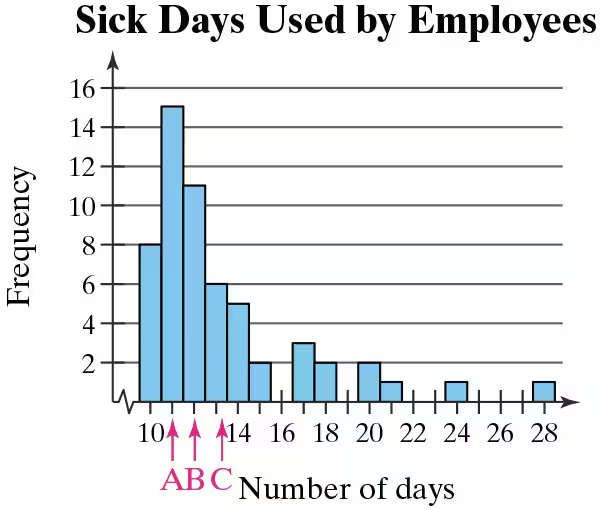
Graphical Analysis In Exercises 59 and 60, the letters A, B, and C are marked on the horizontal axis. Describe the shape of the data. Then determine which is the mean, which is the median, and which is the mode. Justify your answers.


<IMAGE>

Verified step by step guidance
1
Step 1: Observe the graph and identify the distribution shape. The graph shows the frequency of sick days used by employees, with the data skewed to the right (positively skewed). This means most employees took fewer sick days, and fewer employees took a higher number of sick days.
Step 2: Understand the placement of A, B, and C on the horizontal axis. A, B, and C are marked at specific points along the number of sick days. These points likely represent the mode, median, and mean, respectively.
Step 3: Determine the mode. The mode is the value that appears most frequently in the dataset. From the graph, the highest frequency occurs at 10 sick days, so A represents the mode.
Step 4: Determine the median. The median is the middle value when the data is ordered. Since the data is skewed, the median (B) will be closer to the mode but slightly higher, as it balances the number of data points on either side.
Step 5: Determine the mean. The mean is the average of all data points. In a positively skewed distribution, the mean (C) is typically greater than the median because it is influenced by the higher values in the tail of the distribution.

Verified video answer for a similar problem:

This video solution was recommended by our tutors as helpful for the problem above.
Video duration:
3m
Was this helpful?

Key Concepts

Here are the essential concepts you must grasp in order to answer the question correctly.

Shape of the Data Distribution

The shape of a data distribution refers to how the data points are spread across the range of values. Common shapes include normal, skewed, and uniform distributions. In this case, the histogram shows a right-skewed distribution, where most data points cluster on the left side, indicating that most employees used fewer sick days.
Recommended video:
Guided course
04:39
Visualizing Qualitative vs. Quantitative Data

Mean, Median, and Mode

Mean, median, and mode are measures of central tendency that summarize a dataset. The mean is the average of all data points, the median is the middle value when data is ordered, and the mode is the most frequently occurring value. Understanding these concepts is crucial for interpreting the data represented in the histogram.
Recommended video:
Guided course
04:48
Comparing Mean vs. Median

Interpreting Histograms

Histograms are graphical representations of frequency distributions, where the height of each bar indicates the number of occurrences of data points within specific intervals. Analyzing histograms helps identify patterns, such as peaks and gaps, which can inform conclusions about the data's central tendency and variability.
Recommended video:
Guided course
05:54
Intro to Histograms
Related Practice
Textbook Question

Grades In Exercise 46, one of the student’s B grades gets changed to an A. What is the student’s new grade point average?

133
views

Textbook Question

Putting Graphs in Context In Exercises 5–8, match the plot with the description of the sample.

a. Times (in minutes) it takes a sample of employees to drive to work

b. Grade point averages of a sample of students with finance majors

c. Top speeds (in miles per hour) of a sample of high-performance sports cars

d. Ages (in years) of a sample of residents of a retirement home


" style="" width="385">

91
views
Textbook Question

Constructing Data Sets In Exercises 25–28, construct a data set that has the given statistics.


N = 6

μ = 5

σ ≈ 2

109
views
Textbook Question

Using and Interpreting Concepts


Finding and Discussing the Mean, Median, and Mode In Exercises 17–34, find the mean, the median, and the mode of the data, if possible. If any measure cannot be found or does not represent the center of the data, explain why.


Power Failures The durations (in minutes) of power failures at a residence in the last 10 years

18 26 45 75 125 80 33

40 44 49 89 80 96 125

12 61 31 63 103 28 19

100
views
Textbook Question

Constructing a Frequency Distribution and a Frequency Polygon In Exercises 35 and 36, construct a frequency distribution and a frequency polygon for the data set using the indicated number of classes. Describe any patterns.

Ages of the Presidents Number of classes: 7 Data set: Ages of the U.S. presidents at Inauguration (Source: The White House) 57 61 57 57 58 57 61 54 68 51 49 64 50 48 65 52 56 46 54 49 51 47 55 55 54 42 51 56 55 51 54 51 60 62 43 55 56 61 52 69 64 46 54 47 70 78

94
views
Textbook Question

Graphical Analysis In Exercises 13 and 14, use the box-and-whisker plot to identify the five-number summary.

139
views