Explain what a P-value is. What is the criterion for rejecting the null hypothesis using the P-value approach?
Table of contents
- 1. Intro to Stats and Collecting Data1h 14m
- 2. Describing Data with Tables and Graphs1h 55m
- 3. Describing Data Numerically2h 5m
- 4. Probability2h 16m
- 5. Binomial Distribution & Discrete Random Variables3h 6m
- 6. Normal Distribution and Continuous Random Variables2h 11m
- 7. Sampling Distributions & Confidence Intervals: Mean3h 23m
- Sampling Distribution of the Sample Mean and Central Limit Theorem19m
- Distribution of Sample Mean - Excel23m
- Introduction to Confidence Intervals15m
- Confidence Intervals for Population Mean1h 18m
- Determining the Minimum Sample Size Required12m
- Finding Probabilities and T Critical Values - Excel28m
- Confidence Intervals for Population Means - Excel25m
- 8. Sampling Distributions & Confidence Intervals: Proportion1h 25m
- 9. Hypothesis Testing for One Sample3h 29m
- 10. Hypothesis Testing for Two Samples4h 50m
- Two Proportions1h 13m
- Two Proportions Hypothesis Test - Excel28m
- Two Means - Unknown, Unequal Variance1h 3m
- Two Means - Unknown Variances Hypothesis Test - Excel12m
- Two Means - Unknown, Equal Variance15m
- Two Means - Unknown, Equal Variances Hypothesis Test - Excel9m
- Two Means - Known Variance12m
- Two Means - Sigma Known Hypothesis Test - Excel21m
- Two Means - Matched Pairs (Dependent Samples)42m
- Matched Pairs Hypothesis Test - Excel12m
- 11. Correlation1h 24m
- 12. Regression1h 50m
- 13. Chi-Square Tests & Goodness of Fit2h 21m
- 14. ANOVA1h 57m
9. Hypothesis Testing for One Sample
Steps in Hypothesis Testing
Problem 10.5.16
Textbook Question
Waiting in LineOne aspect of queuing theory is to consider waiting time in lines. A fast-food chain is trying to determine whether it should switch from having four cash registers with four separate lines to four cash registers with a single line. It has been determined that the mean wait-time in both lines is equal. However, the chain is uncertain about which line has less variability in wait time. From experience, the chain knows that the wait times in the four separate lines are normally distributed with σ = 1.2 minutes. In a study, the chain reconfigured five restaurants to have a single line and measured the wait times for 50 randomly selected customers. The sample standard deviation was determined to be s = 0.84 minute. Is the variability in wait time less for a single line than for multiple lines at the α = 0.05 level of significance?
Verified step by step guidance1
Identify the null and alternative hypotheses for the test of variance. Since we want to know if the variability (variance) in wait time is less for a single line, set up the hypotheses as:
\(H_0: \sigma^2 = 1.2^2\) (variance is equal)
\(H_a: \sigma^2 < 1.2^2\) (variance is less for the single line).
Determine the test statistic to use. Because the population distribution is normal and the population variance under the null hypothesis is known, use the Chi-square test for variance with the formula:
\(\chi^2 = \frac{(n-1)s^2}{\sigma_0^2}\)
where \(n\) is the sample size, \(s^2\) is the sample variance, and \(\sigma_0^2\) is the hypothesized population variance.
Calculate the degrees of freedom for the Chi-square distribution, which is \(df = n - 1\). In this problem, \(n = 50\), so \(df = 49\).
Find the critical value from the Chi-square distribution table for \(\alpha = 0.05\) and \(df = 49\) for a left-tailed test (since the alternative hypothesis is \(\sigma^2 < 1.2^2\)).
Compare the calculated test statistic \(\chi^2\) to the critical value. If \(\chi^2\) is less than the critical value, reject the null hypothesis and conclude that the variability in wait time is significantly less for the single line at the 0.05 significance level; otherwise, do not reject the null hypothesis.
Verified video answer for a similar problem:This video solution was recommended by our tutors as helpful for the problem above
Video duration:
7mPlay a video:
Was this helpful?
Key Concepts
Here are the essential concepts you must grasp in order to answer the question correctly.
Hypothesis Testing for Variance
This involves testing whether the variability (variance or standard deviation) of a population differs from a specified value or between groups. The null hypothesis typically states that variances are equal, while the alternative suggests a difference. Tests like the Chi-square test for variance are used to assess if observed sample variability significantly deviates from the known population variance.
Recommended video:
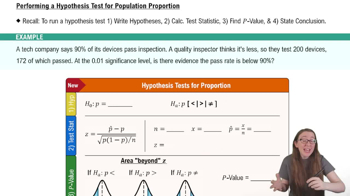
Performing Hypothesis Tests: Proportions
Chi-Square Distribution
The Chi-square distribution is used in tests involving variance because the sample variance, when scaled appropriately, follows this distribution if the data are normally distributed. It is asymmetric and depends on degrees of freedom, which relate to sample size. This distribution helps determine critical values for hypothesis tests about population variance.
Recommended video:
Guided course
Intro to Least Squares Regression
Significance Level and Decision Rule
The significance level (α) is the threshold for rejecting the null hypothesis, commonly set at 0.05. It represents the probability of a Type I error—rejecting a true null hypothesis. The decision rule compares the test statistic to critical values derived from the chosen α to decide whether to reject or fail to reject the null hypothesis.
Recommended video:
Conditional Probability Rule
Watch next
Master Step 1: Write Hypotheses with a bite sized video explanation from Patrick
Start learningRelated Videos
Related Practice
Textbook Question
19
views