


Waiting in LineOne aspect of queuing theory is to consider waiting time in lines. A fast-food chain is trying to determine whether it should switch from having four cash registers with four separate lines to four cash registers with a single line. It has been determined that the mean wait-time in both lines is equal. However, the chain is uncertain about which line has less variability in wait time. From experience, the chain knows that the wait times in the four separate lines are normally distributed with σ = 1.2 minutes. In a study, the chain reconfigured five restaurants to have a single line and measured the wait times for 50 randomly selected customers. The sample standard deviation was determined to be s = 0.84 minute. Is the variability in wait time less for a single line than for multiple lines at the α = 0.05 level of significance?
9. Hypothesis Testing for One Sample
Steps in Hypothesis Testing
 2:45 minutes
Problem 8.T.5b
Textbook Question
According to the National Center for Health Statistics, 22.4% of adults are smokers. A random sample of 300 adults is obtained.
b. In a random sample of 300 adults, what is the probability that at least 50 are smokers?
 Verified step by step guidance
1
Identify the type of distribution to use. Since we are dealing with the number of smokers in a sample and each adult can be considered a Bernoulli trial (smoker or not), the number of smokers follows a Binomial distribution with parameters \(n = 300\) and \(p = 0.224\).
Define the random variable \(X\) as the number of smokers in the sample. Then, \(X \sim \text{Binomial}(n=300, p=0.224)\).
The problem asks for the probability that at least 50 adults are smokers, which can be written as \(P(X \geq 50)\).
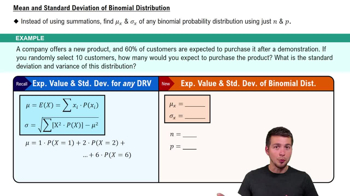
Since calculating binomial probabilities directly for large \(n\) can be cumbersome, consider using a normal approximation to the binomial distribution. The mean and standard deviation of \(X\) are given by \(\mu = np\) and \(\sigma = \sqrt{np(1-p)}\) respectively.
Apply the continuity correction by calculating \(P(X \geq 50) \approx P\left(Y \geq 49.5\right)\) where \(Y\) is a normal random variable with mean \(\mu\) and standard deviation \(\sigma\). Then convert to the standard normal variable \(Z = \frac{Y - \mu}{\sigma}\) and find the corresponding probability using standard normal distribution tables or software.
Verified video answer for a similar problem:This video solution was recommended by our tutors as helpful for the problem above

Video duration:
2mWas this helpful?
Key Concepts
Here are the essential concepts you must grasp in order to answer the question correctly.
Binomial Distribution
The binomial distribution models the number of successes in a fixed number of independent trials, each with the same probability of success. Here, each adult either is a smoker (success) or not, with probability 0.224. The distribution helps calculate probabilities for different counts of smokers in the sample.
Recommended video:
Guided course
 03:28
03:28
Mean & Standard Deviation of Binomial Distribution
Normal Approximation to the Binomial
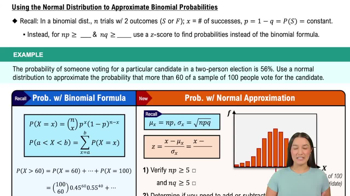
When the sample size is large, the binomial distribution can be approximated by a normal distribution with mean np and variance np(1-p). This simplifies probability calculations, especially for values like 'at least 50 smokers' in a sample of 300, where exact binomial calculations are complex.
Recommended video:
 06:23
06:23Using the Normal Distribution to Approximate Binomial Probabilities
Continuity Correction
When using the normal approximation for a discrete binomial variable, a continuity correction adjusts for the difference between discrete and continuous distributions. For example, to find P(X ≥ 50), we use P(X ≥ 49.5) in the normal distribution to improve accuracy.
Recommended video:
06:23Using the Normal Distribution to Approximate Binomial Probabilities
5:12mWatch next
Master Intro to Hypothesis Testing with a bite sized video explanation from Patrick
Start learningRelated Videos
Related Practice
Textbook Question
13
views