Divorce The following graph represents the results of a survey, in which a random sample of adult Americans was asked, “Please tell me whether you personally believe that in general divorce is morally acceptable or morally wrong.” If Gallup claimed that the results of the survey indicate that 8% of adult Americans believe that divorce is acceptable in certain situations, would you say this statement is descriptive or inferential? Why?
Table of contents
- 1. Intro to Stats and Collecting Data1h 14m
- 2. Describing Data with Tables and Graphs1h 55m
- 3. Describing Data Numerically2h 5m
- 4. Probability2h 16m
- 5. Binomial Distribution & Discrete Random Variables3h 6m
- 6. Normal Distribution and Continuous Random Variables2h 11m
- 7. Sampling Distributions & Confidence Intervals: Mean3h 23m
- Sampling Distribution of the Sample Mean and Central Limit Theorem19m
- Distribution of Sample Mean - Excel23m
- Introduction to Confidence Intervals15m
- Confidence Intervals for Population Mean1h 18m
- Determining the Minimum Sample Size Required12m
- Finding Probabilities and T Critical Values - Excel28m
- Confidence Intervals for Population Means - Excel25m
- 8. Sampling Distributions & Confidence Intervals: Proportion1h 25m
- 9. Hypothesis Testing for One Sample3h 29m
- 10. Hypothesis Testing for Two Samples4h 50m
- Two Proportions1h 13m
- Two Proportions Hypothesis Test - Excel28m
- Two Means - Unknown, Unequal Variance1h 3m
- Two Means - Unknown Variances Hypothesis Test - Excel12m
- Two Means - Unknown, Equal Variance15m
- Two Means - Unknown, Equal Variances Hypothesis Test - Excel9m
- Two Means - Known Variance12m
- Two Means - Sigma Known Hypothesis Test - Excel21m
- Two Means - Matched Pairs (Dependent Samples)42m
- Matched Pairs Hypothesis Test - Excel12m
- 11. Correlation1h 24m
- 12. Regression1h 50m
- 13. Chi-Square Tests & Goodness of Fit2h 21m
- 14. ANOVA1h 57m
1. Intro to Stats and Collecting Data
Intro to Stats
Problem 1.6.25c
Textbook Question
"Designing an Experiment Researchers want to know if there is a link between hypertension (high blood pressure) and consumption of salt. Past studies have indicated that the consumption of fruits and vegetables offsets the negative impact of salt consumption. It is also known that there is quite a bit of person-to-person variability in the ability of the body to process and eliminate salt. However, no method exists for identifying individuals who have a higher ability to process salt. The U.S. Department of Agriculture recommends that daily intake of salt should not exceed 2400 milligrams (mg). The researchers want to keep the design simple, so they choose to conduct their study using a completely randomized design.
For each factor identified, determine whether the variable can be controlled or cannot be controlled. If a factor cannot be controlled, what should be done to reduce variability in the response variable?"
Verified step by step guidance1
Identify the factors mentioned in the problem: (1) salt consumption, (2) consumption of fruits and vegetables, and (3) person-to-person variability in salt processing ability.
Determine which factors can be controlled: Salt consumption can be controlled by setting specific intake levels (e.g., below or above 2400 mg), and consumption of fruits and vegetables can also be controlled by assigning specific diets to participants.
Recognize that person-to-person variability in salt processing ability cannot be controlled because there is no method to identify individuals with higher or lower ability.
To reduce variability from the uncontrollable factor (person-to-person variability), use randomization in the experimental design. This helps distribute the variability evenly across treatment groups, minimizing its impact on the results.
Additionally, consider increasing the sample size to further reduce the effect of variability and improve the reliability of the conclusions.
Verified video answer for a similar problem:This video solution was recommended by our tutors as helpful for the problem above
Video duration:
2mPlay a video:
Was this helpful?
Key Concepts
Here are the essential concepts you must grasp in order to answer the question correctly.
Factors and Variables in Experimental Design
Factors are the independent variables that researchers manipulate or observe to study their effect on the response variable. Variables can be controlled (set or fixed by the experimenter) or uncontrolled (cannot be fixed or manipulated). Identifying which factors can be controlled helps in designing the experiment to isolate effects and reduce confounding.
Recommended video:
Guided course
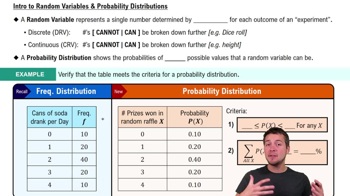
Intro to Random Variables & Probability Distributions
Completely Randomized Design
A completely randomized design assigns experimental units to treatments entirely at random, ensuring each unit has an equal chance of receiving any treatment. This design helps to evenly distribute uncontrolled variability across treatment groups, minimizing bias and allowing for valid statistical inference.
Recommended video:
Guided course
Intro to Random Variables & Probability Distributions
Reducing Variability from Uncontrolled Factors
When factors cannot be controlled, researchers use techniques like randomization, blocking, or increasing sample size to reduce variability in the response variable. These methods help to balance or account for the uncontrolled variability, improving the reliability and validity of the experiment’s conclusions.
Recommended video:
Guided course
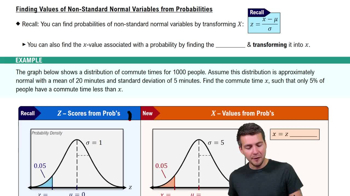
Finding Values of Non-Standard Normal Variables from Probabilities
Watch next
Master Introduction to Statistics Channel with a bite sized video explanation from Patrick
Start learningRelated Videos
Related Practice
Textbook Question
13
views