Distinguish between sampling and nonsampling error.
Table of contents
- 1. Intro to Stats and Collecting Data1h 14m
- 2. Describing Data with Tables and Graphs1h 55m
- 3. Describing Data Numerically2h 5m
- 4. Probability2h 16m
- 5. Binomial Distribution & Discrete Random Variables3h 6m
- 6. Normal Distribution and Continuous Random Variables2h 11m
- 7. Sampling Distributions & Confidence Intervals: Mean3h 23m
- Sampling Distribution of the Sample Mean and Central Limit Theorem19m
- Distribution of Sample Mean - Excel23m
- Introduction to Confidence Intervals15m
- Confidence Intervals for Population Mean1h 18m
- Determining the Minimum Sample Size Required12m
- Finding Probabilities and T Critical Values - Excel28m
- Confidence Intervals for Population Means - Excel25m
- 8. Sampling Distributions & Confidence Intervals: Proportion1h 25m
- 9. Hypothesis Testing for One Sample3h 29m
- 10. Hypothesis Testing for Two Samples4h 50m
- Two Proportions1h 13m
- Two Proportions Hypothesis Test - Excel28m
- Two Means - Unknown, Unequal Variance1h 3m
- Two Means - Unknown Variances Hypothesis Test - Excel12m
- Two Means - Unknown, Equal Variance15m
- Two Means - Unknown, Equal Variances Hypothesis Test - Excel9m
- Two Means - Known Variance12m
- Two Means - Sigma Known Hypothesis Test - Excel21m
- Two Means - Matched Pairs (Dependent Samples)42m
- Matched Pairs Hypothesis Test - Excel12m
- 11. Correlation1h 24m
- 12. Regression1h 50m
- 13. Chi-Square Tests & Goodness of Fit2h 21m
- 14. ANOVA1h 57m
1. Intro to Stats and Collecting Data
Intro to Stats
Problem 2.1.9c
Textbook Question
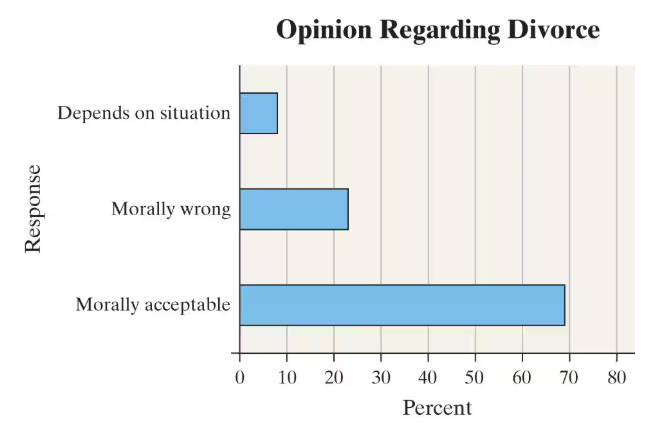
Divorce The following graph represents the results of a survey, in which a random sample of adult Americans was asked, “Please tell me whether you personally believe that in general divorce is morally acceptable or morally wrong.” If Gallup claimed that the results of the survey indicate that 8% of adult Americans believe that divorce is acceptable in certain situations, would you say this statement is descriptive or inferential? Why?

Verified step by step guidance1
Step 1: Understand the difference between descriptive and inferential statistics. Descriptive statistics summarize or describe the characteristics of a data set, such as percentages or averages from the sample data. Inferential statistics use sample data to make generalizations or predictions about a larger population.
Step 2: Look at the graph provided, which shows the results of a survey of a random sample of adult Americans. The graph displays the percentage of respondents who believe divorce is morally acceptable, morally wrong, or depends on the situation.
Step 3: Note that Gallup claims 8% of adult Americans believe divorce is acceptable in certain situations. This percentage is a statement about the entire population of adult Americans, not just the sample.
Step 4: Since the 8% figure is a conclusion drawn about the whole population based on the sample data, this is an example of inferential statistics. It involves making an inference from the sample to the population.
Step 5: Therefore, the statement is inferential because it uses the sample survey results to estimate or infer the opinion of the entire population of adult Americans regarding divorce.
Verified video answer for a similar problem:This video solution was recommended by our tutors as helpful for the problem above
Video duration:
2mPlay a video:
Was this helpful?
Key Concepts
Here are the essential concepts you must grasp in order to answer the question correctly.
Descriptive Statistics
Descriptive statistics summarize or describe the main features of a data set, such as percentages or averages from a sample. In this case, the 8% figure represents a direct summary of the survey responses, describing the sample without making broader claims about the entire population.
Recommended video:
Guided course
Parameters vs. Statistics
Inferential Statistics
Inferential statistics use sample data to make generalizations or predictions about a larger population. When Gallup claims that 8% of all adult Americans believe divorce is acceptable in certain situations, they are making an inference from the sample to the population.
Recommended video:
Guided course
Parameters vs. Statistics
Sample vs. Population
A sample is a subset of a population used to gather data, while the population is the entire group of interest. Understanding the difference is crucial because descriptive statistics describe the sample, whereas inferential statistics draw conclusions about the population based on the sample.
Recommended video:
Sampling Distribution of Sample Proportion
Watch next
Master Introduction to Statistics Channel with a bite sized video explanation from Patrick
Start learningRelated Videos
Related Practice
Textbook Question
5
views