Crime Rate and Cell Phones The linear correlation between violent crime rate and percentage of the population that has a cell phone is −0.918 for years since 1995. Do you believe that increasing the percentage of the population that has a cell phone will decrease the violent crime rate? What might be a lurking variable between percentage of the population with a cell phone and violent crime rate?
Table of contents
- 1. Intro to Stats and Collecting Data1h 14m
- 2. Describing Data with Tables and Graphs1h 55m
- 3. Describing Data Numerically2h 5m
- 4. Probability2h 16m
- 5. Binomial Distribution & Discrete Random Variables3h 6m
- 6. Normal Distribution and Continuous Random Variables2h 11m
- 7. Sampling Distributions & Confidence Intervals: Mean3h 23m
- Sampling Distribution of the Sample Mean and Central Limit Theorem19m
- Distribution of Sample Mean - Excel23m
- Introduction to Confidence Intervals15m
- Confidence Intervals for Population Mean1h 18m
- Determining the Minimum Sample Size Required12m
- Finding Probabilities and T Critical Values - Excel28m
- Confidence Intervals for Population Means - Excel25m
- 8. Sampling Distributions & Confidence Intervals: Proportion1h 25m
- 9. Hypothesis Testing for One Sample3h 29m
- 10. Hypothesis Testing for Two Samples4h 50m
- Two Proportions1h 13m
- Two Proportions Hypothesis Test - Excel28m
- Two Means - Unknown, Unequal Variance1h 3m
- Two Means - Unknown Variances Hypothesis Test - Excel12m
- Two Means - Unknown, Equal Variance15m
- Two Means - Unknown, Equal Variances Hypothesis Test - Excel9m
- Two Means - Known Variance12m
- Two Means - Sigma Known Hypothesis Test - Excel21m
- Two Means - Matched Pairs (Dependent Samples)42m
- Matched Pairs Hypothesis Test - Excel12m
- 11. Correlation1h 24m
- 12. Regression1h 50m
- 13. Chi-Square Tests & Goodness of Fit2h 21m
- 14. ANOVA1h 57m
11. Correlation
Scatterplots & Intro to Correlation
Problem 12.3.24
Textbook Question
Why is it important to perform graphical as well as analytical analyses when analyzing relations between two quantitative variables?
Verified step by step guidance1
Step 1: Understand that graphical analysis involves visualizing data using plots such as scatterplots, which help to identify patterns, trends, clusters, or outliers between two quantitative variables.
Step 2: Recognize that analytical analysis involves calculating numerical measures like correlation coefficients or fitting regression models to quantify the strength and nature of the relationship between the variables.
Step 3: Note that graphical analysis can reveal non-linear relationships, heteroscedasticity (changing variability), or unusual data points that might not be obvious from numerical summaries alone.
Step 4: Understand that analytical methods provide precise, objective measures and allow hypothesis testing, but they can sometimes be misleading if assumptions are violated or if the data contain anomalies.
Step 5: Conclude that combining both graphical and analytical analyses provides a more complete understanding of the relationship, ensuring that insights are both visually intuitive and statistically valid.
Verified video answer for a similar problem:This video solution was recommended by our tutors as helpful for the problem above
Video duration:
3mPlay a video:
Was this helpful?
Key Concepts
Here are the essential concepts you must grasp in order to answer the question correctly.
Graphical Analysis
Graphical analysis involves visualizing data using plots like scatterplots to identify patterns, trends, or outliers. It helps in understanding the relationship between two quantitative variables intuitively and can reveal non-linear associations or anomalies that numerical summaries might miss.
Recommended video:
Guided course
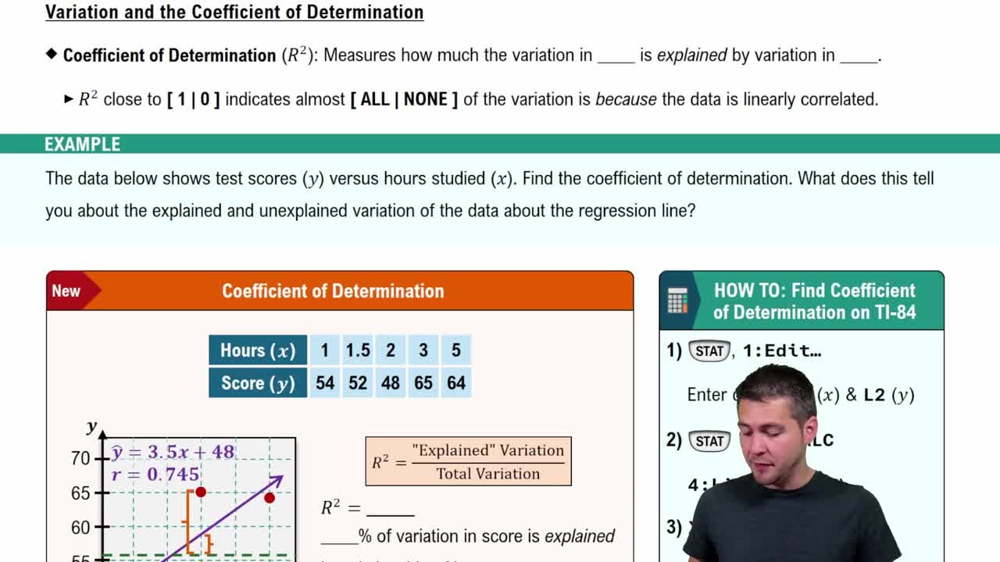
Coefficient of Determination
Analytical Analysis
Analytical analysis uses statistical methods such as correlation coefficients and regression models to quantify the strength and nature of the relationship between variables. This approach provides precise numerical measures and tests for significance, enabling objective conclusions about the data.
Recommended video:
Introduction to ANOVA
Complementarity of Graphical and Analytical Methods
Combining graphical and analytical analyses ensures a comprehensive understanding of data. Graphs offer a visual check for assumptions and data quality, while analytical methods provide formal evidence. Together, they reduce misinterpretation and improve the reliability of conclusions about variable relationships.
Recommended video:
Complementary Events
Watch next
Master Scatterplots & Intro to Correlation with a bite sized video explanation from Patrick
Start learningRelated Videos
Related Practice
Textbook Question
5
views