Explain what is wrong with the following statement: “We have concluded that a high correlation exists between the gender of drivers and rates of automobile accidents.” Suggest a better way to write the sentence.
Table of contents
- 1. Intro to Stats and Collecting Data1h 14m
- 2. Describing Data with Tables and Graphs1h 55m
- 3. Describing Data Numerically2h 5m
- 4. Probability2h 16m
- 5. Binomial Distribution & Discrete Random Variables3h 6m
- 6. Normal Distribution and Continuous Random Variables2h 11m
- 7. Sampling Distributions & Confidence Intervals: Mean3h 23m
- Sampling Distribution of the Sample Mean and Central Limit Theorem19m
- Distribution of Sample Mean - Excel23m
- Introduction to Confidence Intervals15m
- Confidence Intervals for Population Mean1h 18m
- Determining the Minimum Sample Size Required12m
- Finding Probabilities and T Critical Values - Excel28m
- Confidence Intervals for Population Means - Excel25m
- 8. Sampling Distributions & Confidence Intervals: Proportion1h 25m
- 9. Hypothesis Testing for One Sample3h 29m
- 10. Hypothesis Testing for Two Samples4h 50m
- Two Proportions1h 13m
- Two Proportions Hypothesis Test - Excel28m
- Two Means - Unknown, Unequal Variance1h 3m
- Two Means - Unknown Variances Hypothesis Test - Excel12m
- Two Means - Unknown, Equal Variance15m
- Two Means - Unknown, Equal Variances Hypothesis Test - Excel9m
- Two Means - Known Variance12m
- Two Means - Sigma Known Hypothesis Test - Excel21m
- Two Means - Matched Pairs (Dependent Samples)42m
- Matched Pairs Hypothesis Test - Excel12m
- 11. Correlation1h 24m
- 12. Regression1h 50m
- 13. Chi-Square Tests & Goodness of Fit2h 21m
- 14. ANOVA1h 57m
11. Correlation
Scatterplots & Intro to Correlation
Problem 4.1.1
Textbook Question
What is the difference between univariate data and bivariate data?
Verified step by step guidance1
Understand that univariate data involves observations on a single variable. It focuses on analyzing one characteristic or attribute at a time.
Recognize that bivariate data involves observations on two variables simultaneously. It is used to study the relationship or association between these two variables.
Note that univariate data analysis typically includes measures like mean, median, mode, variance, and standard deviation for one variable.
In contrast, bivariate data analysis often involves examining correlation, covariance, or regression to understand how the two variables interact or relate.
Summarize by stating that the key difference is the number of variables involved: univariate data deals with one variable, while bivariate data deals with two variables and their relationship.
Verified video answer for a similar problem:This video solution was recommended by our tutors as helpful for the problem above
Video duration:
1mPlay a video:
Was this helpful?
Key Concepts
Here are the essential concepts you must grasp in order to answer the question correctly.
Univariate Data
Univariate data involves observations on a single variable or attribute. It focuses on analyzing one characteristic at a time, such as height or temperature, to summarize and describe its distribution using measures like mean, median, and variance.
Recommended video:
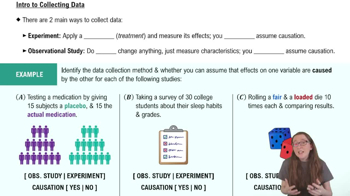
Introduction to Collecting Data
Bivariate Data
Bivariate data consists of observations on two variables collected from the same subjects or units. It is used to explore relationships or associations between the two variables, often analyzed through scatterplots, correlation, and regression techniques.
Recommended video:
Introduction to Collecting Data
Data Analysis Techniques for Univariate vs. Bivariate Data
Univariate analysis uses descriptive statistics and visualizations like histograms to summarize one variable, while bivariate analysis examines how two variables interact, employing tools such as correlation coefficients and scatterplots to identify patterns or dependencies.
Recommended video:
Guided course
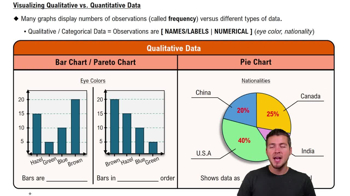
Visualizing Qualitative vs. Quantitative Data
Watch next
Master Scatterplots & Intro to Correlation with a bite sized video explanation from Patrick
Start learningRelated Videos
Related Practice
Textbook Question
6
views