Ch. 5 - Discrete Probability Distributions
Triola - Elementary Statistics 14th Edition
Triola14th EditionElementary StatisticsISBN: 9780137366446Not the one you use?Change textbook
Chapter 5, Problem 5.2.32b

In Exercises 31 and 32, assume that hybridization experiments are conducted with peas having the property that for offspring, there is a 0.75 probability that a pea has green pods (as in one of Mendel’s famous experiments).


Hybrids Assume that offspring peas are randomly selected in groups of 16.


b. Use the range rule of thumb to find the values separating results that are significantly low or significantly high.

Verified step by step guidance
1
Step 1: Understand the problem. The range rule of thumb is used to determine values that are significantly low or significantly high. This involves calculating the mean (μ) and standard deviation (σ) of the binomial distribution, and then using the rule: 'Significantly low values are below μ - 2σ, and significantly high values are above μ + 2σ.'
Step 2: Identify the parameters of the binomial distribution. The number of trials (n) is 16, and the probability of success (p) is 0.75. The probability of failure (q) is 1 - p = 0.25.
Step 3: Calculate the mean (μ) of the binomial distribution using the formula: μ = n × p. Substitute the values of n and p into the formula.
Step 4: Calculate the standard deviation (σ) of the binomial distribution using the formula: σ = √(n × p × q). Substitute the values of n, p, and q into the formula.
Step 5: Apply the range rule of thumb. Compute the significantly low threshold as μ - 2σ and the significantly high threshold as μ + 2σ. These values will separate results that are significantly low or significantly high.

Verified video answer for a similar problem:

This video solution was recommended by our tutors as helpful for the problem above.
Video duration:
2m
Was this helpful?

Key Concepts

Here are the essential concepts you must grasp in order to answer the question correctly.

Probability

Probability is a measure of the likelihood that a particular event will occur, expressed as a number between 0 and 1. In this context, the probability of 0.75 indicates that there is a 75% chance that a randomly selected pea will have green pods. Understanding probability is essential for analyzing outcomes in hybridization experiments and determining the expected distribution of traits in offspring.
Recommended video:
5:37
Introduction to Probability

Range Rule of Thumb

The range rule of thumb is a statistical guideline used to identify significant deviations in data. It suggests that the range of a dataset can be estimated as four times the standard deviation. This rule helps in determining the thresholds for what constitutes significantly low or high results, allowing researchers to assess whether observed outcomes in the pea experiments fall within expected variability.
Recommended video:
5:14
Probability of Mutually Exclusive Events

Binomial Distribution

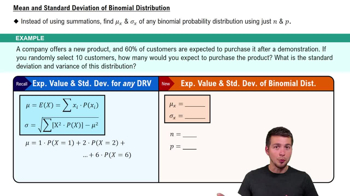
The binomial distribution is a probability distribution that describes the number of successes in a fixed number of independent Bernoulli trials, each with the same probability of success. In this case, the offspring peas can be modeled using a binomial distribution since each pea can either have green pods (success) or not (failure). Understanding this distribution is crucial for calculating probabilities and applying the range rule of thumb in the context of the given hybridization experiments.
Recommended video:
Guided course
03:28
Mean & Standard Deviation of Binomial Distribution
Related Practice
Textbook Question

In Exercises 29 and 30, assume that different groups of couples use the XSORT method of gender selection and each couple gives birth to one baby. The XSORT method is designed to increase the likelihood that a baby will be a girl, but assume that the method has no effect, so the probability of a girl is 0.5.


Gender Selection Assume that the groups consist of 36 couples.


b. Use the range rule of thumb to find the values separating results that are significantly low or significantly high.

91
views
Textbook Question

Binomial Probability Formula. In Exercises 13 and 14, answer the questions designed to help understand the rationale for the binomial probability formula.


Guessing Answers Standard tests, such as the SAT, ACT, or Medical College Admission Test (MCAT), typically use multiple choice questions, each with five possible answers (a, b, c, d, e), one of which is correct. Assume that you guess the answers to the first three questions.


b. Beginning with WWC, make a complete list of the different possible arrangements of two wrong answers and one correct answer, and then find the probability for each entry in the list.

292
views
Textbook Question

 In Exercises 5–8, assume that the Poisson distribution applies; assume that the mean number of Atlantic hurricanes in the United States is 5.5 per year, as in Example 1; and proceed to find the indicated probability.


Hurricanes


a. Find the probability that in a year, there will be 7 hurricanes.

142
views
Textbook Question

In Exercises 5–8, assume that the Poisson distribution applies; assume that the mean number of Atlantic hurricanes in the United States is 5.5 per year, as in Example 1; and proceed to find the indicated probability.

b. In a 118-year period, how many years are expected to have no hurricanes?

126
views
Textbook Question

In Exercises 5–8, assume that the Poisson distribution applies; assume that the mean number of Atlantic hurricanes in the United States is 5.5 per year, as in Example 1; and proceed to find the indicated probability.

b. In a 118-year period, how many years are expected to have 10 hurricanes?

128
views
Textbook Question

One of Mendel’s famous experiments with peas resulted in 580 offspring, and 152 of them were yellow peas. Mendel claimed that under the same conditions, 25% of offspring peas would be yellow. Assume that Mendel’s claim of 25% is true, and assume that a sample consists of 580 offspring peas.


b. Find the probability of exactly 152 yellow peas.


111
views