Which of the following types of graphs is most appropriate for visualizing the distribution of a qualitative () variable?
Table of contents
- 1. Intro to Stats and Collecting Data1h 14m
- 2. Describing Data with Tables and Graphs1h 55m
- 3. Describing Data Numerically2h 5m
- 4. Probability2h 16m
- 5. Binomial Distribution & Discrete Random Variables3h 6m
- 6. Normal Distribution and Continuous Random Variables2h 11m
- 7. Sampling Distributions & Confidence Intervals: Mean3h 23m
- Sampling Distribution of the Sample Mean and Central Limit Theorem19m
- Distribution of Sample Mean - Excel23m
- Introduction to Confidence Intervals15m
- Confidence Intervals for Population Mean1h 18m
- Determining the Minimum Sample Size Required12m
- Finding Probabilities and T Critical Values - Excel28m
- Confidence Intervals for Population Means - Excel25m
- 8. Sampling Distributions & Confidence Intervals: Proportion1h 25m
- 9. Hypothesis Testing for One Sample3h 29m
- 10. Hypothesis Testing for Two Samples4h 50m
- Two Proportions1h 13m
- Two Proportions Hypothesis Test - Excel28m
- Two Means - Unknown, Unequal Variance1h 3m
- Two Means - Unknown Variances Hypothesis Test - Excel12m
- Two Means - Unknown, Equal Variance15m
- Two Means - Unknown, Equal Variances Hypothesis Test - Excel9m
- Two Means - Known Variance12m
- Two Means - Sigma Known Hypothesis Test - Excel21m
- Two Means - Matched Pairs (Dependent Samples)42m
- Matched Pairs Hypothesis Test - Excel12m
- 11. Correlation1h 24m
- 12. Regression1h 50m
- 13. Chi-Square Tests & Goodness of Fit2h 21m
- 14. ANOVA1h 57m
2. Describing Data with Tables and Graphs
Visualizing Qualitative vs. Quantitative Data
Problem 11.1.25b
Textbook Question
"The Process of Statistics: Side Effects In clinical trials of the allergy medicine Clarinex (5 mg), 3307 allergy sufferers were randomly assigned to either a Clarinex group or a placebo group. It was reported that 50 out of 1655 individuals in the Clarinex group and 31 o
ut of 1652 individuals in the placebo group experienced dry mouth as a side effect of their respective treatments. Source: www.clarinex.com
b. What is the response variable? Is it qualitative or quantitative?"
Verified step by step guidance1
Identify the response variable by determining what outcome or characteristic is being measured or observed in the study. In this case, it is whether an individual experienced dry mouth as a side effect.
Recognize that the response variable describes the presence or absence of a side effect (dry mouth), which categorizes individuals into groups based on this outcome.
Understand that since the response variable classifies individuals into categories (experienced dry mouth or did not experience dry mouth), it is a qualitative (categorical) variable.
Recall that qualitative variables describe qualities or attributes and are not measured numerically, unlike quantitative variables which represent numerical measurements.
Conclude that the response variable is the occurrence of dry mouth side effect, and it is qualitative because it categorizes individuals based on a characteristic rather than measuring a numerical value.
Verified video answer for a similar problem:This video solution was recommended by our tutors as helpful for the problem above
Video duration:
3mPlay a video:
Was this helpful?
Key Concepts
Here are the essential concepts you must grasp in order to answer the question correctly.
Response Variable
The response variable is the outcome or dependent variable measured in a study to assess the effect of treatments or conditions. It reflects what is being observed or recorded, such as the presence or absence of a side effect in clinical trials.
Recommended video:
Guided course
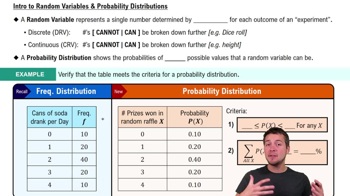
Intro to Random Variables & Probability Distributions
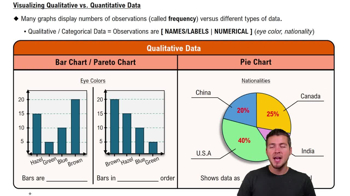
Qualitative vs. Quantitative Variables
Qualitative variables describe categories or qualities and are non-numeric, like types of side effects or treatment groups. Quantitative variables represent numeric measurements or counts, such as blood pressure or number of symptoms.
Recommended video:
Guided course
Visualizing Qualitative vs. Quantitative Data
Random Assignment in Experiments
Random assignment is the process of placing participants into treatment or control groups by chance, reducing bias and ensuring groups are comparable. This helps isolate the effect of the treatment on the response variable.
Recommended video:
Guided course
Intro to Random Variables & Probability Distributions
Watch next
Master Visualizing Qualitative vs. Quantitative Data with a bite sized video explanation from Patrick
Start learningRelated Videos
Related Practice
Multiple Choice
12
views