Which of the following levels of measurement can be used for quantitative data?
Table of contents
- 1. Intro to Stats and Collecting Data1h 14m
- 2. Describing Data with Tables and Graphs1h 55m
- 3. Describing Data Numerically2h 5m
- 4. Probability2h 16m
- 5. Binomial Distribution & Discrete Random Variables3h 6m
- 6. Normal Distribution and Continuous Random Variables2h 11m
- 7. Sampling Distributions & Confidence Intervals: Mean3h 23m
- Sampling Distribution of the Sample Mean and Central Limit Theorem19m
- Distribution of Sample Mean - Excel23m
- Introduction to Confidence Intervals15m
- Confidence Intervals for Population Mean1h 18m
- Determining the Minimum Sample Size Required12m
- Finding Probabilities and T Critical Values - Excel28m
- Confidence Intervals for Population Means - Excel25m
- 8. Sampling Distributions & Confidence Intervals: Proportion1h 25m
- 9. Hypothesis Testing for One Sample3h 29m
- 10. Hypothesis Testing for Two Samples4h 50m
- Two Proportions1h 13m
- Two Proportions Hypothesis Test - Excel28m
- Two Means - Unknown, Unequal Variance1h 3m
- Two Means - Unknown Variances Hypothesis Test - Excel12m
- Two Means - Unknown, Equal Variance15m
- Two Means - Unknown, Equal Variances Hypothesis Test - Excel9m
- Two Means - Known Variance12m
- Two Means - Sigma Known Hypothesis Test - Excel21m
- Two Means - Matched Pairs (Dependent Samples)42m
- Matched Pairs Hypothesis Test - Excel12m
- 11. Correlation1h 24m
- 12. Regression1h 50m
- 13. Chi-Square Tests & Goodness of Fit2h 21m
- 14. ANOVA1h 57m
2. Describing Data with Tables and Graphs
Visualizing Qualitative vs. Quantitative Data
Struggling with Statistics?
Join thousands of students who trust us to help them ace their exams!Watch the first videoMultiple Choice
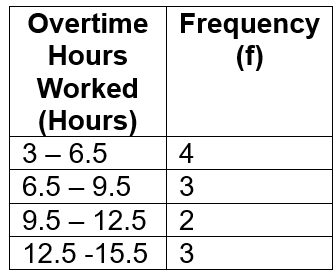
The following data set shows the number of overtime hours that 12 employees worked in a month. Construct a frequency distribution, suing a lower class limit of 3 and a class width of 4.

A
B
C
D
Verified step by step guidance1
Identify the range of the data set by finding the minimum and maximum values. In this case, the minimum is 3 and the maximum is 15.
Determine the number of classes. A good rule of thumb is to use between 5 and 20 classes. For this problem, we will use 4 classes as suggested by the problem statement.
Calculate the class width using the formula: Class Width = (Maximum Value - Minimum Value) / Number of Classes. Here, the class width is (15 - 3) / 4 = 3. However, the problem specifies a class width of 4, so we will use that.
Construct the class intervals starting from the lower class limit of 3. The first class will be 3 to 6, the second class will be 7 to 10, the third class will be 11 to 14, and the fourth class will be 15 to 18.
Count the number of data points that fall into each class interval to determine the frequency for each class. For example, the first class (3-6) includes the data points 3, 5, 6, and 4, resulting in a frequency of 4.
Watch next
Master Visualizing Qualitative vs. Quantitative Data with a bite sized video explanation from Patrick
Start learningRelated Videos
Related Practice
Multiple Choice
17
views
Visualizing Qualitative vs. Quantitative Data practice set