Ch. 1 - Introduction to Statistics
Larson - Elementary Statistics: Picturing the World 8th Edition
Larson8th EditionElementary Statistics: Picturing the WorldISBN: 9780137493470Not the one you use?Change textbook
Chapter 1, Problem 1.CR.12

In Exercises 11 and 12, determine whether the data are qualitative or quantitative, and determine the level of measurement of the data set.


The six top-earning states in 2019 by median household income are listed. (Source: U.S. Census Bureau)
1. Maryland 2. New Jersey 3. Hawaii
4. Massachusetts 5. Connecticut 6. Alaska

Verified step by step guidance
1
Step 1: Understand the difference between qualitative and quantitative data. Qualitative data describes categories or qualities (e.g., names, labels), while quantitative data represents numerical values that can be measured or counted.
Step 2: Analyze the given data. The data consists of the names of the six top-earning states by median household income. These are categorical labels and do not represent numerical values, so the data is qualitative.
Step 3: Understand the levels of measurement. The four levels of measurement are nominal, ordinal, interval, and ratio. Nominal data consists of names or labels without any inherent order, while ordinal data has a meaningful order or ranking.
Step 4: Determine the level of measurement for the data. Since the states are listed in a ranked order based on their median household income, the data is ordinal. The ranking implies a meaningful order, but the differences between ranks are not numerically measurable.
Step 5: Conclude that the data is qualitative and has an ordinal level of measurement because it represents ranked categories (states) based on a specific criterion (median household income).

Verified video answer for a similar problem:

This video solution was recommended by our tutors as helpful for the problem above.
Video duration:
3m
Was this helpful?

Key Concepts

Here are the essential concepts you must grasp in order to answer the question correctly.

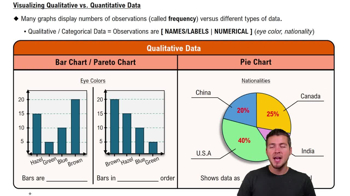
Qualitative vs. Quantitative Data

Qualitative data refers to non-numerical information that describes characteristics or qualities, such as names or categories. In contrast, quantitative data consists of numerical values that can be measured or counted, allowing for statistical analysis. Understanding the distinction between these two types of data is crucial for determining how to analyze and interpret the information presented.
Recommended video:
Guided course
04:39
Visualizing Qualitative vs. Quantitative Data

Levels of Measurement

The levels of measurement categorize data based on the nature of the information they represent. There are four levels: nominal (categorical data without order), ordinal (categorical data with a defined order), interval (numerical data without a true zero), and ratio (numerical data with a true zero). Identifying the correct level of measurement is essential for selecting appropriate statistical methods and accurately interpreting results.
Recommended video:
Guided course
10:28
Difference in Proportions: Hypothesis Tests Example 1

Median Household Income

Median household income is a measure that represents the middle income value of a dataset, where half of the households earn more and half earn less. It is a key indicator of economic health and is often used to compare income levels across different regions. Understanding this concept helps in analyzing the socioeconomic status of the states listed in the question.
Recommended video:
Guided course
04:48
Comparing Mean vs. Median
Related Practice
Textbook Question

"Determine whether the data set is a population or a sample. Explain your reasoning.

A survey of 250 members from an organized union of over 20,000 members"

153
views
Textbook Question

In Exercises 9 and 10, determine whether the study is an observational study or an experiment. Explain.


To study the effect of using digital devices in the classroom on exam performance, researchers divided 726 undergraduate students into three groups, including a group that was allowed to use digital devices, a group that had restricted access to tablets, and a control group that was “technologyfree.” (Source: Massachusetts Institute of Technology)

153
views
Textbook Question

"Determine whether the statement is true or false. If it is false, rewrite it as a true statement.

It is impossible to obtain all the census data about the U.S. population."

94
views
Textbook Question

Determine whether the statement is true or false. If it is false, rewrite it as a true statement.

More types of calculations can be performed with data at the nominal level than with data at the interval level.

179
views
Textbook Question

Identify the sampling technique used in each study. Explain your reasoning.

A study on attitudes about smoking is conducted at a college. The students are divided by class (freshman, sophomore, junior, and senior). Then a random sample is selected from each class and interviewed.

138
views
Textbook Question

In Exercises 4 and 5, determine whether the number is a parameter or a statistic. Explain your reasoning.


In 2021, the median annual salary of a first-year chemist was \$58,700.

162
views