Written below (green dotted curve) is a graph of the function .If g(x) (blue solid curve) is a reflection of f(x) about the y-axis what is the equation for g(x)?
Table of contents
- 0. Review of College Algebra4h 43m
- 1. Measuring Angles40m
- 2. Trigonometric Functions on Right Triangles2h 5m
- 3. Unit Circle1h 19m
- 4. Graphing Trigonometric Functions1h 19m
- 5. Inverse Trigonometric Functions and Basic Trigonometric Equations1h 41m
- 6. Trigonometric Identities and More Equations2h 34m
- 7. Non-Right Triangles1h 38m
- 8. Vectors2h 25m
- 9. Polar Equations2h 5m
- 10. Parametric Equations1h 6m
- 11. Graphing Complex Numbers1h 7m
0. Review of College Algebra
Transformations
Problem 3
Textbook Question
Fill in the blank(s) to correctly complete each sentence.
The graph of ƒ(x) = (x + 4)² is obtained by shifting the graph of y = x² to the ___ 4 units.
Verified step by step guidance1
Identify the base function and the transformation function. The base function here is y = x^2, which is a standard parabola centered at the origin (0,0).
Analyze the transformation function ƒ(x) = (x + 4)^2. The transformation involves (x + 4) instead of x, indicating a horizontal shift.
Understand the direction of the shift. The +4 inside the parentheses with x indicates a shift to the left if it were -4, it would indicate a shift to the right.
Determine the magnitude of the shift. The number 4 represents the number of units the graph shifts from the original position of the base function.
Conclude the direction and magnitude of the shift. The graph of ƒ(x) = (x + 4)^2 is obtained by shifting the graph of y = x^2 to the left by 4 units.
Verified video answer for a similar problem:This video solution was recommended by our tutors as helpful for the problem above
Video duration:
2mPlay a video:
Key Concepts
Here are the essential concepts you must grasp in order to answer the question correctly.
Graph Transformations
Graph transformations involve shifting, reflecting, stretching, or compressing the graph of a function. In this case, the function ƒ(x) = (x + 4)² represents a horizontal shift of the basic quadratic function y = x². Understanding how changes in the function's equation affect its graph is crucial for accurately completing the sentence.
Recommended video:
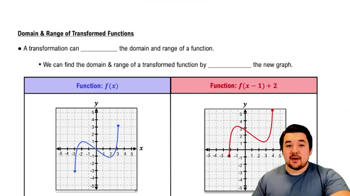
Introduction to Transformations
Horizontal Shifts
A horizontal shift occurs when the graph of a function is moved left or right along the x-axis. For the function ƒ(x) = (x + 4)², the '+4' indicates a shift to the left by 4 units. This concept is essential for determining the correct direction of the shift when completing the sentence.
Recommended video:
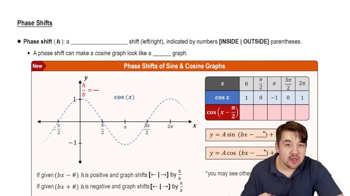
Phase Shifts
Quadratic Functions
Quadratic functions are polynomial functions of degree two, typically represented in the form y = ax² + bx + c. The graph of a quadratic function is a parabola. Recognizing the standard form of a quadratic function helps in understanding how its graph behaves and how transformations affect its position on the coordinate plane.
Recommended video:
Quadratic Formula
Watch next
Master Introduction to Transformations with a bite sized video explanation from Patrick
Start learningRelated Videos
Related Practice
Multiple Choice
384
views
3
rank