Flower color in snapdragons results from the amount of the pigment anthocyanin in the petals. Red flowers are produced by plants that have full anthocyanin production, and ivory-colored flowers are produced by plants that lack the ability to produce anthocyanin. The allele An1 has full activity in anthocyanin production, and the allele An2 is a null allele. Dr. Ara B. Dopsis, a famous genetic researcher, crosses pure-breeding red snapdragons to pure-breeding ivory snapdragons and produces F₁ progeny plants that have pink flowers. He proposes that this outcome is the result of incomplete dominance, and he crosses the F₁ to test his hypothesis. What phenotypes does Dr. Dopsis predict will be found in the F₂, and in what proportions?
Table of contents
- 1. Introduction to Genetics51m
- 2. Mendel's Laws of Inheritance3h 37m
- 3. Extensions to Mendelian Inheritance2h 41m
- 4. Genetic Mapping and Linkage2h 28m
- 5. Genetics of Bacteria and Viruses1h 21m
- 6. Chromosomal Variation1h 48m
- 7. DNA and Chromosome Structure56m
- 8. DNA Replication1h 10m
- 9. Mitosis and Meiosis1h 34m
- 10. Transcription1h 0m
- 11. Translation58m
- 12. Gene Regulation in Prokaryotes1h 19m
- 13. Gene Regulation in Eukaryotes44m
- 14. Genetic Control of Development44m
- 15. Genomes and Genomics1h 50m
- 16. Transposable Elements47m
- 17. Mutation, Repair, and Recombination1h 6m
- 18. Molecular Genetic Tools19m
- 19. Cancer Genetics29m
- 20. Quantitative Genetics1h 26m
- 21. Population Genetics50m
- 22. Evolutionary Genetics29m
3. Extensions to Mendelian Inheritance
Variations of Dominance
Problem 22
Textbook Question
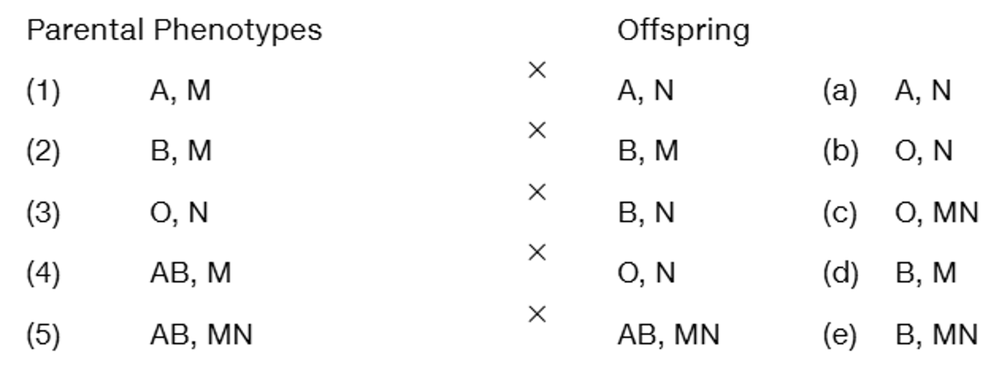
Five human matings (1–5), identified by both maternal and paternal phenotypes for ABO and MN blood-group antigen status, are shown on the left side of the following table:

Each mating resulted in one of the five offspring shown in the right-hand column (a–e). Match each offspring with one correct set of parents, using each parental set only once. Is there more than one set of correct answers?
Verified step by step guidance1
Step 1: Understand the inheritance patterns for both ABO and MN blood groups. The ABO blood group is determined by three alleles (I^A, I^B, and i), where I^A and I^B are codominant and i is recessive. The MN blood group is determined by two codominant alleles (M and N).
Step 2: For each parental pair, list the possible genotypes based on their phenotypes. For example, a parent with blood group A could be I^A I^A or I^A i, and a parent with blood group AB must be I^A I^B. Similarly, for MN, a parent with phenotype M could be M M or M N, and N must be N N.
Step 3: Determine all possible offspring genotypes for each parental pair by combining the parental alleles for both ABO and MN systems. Use Punnett squares or allele combination tables to find all possible offspring phenotypes.
Step 4: Match each offspring phenotype (a–e) to the parental pair (1–5) whose possible offspring phenotypes include that offspring. Remember to consider both ABO and MN phenotypes together for accurate matching.
Step 5: After matching all offspring to parental pairs, check if any offspring phenotype can be produced by more than one parental pair. This will help determine if there is more than one correct set of answers.
Verified video answer for a similar problem:This video solution was recommended by our tutors as helpful for the problem above
Video duration:
2mPlay a video:
Was this helpful?
Key Concepts
Here are the essential concepts you must grasp in order to answer the question correctly.
ABO Blood Group Inheritance
The ABO blood group system is determined by three alleles (A, B, and O) with A and B being codominant and O recessive. Each individual inherits one allele from each parent, and the combination determines the blood type. Understanding parental genotypes helps predict possible offspring blood types.
Recommended video:
Guided course
Organelle Inheritance
MN Blood Group Inheritance
The MN blood group is controlled by two codominant alleles, M and N, located on a single gene. Individuals can be MM, MN, or NN, and the phenotype reflects the presence of these alleles. Parental MN genotypes determine the possible MN phenotypes in offspring.
Recommended video:
Guided course
Organelle Inheritance
Genetic Matching and Phenotypic Prediction
Matching offspring phenotypes to parental phenotypes requires understanding how alleles combine and segregate during reproduction. By analyzing both ABO and MN systems, one can predict which offspring phenotypes are possible from given parental pairs and determine if multiple parental sets can produce the same offspring phenotype.
Recommended video:
Guided course
Mutations and Phenotypes
Watch next
Master Variations on Dominance with a bite sized video explanation from Kylia
Start learningRelated Videos
Related Practice
Textbook Question
427
views