Based on the tree of life in the following figure (Figure 16.12), would you expect human proteins to be more similar to fungal proteins or to plant proteins? Would you expect plant proteins to be more similar to fungal proteins or to human proteins?
Table of contents
- 1. Introduction to Genetics51m
- 2. Mendel's Laws of Inheritance3h 37m
- 3. Extensions to Mendelian Inheritance2h 41m
- 4. Genetic Mapping and Linkage2h 28m
- 5. Genetics of Bacteria and Viruses1h 21m
- 6. Chromosomal Variation1h 48m
- 7. DNA and Chromosome Structure56m
- 8. DNA Replication1h 10m
- 9. Mitosis and Meiosis1h 34m
- 10. Transcription1h 0m
- 11. Translation58m
- 12. Gene Regulation in Prokaryotes1h 19m
- 13. Gene Regulation in Eukaryotes44m
- 14. Genetic Control of Development44m
- 15. Genomes and Genomics1h 50m
- 16. Transposable Elements47m
- 17. Mutation, Repair, and Recombination1h 6m
- 18. Molecular Genetic Tools19m
- 19. Cancer Genetics29m
- 20. Quantitative Genetics1h 26m
- 21. Population Genetics50m
- 22. Evolutionary Genetics29m
15. Genomes and Genomics
Proteomics
Problem 19
Textbook Question
Annotation of the human genome sequence reveals a discrepancy between the number of protein-coding genes and the number of predicted proteins actually expressed by the genome. Proteomic analysis indicates that human cells are capable of synthesizing more than 100,000 different proteins and perhaps three times this number. What is the discrepancy, and how can it be reconciled?
Verified step by step guidance1
Step 1: Understand the discrepancy by recognizing that the human genome contains approximately 20,000-25,000 protein-coding genes, but proteomic analyses detect over 100,000 different proteins, indicating more proteins than genes.
Step 2: Explore the concept of alternative splicing, where a single gene can produce multiple mRNA variants by including or excluding certain exons, leading to different protein isoforms from the same gene.
Step 3: Consider post-translational modifications (PTMs), such as phosphorylation, glycosylation, and ubiquitination, which chemically modify proteins after translation and increase protein diversity without changes in the gene sequence.
Step 4: Recognize other mechanisms contributing to protein diversity, including RNA editing, use of alternative promoters, and alternative translation start sites, all of which can generate multiple protein products from a single gene.
Step 5: Conclude that the discrepancy arises because the number of protein-coding genes does not directly equate to the number of distinct proteins expressed; instead, multiple molecular processes expand the proteome complexity beyond the gene count.
Verified video answer for a similar problem:This video solution was recommended by our tutors as helpful for the problem above
Video duration:
2mPlay a video:
Was this helpful?
Key Concepts
Here are the essential concepts you must grasp in order to answer the question correctly.
Gene Number vs. Protein Diversity
The human genome contains approximately 20,000 protein-coding genes, but the number of distinct proteins expressed is much higher. This discrepancy arises because a single gene can give rise to multiple protein products, meaning gene count alone does not directly reflect protein diversity.
Recommended video:
Guided course
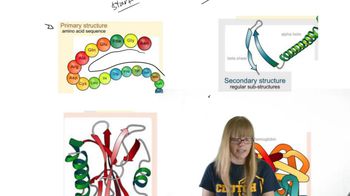
Proteins
Alternative Splicing
Alternative splicing is a process where different combinations of exons are joined from a single pre-mRNA transcript, producing multiple mRNA variants. This mechanism allows one gene to encode several distinct proteins, significantly increasing proteomic complexity beyond the gene count.
Recommended video:
Guided course
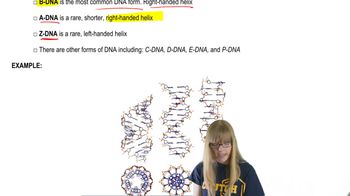
Alternative DNA Forms
Post-Translational Modifications
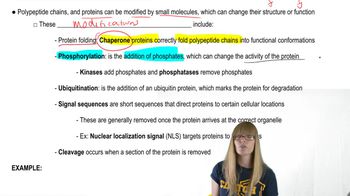
After translation, proteins can undergo chemical modifications such as phosphorylation, glycosylation, or ubiquitination. These post-translational modifications alter protein function and structure, further expanding the diversity of proteins derived from the genome.
Recommended video:
Guided course
Post Translational Modifications
Related Videos
Related Practice
Textbook Question
449
views
