
Why are frameshift mutations likely to be more detrimental than point mutations, in which a single pyrimidine or purine has been substituted?
Table of contents
- 1. Introduction to Genetics51m
- 2. Mendel's Laws of Inheritance3h 37m
- 3. Extensions to Mendelian Inheritance2h 41m
- 4. Genetic Mapping and Linkage2h 28m
- 5. Genetics of Bacteria and Viruses1h 21m
- 6. Chromosomal Variation1h 48m
- 7. DNA and Chromosome Structure56m
- 8. DNA Replication1h 10m
- 9. Mitosis and Meiosis1h 34m
- 10. Transcription1h 0m
- 11. Translation58m
- 12. Gene Regulation in Prokaryotes1h 19m
- 13. Gene Regulation in Eukaryotes44m
- 14. Genetic Control of Development44m
- 15. Genomes and Genomics1h 50m
- 16. Transposable Elements47m
- 17. Mutation, Repair, and Recombination1h 6m
- 18. Molecular Genetic Tools19m
- 19. Cancer Genetics29m
- 20. Quantitative Genetics1h 26m
- 21. Population Genetics50m
- 22. Evolutionary Genetics29m
17. Mutation, Repair, and Recombination
Types of Mutations
Problem 12
Textbook Question
Why are X rays more potent mutagens than UV radiation?
Verified step by step guidance1
Understand the nature of X rays and UV radiation in terms of their energy and wavelength. X rays have shorter wavelengths and higher energy compared to UV radiation.
Recognize that the higher energy of X rays allows them to penetrate deeper into biological tissues and cause more direct damage to DNA molecules.
Learn that X rays can cause ionization, which means they can remove tightly bound electrons from atoms, leading to breaks in the DNA strands (both single and double-strand breaks).
Contrast this with UV radiation, which primarily causes damage by inducing the formation of thymine dimers—covalent linkages between adjacent thymine bases—leading to distortions in the DNA structure but generally not causing strand breaks.
Conclude that because X rays cause more severe types of DNA damage (strand breaks and ionization) compared to the more localized damage caused by UV radiation, they are considered more potent mutagens.
Verified video answer for a similar problem:This video solution was recommended by our tutors as helpful for the problem above
Video duration:
2mPlay a video:
Was this helpful?
Key Concepts
Here are the essential concepts you must grasp in order to answer the question correctly.
Types of Radiation and Their Energy Levels
X-rays are a form of ionizing radiation with higher energy than ultraviolet (UV) radiation. This higher energy allows X-rays to penetrate cells and tissues more deeply, causing more severe damage to DNA molecules compared to UV radiation.
Recommended video:
Guided course
Types of Maternal Inheritance
Mechanisms of DNA Damage by Radiation
X-rays cause direct breaks in the DNA strands, including single- and double-strand breaks, which are difficult for the cell to repair. In contrast, UV radiation primarily induces thymine dimers, which distort the DNA but are generally easier for cellular repair mechanisms to fix.
Recommended video:
Guided course
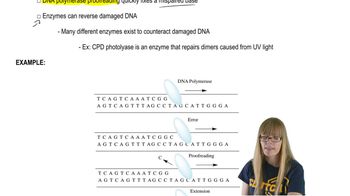
DNA Proofreading
Mutagenic Potency and Cellular Repair
The mutagenic potency of radiation depends on the extent and type of DNA damage and the efficiency of cellular repair systems. Because X-rays cause more complex and severe DNA damage, they have a higher chance of causing mutations that persist, making them more potent mutagens than UV radiation.
Recommended video:
Guided course
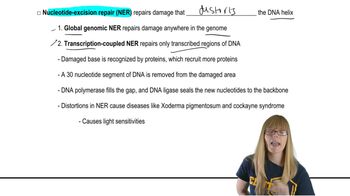
Repair Pathways
Related Videos
Related Practice
Textbook Question
700
views
