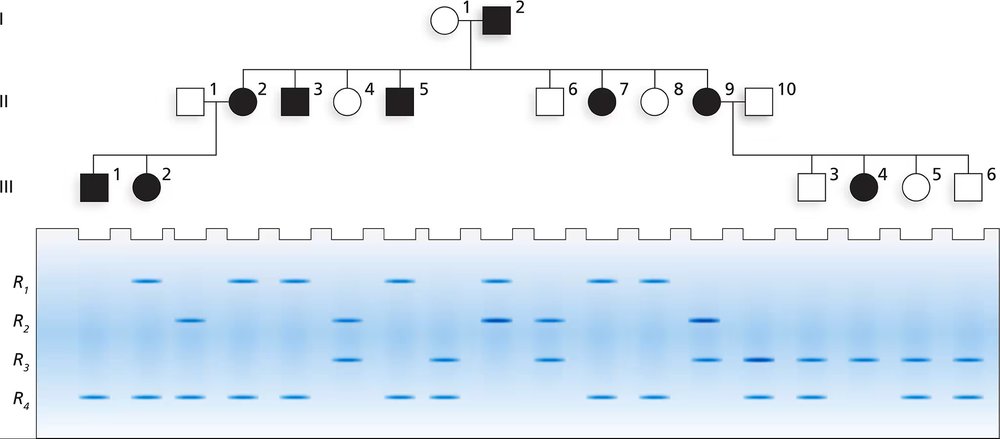
Based on previous family studies, an autosomal recessive disease with alleles A and a is suspected to be linked to an RFLP marker. The RFLP marker has four alleles, R₁, R₂, R₃, and R₄. The accompanying pedigree shows a three-generation family in which the disease is present. The gel shows the RFLP alleles for each family member directly below the pedigree symbol for that person. After determining the genotypes for the RFLP and disease gene for each family member, answer the following questions. Is there any evidence of recombination in this pedigree? If so, identify the recombinant individuals and illustrate the recombination that has occurred.
Verified step by step guidance
1
Step 1: Understand the problem. The question involves determining whether recombination has occurred between an autosomal recessive disease gene (A/a) and an RFLP marker with four alleles (R₁, R₂, R₃, R₄). Recombination refers to the exchange of genetic material between homologous chromosomes during meiosis, which can result in new allele combinations.
Step 2: Analyze the pedigree and gel electrophoresis data. Begin by identifying the genotypes for the disease gene (A/a) and the RFLP marker (R₁, R₂, R₃, R₄) for each individual in the pedigree. Use the gel bands to determine the RFLP alleles and the inheritance pattern of the disease gene to deduce the A/a genotypes.
Step 3: Determine the parental haplotypes. For each parent, identify the combination of disease gene allele (A or a) and RFLP marker allele (R₁, R₂, R₃, or R₄) that they pass to their offspring. This will help establish the original linkage phase (non-recombinant haplotypes).
Step 4: Compare offspring genotypes to parental haplotypes. For each child in the pedigree, check whether their combination of disease gene allele and RFLP marker allele matches one of the parental haplotypes. If it does not match, this indicates a recombination event.
Step 5: Identify recombinant individuals and illustrate recombination. List the individuals whose genotypes show evidence of recombination. For each recombinant individual, describe the specific recombination event (e.g., which alleles were exchanged) and illustrate it using a diagram or written explanation of the crossover event between homologous chromosomes.
Verified video answer for a similar problem:
This video solution was recommended by our tutors as helpful for the problem above
Video duration:
3m
Play a video:
Was this helpful?
Key Concepts
Here are the essential concepts you must grasp in order to answer the question correctly.
Autosomal Recessive Inheritance
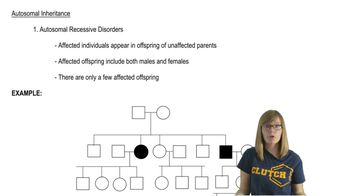
Autosomal recessive inheritance refers to a pattern where two copies of a mutated gene (one from each parent) are necessary for an individual to express a trait or disease. In this case, alleles A (normal) and a (mutated) determine the presence of the disease. Individuals with genotype aa will exhibit the disease, while those with AA or Aa will be unaffected. Understanding this inheritance pattern is crucial for analyzing the pedigree and determining which individuals may carry the disease allele.
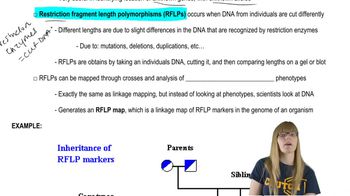
RFLP is a molecular technique used to analyze the variations in DNA sequences by digesting DNA with specific restriction enzymes, resulting in fragments of different lengths. These variations can serve as genetic markers, helping to track inheritance patterns in families. In this scenario, the RFLP marker with alleles R₁, R₂, R₃, and R₄ is used to identify potential linkage to the autosomal recessive disease, providing insight into the genetic relationships among family members.
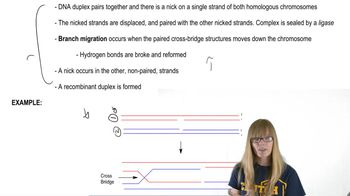
Recombination is the process by which genetic material is exchanged between homologous chromosomes during meiosis, leading to new allele combinations in offspring. This can result in recombinant individuals who possess a mix of alleles from both parents. In the context of the pedigree and RFLP analysis, identifying recombinant individuals involves comparing the alleles present in offspring with those of their parents to determine if any new combinations have arisen, indicating that recombination has occurred.