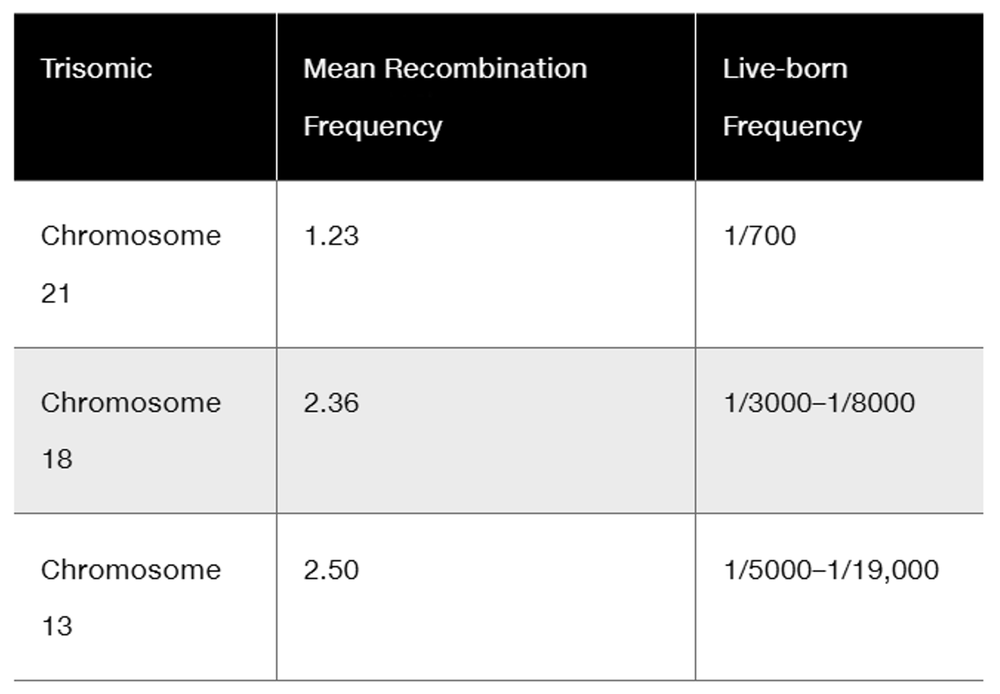
Because of the relatively high frequency of meiotic errors that lead to developmental abnormalities in humans, many research efforts have focused on identifying correlations between error frequency and chromosome morphology and behavior. Tease et al. (2002) studied human fetal oocytes of chromosomes 21, 18, and 13 using an immunocytological approach that allowed a direct estimate of the frequency and position of meiotic recombination. Below is a summary of information that compares recombination frequency with the frequency of trisomy for chromosomes 21, 18, and 13. What conclusions can be drawn from these data in terms of recombination and nondisjunction frequencies? How might recombination frequencies influence trisomic frequencies?
Verified step by step guidance
1
Understand the relationship between recombination and nondisjunction: Recombination during meiosis is a critical process that ensures proper segregation of homologous chromosomes. Errors in recombination can lead to nondisjunction, where chromosomes fail to separate properly, resulting in trisomy (an extra chromosome).
Analyze the data provided: The table shows the mean recombination frequency for chromosomes 21, 18, and 13, along with the frequency of live-born trisomic individuals. Chromosome 21 has the lowest recombination frequency (1.23) and the highest live-born trisomy frequency (1/700), while chromosomes 18 and 13 have higher recombination frequencies (2.36 and 2.50, respectively) and lower live-born trisomy frequencies.
Draw a correlation: The data suggests an inverse relationship between recombination frequency and trisomy frequency. Lower recombination frequency appears to be associated with a higher likelihood of nondisjunction, leading to trisomy. This could be because fewer recombination events may result in improper chromosome segregation during meiosis.
Consider the biological implications: Chromosome 21's lower recombination frequency may make it more prone to nondisjunction, explaining the higher frequency of live-born individuals with trisomy 21 (Down syndrome). In contrast, chromosomes 18 and 13, with higher recombination frequencies, show lower live-born trisomy frequencies, possibly due to better segregation or higher lethality of these trisomies during development.
Conclude the influence of recombination on trisomy: Recombination frequency plays a significant role in determining the likelihood of nondisjunction. Lower recombination rates increase the risk of improper chromosome segregation, leading to higher trisomy frequencies. This highlights the importance of recombination in maintaining chromosomal stability during meiosis.
Verified video answer for a similar problem:
This video solution was recommended by our tutors as helpful for the problem above
Video duration:
2m
Play a video:
Was this helpful?
Key Concepts
Here are the essential concepts you must grasp in order to answer the question correctly.
Meiotic Recombination
Meiotic recombination is a process during meiosis where homologous chromosomes exchange genetic material, leading to genetic diversity in gametes. The frequency of recombination can vary between different chromosomes and is influenced by factors such as chromosome structure and the presence of recombination hotspots. Understanding this process is crucial for analyzing how variations in recombination rates may correlate with the occurrence of chromosomal abnormalities like trisomy.
Nondisjunction is the failure of homologous chromosomes or sister chromatids to separate properly during cell division, which can occur in meiosis I or II. This error can lead to aneuploidy, where cells have an abnormal number of chromosomes, such as in trisomy conditions. Recognizing the relationship between nondisjunction events and recombination frequencies is essential for understanding the mechanisms behind chromosomal abnormalities in humans.
Trisomy is a genetic condition where an individual has three copies of a particular chromosome instead of the usual two. This can result from nondisjunction during meiosis and is associated with various developmental and health issues, depending on the chromosome involved. The data presented in the question highlights the correlation between recombination frequency and the incidence of trisomy, suggesting that lower recombination rates may be linked to higher rates of nondisjunction and subsequent trisomic conditions.