How was it established that particular phenotypes are inherited as a result of genetic information present in the chloroplast rather than in the nucleus?
Table of contents
- 1. Introduction to Genetics51m
- 2. Mendel's Laws of Inheritance3h 37m
- 3. Extensions to Mendelian Inheritance2h 41m
- 4. Genetic Mapping and Linkage2h 28m
- 5. Genetics of Bacteria and Viruses1h 21m
- 6. Chromosomal Variation1h 48m
- 7. DNA and Chromosome Structure56m
- 8. DNA Replication1h 10m
- 9. Mitosis and Meiosis1h 34m
- 10. Transcription1h 0m
- 11. Translation58m
- 12. Gene Regulation in Prokaryotes1h 19m
- 13. Gene Regulation in Eukaryotes44m
- 14. Genetic Control of Development44m
- 15. Genomes and Genomics1h 50m
- 16. Transposable Elements47m
- 17. Mutation, Repair, and Recombination1h 6m
- 18. Molecular Genetic Tools19m
- 19. Cancer Genetics29m
- 20. Quantitative Genetics1h 26m
- 21. Population Genetics50m
- 22. Evolutionary Genetics29m
6. Chromosomal Variation
Chromosomal Mutations: Aneuploidy
Problem 5
Textbook Question
What evidence suggests that Down syndrome is more often the result of nondisjunction during oogenesis rather than during spermatogenesis?
Verified step by step guidance1
Understand that Down syndrome is most commonly caused by trisomy 21, which results from nondisjunction, an error in chromosome separation during meiosis.
Recognize that oogenesis (egg formation) and spermatogenesis (sperm formation) are the two processes where nondisjunction can occur, leading to an abnormal number of chromosomes in the gametes.
Review cytogenetic studies and parental origin analyses of the extra chromosome 21 in individuals with Down syndrome, which often use molecular markers to determine whether the extra chromosome came from the mother or the father.
Note that a majority of these studies show the extra chromosome 21 is maternally derived, indicating nondisjunction occurred during oogenesis rather than spermatogenesis.
Consider biological factors such as the prolonged arrest of oocytes in meiosis I, which increases the chance of nondisjunction during egg formation, providing a mechanistic explanation for the maternal origin bias.
Verified video answer for a similar problem:This video solution was recommended by our tutors as helpful for the problem above
Video duration:
1mPlay a video:
Was this helpful?
Key Concepts
Here are the essential concepts you must grasp in order to answer the question correctly.
Nondisjunction
Nondisjunction is the failure of chromosome pairs to separate properly during cell division, leading to gametes with abnormal chromosome numbers. In the context of Down syndrome, nondisjunction results in an extra copy of chromosome 21, causing trisomy 21.
Recommended video:
Guided course
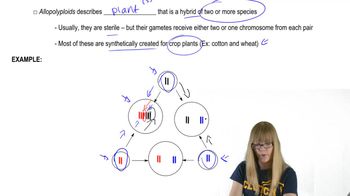
Allopolyploidy
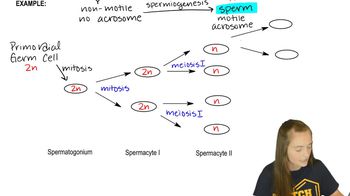
Oogenesis vs. Spermatogenesis
Oogenesis is the process of egg formation in females, characterized by long arrest phases and fewer cell divisions, while spermatogenesis is sperm formation in males, involving continuous and rapid cell divisions. These differences influence the likelihood of nondisjunction events.
Recommended video:
Guided course
Gamete Development
Parental Origin of Trisomy 21
Studies using genetic markers show that most cases of trisomy 21 originate from errors in the maternal egg rather than the paternal sperm. This evidence includes higher rates of nondisjunction during oogenesis, especially with increasing maternal age.
Recommended video:
Guided course
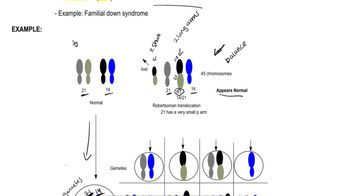
Robertsonian Translocations
Related Videos
Related Practice
Textbook Question
398
views