Two populations of deer, one of them large and living in a mainland forest and the other small and inhabiting a forest on an island, regularly exchange members that migrate across a land bridge that connects the island to the mainland. An earthquake destroys the bridge between the island and the mainland, making migration impossible for the deer. What do you expect will happen to allele frequencies in the two populations over the following 10 generations?
Table of contents
- 1. Introduction to Genetics51m
- 2. Mendel's Laws of Inheritance3h 37m
- 3. Extensions to Mendelian Inheritance2h 41m
- 4. Genetic Mapping and Linkage2h 28m
- 5. Genetics of Bacteria and Viruses1h 21m
- 6. Chromosomal Variation1h 48m
- 7. DNA and Chromosome Structure56m
- 8. DNA Replication1h 10m
- 9. Mitosis and Meiosis1h 34m
- 10. Transcription1h 0m
- 11. Translation58m
- 12. Gene Regulation in Prokaryotes1h 19m
- 13. Gene Regulation in Eukaryotes44m
- 14. Genetic Control of Development44m
- 15. Genomes and Genomics1h 50m
- 16. Transposable Elements47m
- 17. Mutation, Repair, and Recombination1h 6m
- 18. Molecular Genetic Tools19m
- 19. Cancer Genetics29m
- 20. Quantitative Genetics1h 26m
- 21. Population Genetics50m
- 22. Evolutionary Genetics29m
21. Population Genetics
Allelic Frequency Changes
Problem 14
Textbook Question
One of the first Mendelian traits identified in humans was a dominant condition known as brachydactyly. This gene causes an abnormal shortening of the fingers or toes (or both). At the time, some researchers thought that the dominant trait would spread until 75 percent of the population would be affected (because the phenotypic ratio of dominant to recessive is 3 : 1). Show that the reasoning was incorrect.
Verified step by step guidance1
Understand that the 3:1 phenotypic ratio (dominant : recessive) applies to the offspring of heterozygous parents in a controlled Mendelian cross, not directly to the overall population frequency.
Define the frequency of the dominant allele as \(p\) and the recessive allele as \(q\), where \(p + q = 1\) in the population under Hardy-Weinberg equilibrium.
Recall that the frequency of individuals showing the dominant phenotype is given by \(p^2 + 2pq\), since both homozygous dominant (\(p^2\)) and heterozygous (\$2pq$) genotypes express the dominant trait.
Note that the frequency of the recessive phenotype is \(q^2\), representing homozygous recessive individuals.
Use the relationship \(p + q = 1\) and the expression for dominant phenotype frequency \(p^2 + 2pq = 1 - q^2\) to show that the maximum proportion of affected individuals cannot simply be 75%, because this depends on allele frequencies in the population, not just Mendelian ratios from a single cross.
Verified video answer for a similar problem:This video solution was recommended by our tutors as helpful for the problem above
Video duration:
2mPlay a video:
Was this helpful?
Key Concepts
Here are the essential concepts you must grasp in order to answer the question correctly.
Mendelian Inheritance and Phenotypic Ratios
Mendelian inheritance describes how traits are passed from parents to offspring through dominant and recessive alleles. A 3:1 phenotypic ratio typically appears in a monohybrid cross of heterozygotes, meaning 75% of offspring show the dominant trait in that specific generation, not the entire population over time.
Recommended video:
Guided course
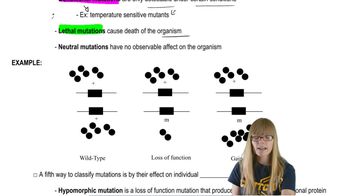
Mutations and Phenotypes
Allele Frequency vs. Phenotypic Ratio
Phenotypic ratios describe the proportion of traits in offspring from specific crosses, while allele frequencies represent how common an allele is in a population. The 3:1 ratio applies to offspring genotypes, not to the overall population frequency, which is influenced by factors like mating patterns and selection.
Recommended video:
Guided course
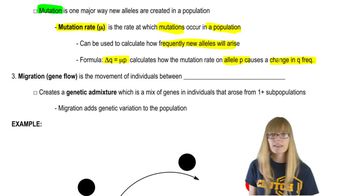
New Alleles and Migration
Population Genetics and Hardy-Weinberg Equilibrium
Population genetics studies allele frequencies in populations over time. Hardy-Weinberg equilibrium predicts stable allele frequencies without evolutionary forces. A dominant trait does not necessarily increase to 75% prevalence because allele frequencies depend on genotype proportions and fitness, not just dominance.
Recommended video:
Guided course
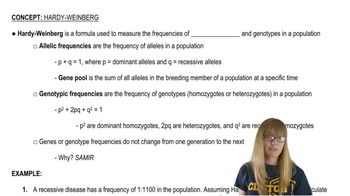
Hardy Weinberg
Related Videos
Related Practice
Textbook Question
442
views