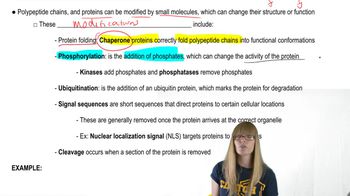
Which of the following posttranslational modifications is defined by the addition of phosphates to a protein?
Table of contents
- 1. Introduction to Genetics51m
- 2. Mendel's Laws of Inheritance3h 37m
- 3. Extensions to Mendelian Inheritance2h 41m
- 4. Genetic Mapping and Linkage2h 28m
- 5. Genetics of Bacteria and Viruses1h 21m
- 6. Chromosomal Variation1h 48m
- 7. DNA and Chromosome Structure56m
- 8. DNA Replication1h 10m
- 9. Mitosis and Meiosis1h 34m
- 10. Transcription1h 0m
- 11. Translation58m
- 12. Gene Regulation in Prokaryotes1h 19m
- 13. Gene Regulation in Eukaryotes44m
- 14. Genetic Control of Development44m
- 15. Genomes and Genomics1h 50m
- 16. Transposable Elements47m
- 17. Mutation, Repair, and Recombination1h 6m
- 18. Molecular Genetic Tools19m
- 19. Cancer Genetics29m
- 20. Quantitative Genetics1h 26m
- 21. Population Genetics50m
- 22. Evolutionary Genetics29m
13. Gene Regulation in Eukaryotes
Post Translational Modifications
Problem 28
Textbook Question
List three different types of posttranslational modifications that may happen to a protein and the significance of each in the context of protein function.
Verified step by step guidance1
Identify what posttranslational modifications (PTMs) are: chemical changes that occur to a protein after it has been synthesized (translated) from mRNA, which can alter the protein's function, localization, stability, or interactions.
List the first type of PTM, such as phosphorylation, and explain that it involves the addition of a phosphate group (PO₄³⁻) typically to serine, threonine, or tyrosine residues, which can regulate protein activity, signaling pathways, and interactions.
List the second type of PTM, such as glycosylation, which is the attachment of carbohydrate groups to specific amino acids, important for protein folding, stability, and cell-cell recognition.
List the third type of PTM, such as ubiquitination, where ubiquitin proteins are attached to lysine residues, marking the protein for degradation by the proteasome or altering its cellular location or activity.
For each PTM, emphasize its significance in modulating protein function dynamically, allowing cells to respond to environmental signals and maintain homeostasis.
Verified video answer for a similar problem:This video solution was recommended by our tutors as helpful for the problem above
Video duration:
57sPlay a video:
Was this helpful?
Key Concepts
Here are the essential concepts you must grasp in order to answer the question correctly.
Posttranslational Modifications (PTMs)
PTMs are chemical changes made to a protein after its synthesis, altering its properties and functions. These modifications regulate protein activity, localization, stability, and interactions, enabling dynamic control of cellular processes.
Recommended video:
Guided course
Post Translational Modifications
Phosphorylation
Phosphorylation involves adding a phosphate group to amino acids like serine, threonine, or tyrosine. This modification often acts as an on/off switch for protein activity, playing a critical role in signaling pathways and cellular regulation.
Recommended video:
Guided course
Post Translational Modifications
Glycosylation
Glycosylation is the attachment of sugar molecules to proteins, influencing folding, stability, and cell-cell recognition. It is essential for protein trafficking and immune responses, especially in membrane and secreted proteins.
Watch next
Master Post Translational Modifications with a bite sized video explanation from Kylia
Start learningRelated Videos
Related Practice
Multiple Choice