In enhancer trapping experiments, a minimal promoter and a reporter gene are placed adjacent to the end of a transposon so that genomic enhancers adjacent to the insertion site can act to drive expression of the reporter gene. In a modification of this approach, a series of enhancers and a promoter can be placed at the end of a transposon so that transcription is activated from the transposon into adjacent genomic DNA. What types of mutations do you expect to be induced by such a transposon in a mutagenesis experiment?
Verified step by step guidance
1
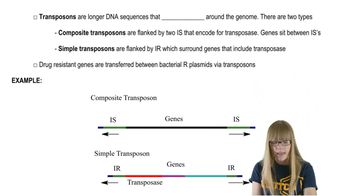
Understand the concept of enhancer trapping: Enhancer trapping is a genetic technique where a minimal promoter and a reporter gene are used to identify and study enhancers in the genome. The transposon carrying these elements integrates randomly into the genome, and nearby enhancers drive the expression of the reporter gene.
Analyze the modification described: In this modified approach, the transposon contains a series of enhancers and a promoter that can activate transcription into adjacent genomic DNA. This means that the transposon can potentially influence the expression of nearby genes by activating their transcription.
Consider the types of mutations that can occur: The insertion of the transposon can disrupt the coding sequence of a gene, leading to a loss-of-function mutation. This happens if the transposon integrates into an exon or other critical region of the gene.
Evaluate the effects of transcriptional activation: The enhancers and promoter in the transposon can cause ectopic (abnormal) expression of nearby genes. This can lead to gain-of-function mutations if the gene is expressed inappropriately in terms of timing, location, or level of expression.
Account for potential regulatory disruptions: The insertion of the transposon can also disrupt regulatory elements, such as silencers or insulators, leading to changes in the normal regulation of gene expression. This can result in either upregulation or downregulation of nearby genes.
Verified video answer for a similar problem:
This video solution was recommended by our tutors as helpful for the problem above
Video duration:
2m
Play a video:
Was this helpful?
Key Concepts
Here are the essential concepts you must grasp in order to answer the question correctly.
Transposons
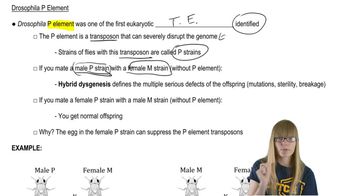
Transposons, or 'jumping genes,' are DNA sequences that can change their position within the genome. They can cause mutations by inserting themselves into or near genes, potentially disrupting normal gene function or regulatory elements. Understanding transposons is crucial for predicting the types of mutations they may induce during experiments, such as enhancer trapping.
Enhancers are regulatory DNA sequences that can increase the likelihood of transcription of specific genes. They can be located far from the genes they regulate and interact with promoters to enhance gene expression. In the context of the question, the placement of enhancers adjacent to a transposon can lead to increased expression of the reporter gene, which is essential for understanding the mutagenesis outcomes.
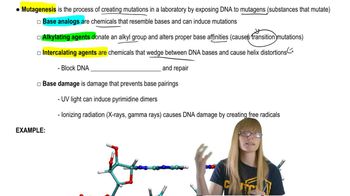
Mutagenesis refers to the process by which genetic information is changed, resulting in mutations. In the context of transposon experiments, mutagenesis can lead to various types of mutations, including insertions, deletions, or changes in gene expression. Recognizing the potential outcomes of mutagenesis is vital for predicting the effects of transposon insertions on adjacent genomic DNA.