In some organisms, cytosine is methylated at carbon 5 of the pyrimidine ring after it is incorporated into DNA. If a 5-methyl cytosine molecule is then hydrolyzed, what base will be generated?
Table of contents
- 1. Introduction to Genetics51m
- 2. Mendel's Laws of Inheritance3h 37m
- 3. Extensions to Mendelian Inheritance2h 41m
- 4. Genetic Mapping and Linkage2h 28m
- 5. Genetics of Bacteria and Viruses1h 21m
- 6. Chromosomal Variation1h 48m
- 7. DNA and Chromosome Structure56m
- 8. DNA Replication1h 10m
- 9. Mitosis and Meiosis1h 34m
- 10. Transcription1h 0m
- 11. Translation58m
- 12. Gene Regulation in Prokaryotes1h 19m
- 13. Gene Regulation in Eukaryotes44m
- 14. Genetic Control of Development44m
- 15. Genomes and Genomics1h 50m
- 16. Transposable Elements47m
- 17. Mutation, Repair, and Recombination1h 6m
- 18. Molecular Genetic Tools19m
- 19. Cancer Genetics29m
- 20. Quantitative Genetics1h 26m
- 21. Population Genetics50m
- 22. Evolutionary Genetics29m
7. DNA and Chromosome Structure
DNA Structure
Problem 31d
Textbook Question
A primitive eukaryote was discovered that displayed a unique nucleic acid as its genetic material. Analysis provided the following information:
About 75 percent of the sugars are deoxyribose, while 25 percent are ribose.
Postulate a model for the structure of this molecule that is consistent with the foregoing observations.
Verified step by step guidance1
Step 1: Understand the composition of the nucleic acid based on the sugar content. Since 75% of the sugars are deoxyribose and 25% are ribose, the molecule likely contains both DNA and RNA components or a hybrid structure.
Step 2: Recall the structural differences between DNA and RNA. DNA contains deoxyribose sugars and typically forms a double helix, while RNA contains ribose sugars and is usually single-stranded but can form complex secondary structures.
Step 3: Consider possible models that incorporate both sugar types. One possibility is a nucleic acid polymer where some nucleotides have deoxyribose and others have ribose, either randomly interspersed or organized in distinct regions.
Step 4: Think about how the presence of both sugars might affect the overall structure and stability. The molecule might have regions resembling DNA double helices interspersed with RNA-like single-stranded or looped regions, potentially allowing unique folding or function.
Step 5: Formulate a structural model hypothesis that explains the mixed sugar composition, such as a chimeric nucleic acid with alternating or block segments of DNA and RNA, or a hybrid strand with modified backbone chemistry that incorporates both sugar types.
Verified video answer for a similar problem:This video solution was recommended by our tutors as helpful for the problem above
Video duration:
1mPlay a video:
Was this helpful?
Key Concepts
Here are the essential concepts you must grasp in order to answer the question correctly.
Nucleic Acid Structure and Sugar Components
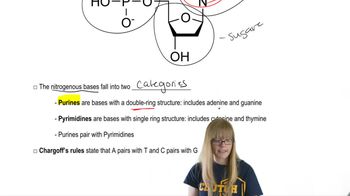
Nucleic acids are polymers made of nucleotides, each containing a sugar, a phosphate group, and a nitrogenous base. DNA contains deoxyribose sugars, while RNA contains ribose sugars. The sugar type influences the nucleic acid’s stability and structure, with deoxyribose lacking an oxygen atom present in ribose.
Recommended video:
Guided course
DNA Structure
Hybrid Nucleic Acid Molecules
A nucleic acid containing both deoxyribose and ribose sugars suggests a hybrid or chimeric molecule. This could imply a novel structure combining features of DNA and RNA, possibly with segments or alternating nucleotides containing different sugars, affecting its chemical properties and biological function.
Recommended video:
Guided course
Ribosome Structure
Molecular Modeling Based on Chemical Composition
Constructing a model for an unusual nucleic acid requires integrating chemical composition data with known molecular structures. The 75% deoxyribose and 25% ribose ratio suggests a predominant DNA-like backbone with RNA-like insertions, guiding hypotheses about strand arrangement, sugar-phosphate backbone continuity, and base pairing.
Recommended video:
Guided course
Point Mutations
Related Videos
Related Practice
Textbook Question
621
views