Newsdate: March 1, 2030. A unique creature has been discovered during exploration of outer space. Recently, its genetic material has been isolated and analyzed. This material is similar in some ways to DNA in its chemical makeup. It contains in abundance the 4-carbon sugar erythrose and a molar equivalent of phosphate groups. In addition, it contains six nitrogenous bases: adenine (A), guanine (G), thymine (T), cytosine (C), hypoxanthine (H), and xanthine (X). These bases exist in the following relative proportions: A =T = H and C = G = X X-ray diffraction studies have established a regularity in the molecule and a constant diameter of about 30 Å. Together, these data have suggested a model for the structure of this molecule. Given the constant diameter of 30 Å, do you think that either (i) both H and X are purines or both pyrimidines, or (ii) one is a purine and one is a pyrimidine?
Verified step by step guidance
1
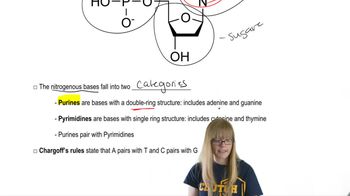
Step 1: Recall the structural difference between purines and pyrimidines. Purines have a two-ring structure and are larger, while pyrimidines have a single-ring structure and are smaller. This size difference affects the diameter of a double-stranded nucleic acid molecule.
Step 2: Understand that in DNA, the constant diameter (~20 Å) is maintained because purines always pair with pyrimidines, ensuring a uniform width. If purines paired with purines or pyrimidines paired with pyrimidines, the diameter would vary due to size differences.
Step 3: Note that the molecule in question has a constant diameter of about 30 Å, which is larger than typical DNA but still constant, suggesting a regular pairing pattern that maintains uniform width.
Step 4: Given the bases A, G, H, and X, and the equal proportions A = T = H and C = G = X, consider the pairing possibilities. Since A and G are purines and T and C are pyrimidines, analyze whether H and X fit better as purines or pyrimidines to maintain a constant diameter.
Step 5: Conclude that to maintain a constant diameter, one of the bases (H or X) should be a purine and the other a pyrimidine, because pairing a purine with a pyrimidine keeps the width uniform, consistent with the observed constant diameter of 30 Å.
Verified video answer for a similar problem:
This video solution was recommended by our tutors as helpful for the problem above
Video duration:
58s
Play a video:
Was this helpful?
Key Concepts
Here are the essential concepts you must grasp in order to answer the question correctly.
Purines and Pyrimidines Structure
Purines and pyrimidines are the two categories of nitrogenous bases in nucleic acids. Purines (adenine and guanine) have a double-ring structure, while pyrimidines (cytosine, thymine, and uracil) have a single-ring structure. The size difference affects the overall diameter of the nucleic acid helix, as purine-purine pairs are too wide and pyrimidine-pyrimidine pairs are too narrow to maintain a consistent helix diameter.
Base pairing in nucleic acids follows specific rules where purines pair with pyrimidines to maintain a uniform helix diameter. For example, adenine pairs with thymine, and guanine pairs with cytosine. This complementary pairing ensures consistent spacing between strands, which is critical for the stability and regularity of the double helix structure.
X-ray diffraction is a technique used to determine the three-dimensional structure of molecules like DNA. The constant diameter observed (about 20 Å in DNA, 30 Å here) indicates a regular, repeating structure. A uniform diameter suggests that base pairs consist of one purine and one pyrimidine, as purine-purine or pyrimidine-pyrimidine pairs would disrupt this uniformity.