Newsdate: March 1, 2030. A unique creature has been discovered during exploration of outer space. Recently, its genetic material has been isolated and analyzed. This material is similar in some ways to DNA in its chemical makeup. It contains in abundance the 4-carbon sugar erythrose and a molar equivalent of phosphate groups. In addition, it contains six nitrogenous bases: adenine (A), guanine (G), thymine (T), cytosine (C), hypoxanthine (H), and xanthine (X). These bases exist in the following relative proportions: A =T = H and C = G = X X-ray diffraction studies have established a regularity in the molecule and a constant diameter of about 30 Å. Together, these data have suggested a model for the structure of this molecule. What base-pairing properties must exist for H and for X in the model?
Verified step by step guidance
1
Step 1: Understand the given base proportions and their equivalences. The problem states that A = T = H and C = G = X in relative amounts, suggesting that these bases form pairs with equal molar ratios, similar to Chargaff's rules in DNA.
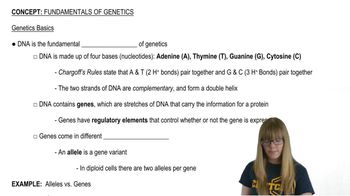
Step 2: Recall the base-pairing rules in DNA: adenine (A) pairs with thymine (T) via two hydrogen bonds, and cytosine (C) pairs with guanine (G) via three hydrogen bonds. These pairs maintain a constant diameter of the double helix.
Step 3: Since the molecule has a constant diameter (~30 Å) and the sugar-phosphate backbone is similar to DNA, the new bases hypoxanthine (H) and xanthine (X) must pair in a way that preserves this diameter and the regularity of the structure.
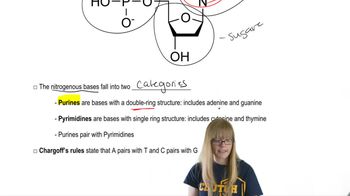
Step 4: Given the equivalences A = T = H and C = G = X, hypothesize that hypoxanthine (H) pairs with adenine (A) or thymine (T) analogously, and xanthine (X) pairs with cytosine (C) or guanine (G) analogously, maintaining complementary pairing and hydrogen bonding patterns.
Step 5: Conclude that the base-pairing properties of H and X must allow them to form stable hydrogen bonds with their complementary bases, preserving the molecular geometry and constant diameter, similar to how A-T and C-G pairs function in DNA.
Verified video answer for a similar problem:
This video solution was recommended by our tutors as helpful for the problem above
Video duration:
1m
Play a video:
Was this helpful?
Key Concepts
Here are the essential concepts you must grasp in order to answer the question correctly.
Base Pairing Rules in Nucleic Acids
Base pairing involves specific hydrogen bonding between nitrogenous bases, ensuring complementary pairing and stable double-stranded structures. In DNA, adenine pairs with thymine, and guanine pairs with cytosine, maintaining consistent molecular dimensions. Understanding these rules helps predict how novel bases like hypoxanthine (H) and xanthine (X) might pair to preserve structural regularity.
Chemical Structure and Properties of Nitrogenous Bases
Nitrogenous bases differ in ring structure and functional groups, influencing their hydrogen bonding capabilities. Hypoxanthine and xanthine are modified purines with keto and amino groups that affect their pairing potential. Analyzing their chemical groups helps determine possible complementary partners and the nature of hydrogen bonds they can form.
Molecular Geometry and Structural Constraints of Nucleic Acids
The uniform diameter (~30 Å) and regularity observed via X-ray diffraction imply strict spatial constraints on base pairing. Complementary bases must fit within this geometry to maintain the molecule’s stability. This concept guides the prediction of how new bases pair to preserve consistent width and helical structure.