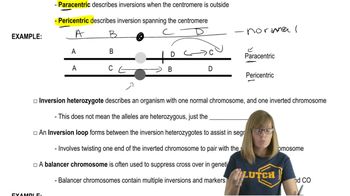
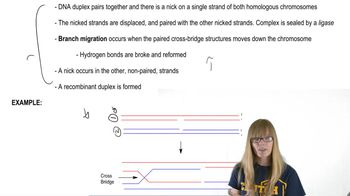
A normal chromosome and its homolog carrying a paracentric inversion are shown here. The dot (·) represents the centromere. Normal ABC • DEFGHIJK Inversion abc • djihgfe Assume a crossover takes place in the region between F and G. Identify the gametes that are formed following this crossover, and indicate which, if any, gametes are viable.
Verified step by step guidance
1
Step 1: Understand the concept of a paracentric inversion. A paracentric inversion occurs when a segment of a chromosome is reversed, but the inversion does not include the centromere. In this problem, the inversion affects the region from D to J.
Step 2: Recognize the consequences of crossing over in the inverted region. When a crossover occurs between F and G in the inverted region, it can lead to the formation of a dicentric chromosome (with two centromeres) and an acentric fragment (without a centromere). These structures are typically non-viable.
Step 3: Analyze the gametes formed. After the crossover, the resulting chromatids will include: (1) a normal chromatid, (2) an inverted chromatid, (3) a dicentric chromatid, and (4) an acentric fragment. The dicentric and acentric products are usually lost during cell division due to their structural instability.
Step 4: Determine the viability of the gametes. The normal and inverted chromatids are viable because they retain a single centromere and complete genetic information. The dicentric and acentric products are non-viable due to their inability to segregate properly during meiosis.
Step 5: Summarize the outcome. The viable gametes are those carrying either the normal chromosome or the inverted chromosome. The gametes containing the dicentric chromosome or acentric fragment are non-viable.
Verified video answer for a similar problem:
This video solution was recommended by our tutors as helpful for the problem above
Video duration:
4m
Play a video:
Was this helpful?
Key Concepts
Here are the essential concepts you must grasp in order to answer the question correctly.
Chromosomal Inversion
A chromosomal inversion occurs when a segment of a chromosome is reversed end to end. In the case of a paracentric inversion, the inverted segment does not include the centromere. This structural alteration can affect gene expression and recombination during meiosis, particularly when crossovers occur within the inverted region.
Crossover is a genetic process during meiosis where homologous chromosomes exchange segments of genetic material. This event increases genetic diversity in gametes. However, in the presence of inversions, crossovers can lead to the formation of nonviable gametes due to the production of unbalanced chromosomal arrangements, which can result in lethal combinations.
Viable gametes are those that can successfully participate in fertilization and develop into a viable organism. In the context of inversions and crossovers, certain gametes may carry duplications or deletions of genetic material, rendering them nonviable. Identifying which gametes are viable requires analyzing the resulting chromosomal arrangements post-crossover.