Ch. 12 - Regulation of Gene Expression in Bacteria and Bacteriophage
Sanders - Genetic Analysis: An Integrated Approach 3rd Edition
Sanders3rd EditionGenetic Analysis: An Integrated ApproachISBN: 9780135564172Not the one you use?Change textbook
Chapter 12, Problem 33

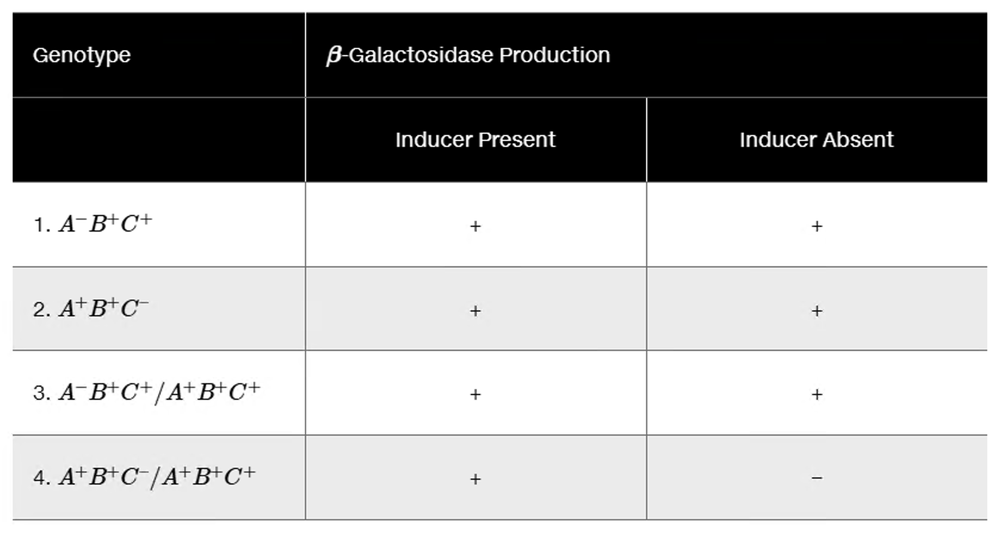
The following hypothetical genotypes have genes A, B, and C corresponding to lacI, lacO, and lacZ, but not necessarily in that order. Data in the table indicate whether β-galactosidase is produced in the presence and absence of the inducer for each genotype. Use these data to identify the correspondence between A, B, and C and the lacI, lacO, and lacZ genes. Carefully explain your reasoning for identifying each gene.
Table displaying genotypes and β-galactosidase production with inducer presence and absence.

Verified step by step guidance
1
Step 1: Understand the lac operon system. The lac operon in E. coli consists of three main components: lacI (the repressor gene), lacO (the operator region), and lacZ (the structural gene encoding β-galactosidase). The lacI gene produces a repressor protein that binds to the operator (lacO) to inhibit transcription. The presence of an inducer (e.g., lactose or IPTG) prevents the repressor from binding, allowing transcription of lacZ and production of β-galactosidase.
Step 2: Analyze the data for genotype 1 (A⁻B⁺C⁺). The β-galactosidase is produced both in the presence and absence of the inducer. This suggests that the repressor gene (lacI) is nonfunctional (A⁻), leading to constitutive expression of β-galactosidase regardless of the inducer's presence. Thus, A corresponds to lacI.
Step 3: Analyze the data for genotype 2 (A⁺B⁺C⁻). The β-galactosidase is not produced in either condition. This indicates that the structural gene (lacZ) is nonfunctional (C⁻), as the enzyme cannot be produced even when the operon is induced. Thus, C corresponds to lacZ.
Step 4: Analyze the data for genotype 3 (A⁻B⁺C⁺/A⁺B⁺C⁺). The β-galactosidase is produced in both conditions. This is consistent with the presence of a functional lacZ gene (C⁺) and a nonfunctional lacI gene (A⁻) in one copy of the operon, leading to constitutive expression. This further supports the identification of A as lacI and C as lacZ.
Step 5: Analyze the data for genotype 4 (A⁺B⁺C/A⁺B⁺C⁺⁻). The β-galactosidase is produced only in the presence of the inducer. This indicates that the operator (lacO) is functional (B⁺), as it allows proper regulation of the operon. Thus, B corresponds to lacO. Summarizing, A = lacI, B = lacO, and C = lacZ.

Verified video answer for a similar problem:

This video solution was recommended by our tutors as helpful for the problem above.
Video duration:
2m
Was this helpful?

Key Concepts

Here are the essential concepts you must grasp in order to answer the question correctly.

Lac Operon

The lac operon is a set of genes in E. coli that are involved in the metabolism of lactose. It consists of three structural genes: lacZ, lacY, and lacA, which encode proteins necessary for lactose utilization. The operon is regulated by the lacI gene, which produces a repressor that inhibits transcription in the absence of lactose. Understanding the lac operon is crucial for analyzing how the presence or absence of an inducer affects β-galactosidase production.
Recommended video:
Guided course
04:27
Lac Operon Overview

Gene Function and Interaction

Each gene in the lac operon has a specific function: lacZ encodes β-galactosidase, which breaks down lactose; lacY encodes permease, facilitating lactose entry into the cell; and lacI encodes the repressor that controls the operon. The interaction between these genes determines whether β-galactosidase is produced, especially in response to the presence of an inducer like allolactose. Analyzing the genotypes in the question requires understanding these interactions to deduce which gene corresponds to A, B, and C.
Recommended video:
Guided course
07:56
Interacting Genes Overview

Inducer Effect

An inducer, such as allolactose, binds to the lac repressor, causing it to change shape and release from the operator region of the lac operon. This allows RNA polymerase to transcribe the structural genes, leading to the production of β-galactosidase. The presence or absence of the inducer in the experimental data is critical for determining the functionality of the genes represented by A, B, and C, as it directly influences whether β-galactosidase is produced.
Recommended video:
Guided course
03:38
Maternal Effect
Related Practice
Textbook Question

How could antisense RNA be used as an antibiotic? What types of genes would you target using this scheme?

529
views
Textbook Question

Northern blot analysis is performed on cellular mRNA isolated from E. coli. The probe used in the northern blot analysis hybridizes to a portion of the lacY sequence. Below is an example of the gel from northern blot analysis for a wild-type lac⁺ bacterial strain. In this gel, lane 1 is from bacteria grown in a medium containing only glucose (minimal medium). Lane 2 is from bacteria in a medium containing only lactose. Following the style of this diagram, draw the gel appearance for northern blots of the bacteria listed below. In each case, lane 1 is for mRNA isolated after growth in a glucose-containing (minimal) medium, and lane 2 is for mRNA isolated after growth in a lactose-only medium.

lac⁺ bacteria with the genotype I⁺ P⁺ OC Z⁺ Y⁺ 

803
views
Textbook Question

The function of tRNA synthetases is to attach amino acids to tRNAs. Suppose the tRNA synthetase responsible for attaching tryptophan to tRNA is mutated in a bacterial strain, with the result that the tRNA synthetase functions at about 15% of the efficiency of the wild-type tRNA synthetase. Would formation of the 3–4 stem-loop structure in mRNA be more frequent or less frequent in the mutant strain than in the wild-type strain? Why?

489
views
Textbook Question

Northern blot analysis is performed on cellular mRNA isolated from E. coli. The probe used in the northern blot analysis hybridizes to a portion of the lacY sequence. Below is an example of the gel from northern blot analysis for a wild-type lac⁺ bacterial strain. In this gel, lane 1 is from bacteria grown in a medium containing only glucose (minimal medium). Lane 2 is from bacteria in a medium containing only lactose. Following the style of this diagram, draw the gel appearance for northern blots of the bacteria listed below. In each case, lane 1 is for mRNA isolated after growth in a glucose-containing (minimal) medium, and lane 2 is for mRNA isolated after growth in a lactose-only medium.

lac⁻ bacteria with the genotype I⁺ P⁺ O⁺ Z⁻ Y⁺ 

568
views
Textbook Question

The function of tRNA synthetases is to attach amino acids to tRNAs. Suppose the tRNA synthetase responsible for attaching tryptophan to tRNA is mutated in a bacterial strain, with the result that the tRNA synthetase functions at about 15% of the efficiency of the wild-type tRNA synthetase.

How would this mutation affect attenuation of the tryptophan operon? Explain your answer.

468
views
Textbook Question

Northern blot analysis is performed on cellular mRNA isolated from E. coli. The probe used in the northern blot analysis hybridizes to a portion of the lacY sequence. Below is an example of the gel from northern blot analysis for a wild-type lac⁺ bacterial strain. In this gel, lane 1 is from bacteria grown in a medium containing only glucose (minimal medium). Lane 2 is from bacteria in a medium containing only lactose. Following the style of this diagram, draw the gel appearance for northern blots of the bacteria listed below. In each case, lane 1 is for mRNA isolated after growth in a glucose-containing (minimal) medium, and lane 2 is for mRNA isolated after growth in a lactose-only medium.

lac⁻ bacteria with the genotype I⁺ P⁻ OC Z⁺ Y⁺

522
views