Table of contents
- 1. Introduction to Genetics51m
- 2. Mendel's Laws of Inheritance3h 37m
- 3. Extensions to Mendelian Inheritance2h 41m
- 4. Genetic Mapping and Linkage2h 28m
- 5. Genetics of Bacteria and Viruses1h 21m
- 6. Chromosomal Variation1h 48m
- 7. DNA and Chromosome Structure56m
- 8. DNA Replication1h 10m
- 9. Mitosis and Meiosis1h 34m
- 10. Transcription1h 0m
- 11. Translation58m
- 12. Gene Regulation in Prokaryotes1h 19m
- 13. Gene Regulation in Eukaryotes44m
- 14. Genetic Control of Development44m
- 15. Genomes and Genomics1h 50m
- 16. Transposable Elements47m
- 17. Mutation, Repair, and Recombination1h 6m
- 18. Molecular Genetic Tools19m
- 19. Cancer Genetics29m
- 20. Quantitative Genetics1h 26m
- 21. Population Genetics50m
- 22. Evolutionary Genetics29m
20. Quantitative Genetics
Heritability
Problem 1e
Textbook Question
How do we know that monozygotic twins are not identical genotypically as adults?
Verified step by step guidance1
Understand that monozygotic twins originate from a single fertilized egg, so they start with identical genotypes at conception.
Recognize that as twins develop and age, various genetic and epigenetic changes can occur, such as mutations and DNA methylation, which can alter gene expression without changing the DNA sequence.
Consider that environmental factors and random cellular events can lead to differences in gene regulation and expression between the twins, contributing to phenotypic differences.
Learn about studies that compare the DNA sequences of adult monozygotic twins, which have found small genetic differences due to somatic mutations accumulated over time.
Conclude that these genetic and epigenetic changes explain why monozygotic twins are not completely identical genotypically as adults, despite originating from the same zygote.
Verified video answer for a similar problem:This video solution was recommended by our tutors as helpful for the problem above
Video duration:
1mPlay a video:
Was this helpful?
Key Concepts
Here are the essential concepts you must grasp in order to answer the question correctly.
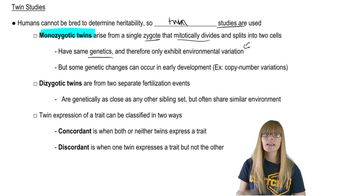
Monozygotic Twins and Genetic Identity
Monozygotic twins originate from a single fertilized egg that splits, resulting in two individuals with nearly identical DNA at conception. However, despite their initial genetic identity, differences can arise over time due to various biological processes.
Recommended video:
Guided course
Twin Studies
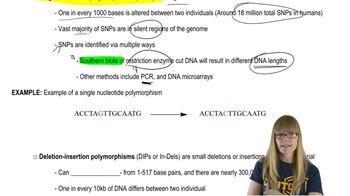
Somatic Mutations and Genetic Variation
As monozygotic twins develop and age, somatic mutations—random changes in DNA occurring in body cells—can accumulate differently in each twin. These mutations contribute to genetic differences that make their genomes not perfectly identical in adulthood.
Recommended video:
Guided course
Genomic Variation
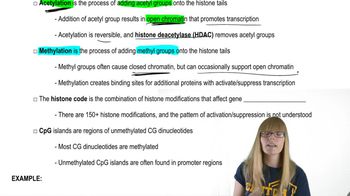
Epigenetic Modifications
Epigenetic changes, such as DNA methylation and histone modification, alter gene expression without changing the DNA sequence. Environmental factors and life experiences cause distinct epigenetic patterns in each twin, leading to phenotypic and functional differences despite similar genotypes.
Recommended video:
Guided course
Histone Protein Modifications
Watch next
Master Calculating Heritability with a bite sized video explanation from Kylia
Start learningRelated Videos
Related Practice
Multiple Choice
Which of the following calculations would you use to estimate the heritability (broad-sense, H^2) of metal tolerance in a population of sunstalks?
33
views