In the discussion, we focused on how DNA is organized at the chromosomal level. Along the way, we found many opportunities to consider the methods and reasoning by which much of this information was acquired. From the explanations given in the chapter, what answers would you propose to the following fundamental questions: How did we learn that eukaryotic chromatin exists in the form of repeating nucleosomes, each consisting of about 200 base pairs and an octamer of histones?
Verified step by step guidance
1
Start by understanding the historical context: early experiments used biochemical methods to isolate chromatin and analyze its components, revealing DNA and histone proteins as major constituents.
Examine how electron microscopy provided visual evidence of chromatin structure, showing a 'beads-on-a-string' appearance, which suggested repeating units along the DNA.
Consider the role of micrococcal nuclease digestion experiments, which selectively cut DNA between nucleosomes, resulting in DNA fragments of approximately 200 base pairs, indicating the length of DNA wrapped around each nucleosome.
Review how protein analysis identified the histone octamer composition, consisting of two copies each of histones H2A, H2B, H3, and H4, through biochemical purification and sequencing techniques.
Integrate these findings to conclude that the combination of biochemical digestion patterns, microscopy images, and protein characterization led to the model of chromatin organized into repeating nucleosomes with about 200 base pairs of DNA wrapped around a histone octamer.
Verified video answer for a similar problem:
This video solution was recommended by our tutors as helpful for the problem above
Video duration:
2m
Play a video:
Was this helpful?
Key Concepts
Here are the essential concepts you must grasp in order to answer the question correctly.
Chromatin Structure and Nucleosomes
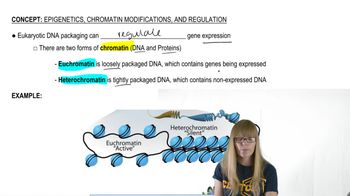
Chromatin is the complex of DNA and proteins that packages eukaryotic DNA into a compact, organized form. The fundamental unit of chromatin is the nucleosome, which consists of about 200 base pairs of DNA wrapped around an octamer of histone proteins. This repeating structure helps regulate DNA accessibility and compaction within the nucleus.
Techniques such as micrococcal nuclease digestion and electron microscopy were crucial in discovering nucleosome structure. Micrococcal nuclease cuts DNA between nucleosomes, revealing DNA fragments of about 200 base pairs, while electron microscopy visualizes the 'beads-on-a-string' appearance of nucleosomes along DNA.
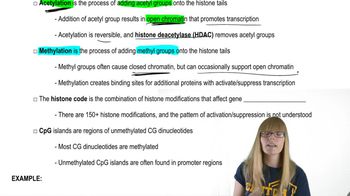
Histones are positively charged proteins that form an octamer core around which DNA wraps to form nucleosomes. The histone octamer consists of two copies each of H2A, H2B, H3, and H4, and their interaction with DNA is essential for chromatin structure and gene regulation.