In eukaryotic DNA, along a 6000-bp segment of DNA, approximately how many molecules of each kind of histone protein do you expect to find? Explain your answer.
Verified step by step guidance
1
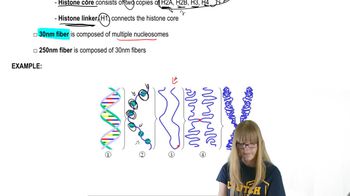
Understand the structure of eukaryotic chromatin: DNA in eukaryotic cells is packaged into nucleosomes, which consist of DNA wrapped around histone proteins. Each nucleosome contains an octamer of histones (two copies each of H2A, H2B, H3, and H4) and is associated with a linker histone (H1).
Determine the length of DNA associated with one nucleosome: Each nucleosome core particle wraps approximately 146 base pairs (bp) of DNA, and the linker DNA between nucleosomes adds about 20-80 bp. On average, the total DNA length per nucleosome is approximately 200 bp.
Calculate the number of nucleosomes in the 6000-bp DNA segment: Divide the total DNA length (6000 bp) by the average DNA length per nucleosome (200 bp). This gives the approximate number of nucleosomes in the segment.
Determine the number of histone proteins per nucleosome: Each nucleosome contains 8 core histones (2 copies each of H2A, H2B, H3, and H4) and 1 linker histone (H1). Multiply the number of nucleosomes by the number of each type of histone protein per nucleosome.
Summarize the result: State the approximate number of molecules of each kind of histone protein (H2A, H2B, H3, H4, and H1) expected in the 6000-bp DNA segment based on the calculations.
Verified video answer for a similar problem:
This video solution was recommended by our tutors as helpful for the problem above
Video duration:
1m
Play a video:
Was this helpful?
Key Concepts
Here are the essential concepts you must grasp in order to answer the question correctly.
Histone Proteins
Histone proteins are essential components of chromatin in eukaryotic cells, serving as spools around which DNA winds. They play a crucial role in packaging DNA into a compact, organized structure, allowing for efficient storage and regulation of genetic material. There are five main types of histones: H1, H2A, H2B, H3, and H4, each contributing to the formation of nucleosomes, the fundamental units of chromatin.
A nucleosome consists of a segment of DNA wrapped around a core of histone proteins, specifically two copies each of H2A, H2B, H3, and H4. This structure forms the basic repeating unit of chromatin, with approximately 146 base pairs of DNA per nucleosome. Understanding nucleosome organization is vital for estimating the number of histone molecules in a given length of DNA, as each nucleosome requires a specific number of histone proteins.
In eukaryotic cells, DNA is highly condensed to fit within the nucleus, with a typical packaging ratio of about 7:1 due to the presence of nucleosomes. For every 200 base pairs of DNA, there is generally one nucleosome, which means that in a 6000-bp segment, approximately 30 nucleosomes would be present. Consequently, this leads to the expectation of a specific number of histone molecules based on the nucleosome count, as each nucleosome contains multiple histone proteins.