What happens to the lac operon when lactose concentration is high?
Table of contents
- 1. Introduction to Genetics51m
- 2. Mendel's Laws of Inheritance3h 37m
- 3. Extensions to Mendelian Inheritance2h 41m
- 4. Genetic Mapping and Linkage2h 28m
- 5. Genetics of Bacteria and Viruses1h 21m
- 6. Chromosomal Variation1h 48m
- 7. DNA and Chromosome Structure56m
- 8. DNA Replication1h 10m
- 9. Mitosis and Meiosis1h 34m
- 10. Transcription1h 0m
- 11. Translation58m
- 12. Gene Regulation in Prokaryotes1h 19m
- 13. Gene Regulation in Eukaryotes44m
- 14. Genetic Control of Development44m
- 15. Genomes and Genomics1h 50m
- 16. Transposable Elements47m
- 17. Mutation, Repair, and Recombination1h 6m
- 18. Molecular Genetic Tools19m
- 19. Cancer Genetics29m
- 20. Quantitative Genetics1h 26m
- 21. Population Genetics50m
- 22. Evolutionary Genetics29m
12. Gene Regulation in Prokaryotes
Lac Operon
Problem 1
Textbook Question
Bacterial genomes frequently contain groups of genes organized into operons. What is the biological advantage of operons to bacteria? Identify the regulatory components you would expect to find in an operon. How are the expressed genes of an operon usually arranged?
Verified step by step guidance1
Understand that an operon is a cluster of genes under the control of a single promoter and regulatory elements, allowing coordinated expression of genes with related functions.
Explain the biological advantage: operons enable bacteria to efficiently regulate multiple genes simultaneously, conserving energy by expressing genes only when needed.
Identify the key regulatory components of an operon, which typically include the promoter (where RNA polymerase binds), the operator (a DNA segment where repressors or activators bind), and structural genes (coding for proteins).
Describe how regulatory proteins such as repressors or activators interact with the operator to control transcription of the operon genes in response to environmental signals.
Note that the expressed genes in an operon are usually arranged sequentially and transcribed together into a single polycistronic mRNA, allowing coordinated translation of all gene products.
Verified video answer for a similar problem:This video solution was recommended by our tutors as helpful for the problem above
Video duration:
1mPlay a video:
Was this helpful?
Key Concepts
Here are the essential concepts you must grasp in order to answer the question correctly.
Operons in Bacterial Genomes
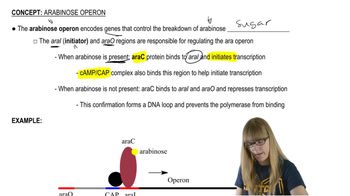
An operon is a cluster of genes under the control of a single promoter and regulatory elements, allowing coordinated expression. This organization enables bacteria to efficiently regulate genes with related functions, often involved in the same metabolic pathway, ensuring resources are conserved and responses are rapid.
Recommended video:
Guided course
Arabinose Operon
Regulatory Components of an Operon
Key regulatory components of an operon include the promoter, where RNA polymerase binds to initiate transcription; the operator, a DNA segment where repressors or activators bind to control gene expression; and regulatory genes that produce these proteins. These elements work together to turn gene expression on or off in response to environmental signals.
Recommended video:
Guided course
Arabinose Operon
Gene Arrangement and Expression in Operons
Genes within an operon are typically arranged sequentially and transcribed together into a single polycistronic mRNA. This arrangement ensures that all genes involved in a specific function are expressed simultaneously and in the correct stoichiometric ratios, facilitating coordinated protein production.
Recommended video:
Guided course
Penetrance and Expressivity
Related Videos
Related Practice
Multiple Choice
1097
views
5
rank
