What happens to the lac operon when the CAP/cAMP complex binds to the CAP binding site?
Table of contents
- 1. Introduction to Genetics51m
- 2. Mendel's Laws of Inheritance3h 37m
- 3. Extensions to Mendelian Inheritance2h 41m
- 4. Genetic Mapping and Linkage2h 28m
- 5. Genetics of Bacteria and Viruses1h 21m
- 6. Chromosomal Variation1h 48m
- 7. DNA and Chromosome Structure56m
- 8. DNA Replication1h 10m
- 9. Mitosis and Meiosis1h 34m
- 10. Transcription1h 0m
- 11. Translation58m
- 12. Gene Regulation in Prokaryotes1h 19m
- 13. Gene Regulation in Eukaryotes44m
- 14. Genetic Control of Development44m
- 15. Genomes and Genomics1h 50m
- 16. Transposable Elements47m
- 17. Mutation, Repair, and Recombination1h 6m
- 18. Molecular Genetic Tools19m
- 19. Cancer Genetics29m
- 20. Quantitative Genetics1h 26m
- 21. Population Genetics50m
- 22. Evolutionary Genetics29m
12. Gene Regulation in Prokaryotes
Lac Operon
Problem 1a
Textbook Question
In this chapter, we focused on the regulation of gene expression in bacteria. Along the way, we found many opportunities to consider the methods and reasoning by which much of this information was acquired. From the explanations given in the chapter, what answers would you propose to the following fundamental questions? How do we know that bacteria regulate the expression of certain genes in response to the environment?
Verified step by step guidance1
Step 1: Understand the concept of gene regulation in bacteria, which means bacteria can turn genes on or off depending on environmental conditions to conserve energy and resources.
Step 2: Consider experimental evidence such as observing bacterial growth and protein production in different environments, for example, the presence or absence of a specific nutrient like lactose.
Step 3: Analyze classic experiments like the lac operon study, where researchers measured enzyme activity (e.g., β-galactosidase) in bacteria grown with and without lactose, showing gene expression changes in response to the environment.
Step 4: Examine molecular techniques such as measuring mRNA levels or using reporter genes to detect when specific genes are transcribed under different environmental conditions.
Step 5: Conclude that the combination of these experimental observations and molecular data demonstrates that bacteria regulate gene expression in response to environmental signals.
Verified video answer for a similar problem:This video solution was recommended by our tutors as helpful for the problem above
Video duration:
2mPlay a video:
Was this helpful?
Key Concepts
Here are the essential concepts you must grasp in order to answer the question correctly.
Gene Regulation in Bacteria
Bacteria regulate gene expression to adapt to environmental changes by turning specific genes on or off. This regulation ensures that proteins are produced only when needed, conserving energy and resources. Key mechanisms include operons, such as the lac operon, which respond to environmental signals like nutrient availability.
Recommended video:
Guided course
Review of Regulation
Experimental Evidence for Gene Regulation
Scientists use experiments like measuring enzyme activity or mRNA levels under different conditions to show gene regulation. For example, observing increased production of enzymes only when their substrates are present demonstrates that gene expression is environmentally responsive. Mutant studies and reporter genes also help reveal regulatory mechanisms.
Recommended video:
Guided course
Review of Regulation
Operon Model and Environmental Response
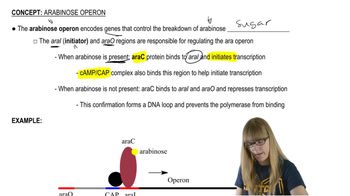
The operon model explains how groups of genes are controlled together by regulatory proteins that respond to environmental cues. Repressors and activators bind DNA to inhibit or promote transcription based on signals like nutrient presence, illustrating a direct link between environment and gene expression in bacteria.
Recommended video:
Guided course
Arabinose Operon
Related Videos
Related Practice
Multiple Choice
1051
views
2
rank