What are the advantages and disadvantages of using GFP versus lacZ as a reporter gene in mice, C. elegans, and Drosophila?
Table of contents
- 1. Introduction to Genetics51m
- 2. Mendel's Laws of Inheritance3h 37m
- 3. Extensions to Mendelian Inheritance2h 41m
- 4. Genetic Mapping and Linkage2h 28m
- 5. Genetics of Bacteria and Viruses1h 21m
- 6. Chromosomal Variation1h 48m
- 7. DNA and Chromosome Structure56m
- 8. DNA Replication1h 10m
- 9. Mitosis and Meiosis1h 34m
- 10. Transcription1h 0m
- 11. Translation58m
- 12. Gene Regulation in Prokaryotes1h 19m
- 13. Gene Regulation in Eukaryotes44m
- 14. Genetic Control of Development44m
- 15. Genomes and Genomics1h 50m
- 16. Transposable Elements47m
- 17. Mutation, Repair, and Recombination1h 6m
- 18. Molecular Genetic Tools19m
- 19. Cancer Genetics29m
- 20. Quantitative Genetics1h 26m
- 21. Population Genetics50m
- 22. Evolutionary Genetics29m
12. Gene Regulation in Prokaryotes
Lac Operon
Problem 1c
Textbook Question
What led researchers to conclude that a repressor molecule regulates the lac operon?
Verified step by step guidance1
Understand the lac operon system: It is a set of genes involved in lactose metabolism in bacteria, regulated to be active only when lactose is present and glucose is absent.
Recognize the role of gene expression regulation: Researchers observed that the lac operon genes are not always expressed, suggesting the presence of a regulatory mechanism controlling transcription.
Examine experimental evidence: Scientists performed experiments where they added or removed lactose and observed changes in enzyme production, indicating that something was inhibiting gene expression in the absence of lactose.
Identify the repressor hypothesis: The idea emerged that a molecule (the repressor) binds to the operator region of the lac operon to block RNA polymerase and prevent transcription when lactose is absent.
Confirm through mutations and binding studies: Mutations in the operator or repressor gene led to continuous expression of the operon, supporting the conclusion that a repressor molecule regulates the lac operon by binding to the operator and controlling gene expression.
Verified video answer for a similar problem:This video solution was recommended by our tutors as helpful for the problem above
Video duration:
26sPlay a video:
Was this helpful?
Key Concepts
Here are the essential concepts you must grasp in order to answer the question correctly.
Lac Operon Structure and Function
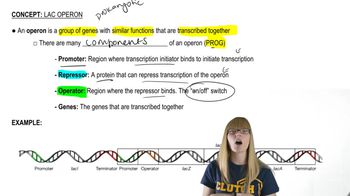
The lac operon is a set of genes in E. coli responsible for metabolizing lactose. It includes structural genes, a promoter, an operator, and regulatory elements. Understanding its components is essential to grasp how gene expression is controlled in response to environmental lactose.
Recommended video:
Guided course
Lac Operon Overview
Role of the Repressor Protein
The repressor is a protein that binds to the operator region of the lac operon, blocking RNA polymerase and preventing transcription when lactose is absent. This negative regulation ensures the operon is only active when lactose is available, conserving cellular resources.
Recommended video:
Guided course
Proteins
Experimental Evidence for Repression
Researchers used genetic mutations and biochemical assays to show that mutations in the operator or repressor gene altered lac operon expression. These experiments demonstrated that a diffusible repressor molecule binds the operator to regulate gene activity, leading to the conclusion of repressor-mediated control.
Recommended video:
Guided course
Transformation
Related Videos
Related Practice
Textbook Question
850
views