The nuclear DNA content of a single sperm cell in Drosophila melanogaster is approximately 0.18 picogram. What would be the expected nuclear DNA content of a primary spermatocyte in Drosophila? What would be the expected nuclear DNA content of a somatic cell (non-sex cell) in the G1 phase? What would be the expected nuclear DNA content of a somatic cell at metaphase?
Verified step by step guidance
1
Understand the ploidy and DNA content of the cells involved. A sperm cell in Drosophila is haploid (1n) and contains one set of chromosomes, so its DNA content represents the haploid amount, which is given as 0.18 picograms.
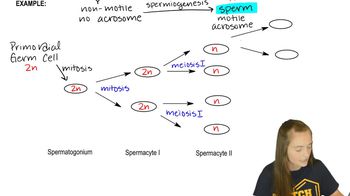
Determine the DNA content of a primary spermatocyte. Primary spermatocytes are diploid (2n) cells that have undergone DNA replication, so they contain duplicated chromosomes. Therefore, their DNA content is twice the diploid amount (4n). Calculate this by multiplying the haploid DNA content by 4: \$4 \times 0.18$ picograms.
Find the DNA content of a somatic cell in the G1 phase. Somatic cells are diploid (2n), and in G1 phase, they have not yet replicated their DNA. So, their DNA content is twice the haploid amount (2n). Calculate this by multiplying the haploid DNA content by 2: \$2 \times 0.18$ picograms.
Determine the DNA content of a somatic cell at metaphase. At metaphase, the cell has replicated its DNA but not yet divided, so it contains duplicated chromosomes (4n DNA content). Calculate this by multiplying the haploid DNA content by 4: \$4 \times 0.18$ picograms.
Summarize the relationships: haploid sperm (1n, 0.18 pg), diploid G1 somatic cell (2n, \$2 \times 0.18\( pg), diploid metaphase somatic cell (4n, \)4 \times 0.18\( pg), and primary spermatocyte (4n, \)4 \times 0.18$ pg). This helps understand how DNA content changes during the cell cycle and gametogenesis.
Verified video answer for a similar problem:
This video solution was recommended by our tutors as helpful for the problem above
Video duration:
3m
Play a video:
Was this helpful?
Key Concepts
Here are the essential concepts you must grasp in order to answer the question correctly.
Ploidy and DNA Content in Gametes and Somatic Cells
Ploidy refers to the number of sets of chromosomes in a cell. In Drosophila, sperm cells are haploid (1n), containing one set of chromosomes, while somatic cells are diploid (2n), containing two sets. DNA content correlates with ploidy, so haploid cells have half the DNA content of diploid cells.
During the cell cycle, DNA content changes depending on the phase. In G1 phase, cells have unreplicated DNA (2n for somatic cells). After DNA replication in S phase, cells have doubled DNA content (4n) by metaphase, preparing for cell division.
Primary spermatocytes are diploid cells (2n) that have replicated their DNA (4n) before meiosis. Sperm cells are haploid (1n) with unreplicated DNA. Understanding these stages helps relate DNA content measurements to specific cell types in Drosophila.