Write a short essay that correlates Mendel's four postulates with what is now known about genes, alleles, and homologous chromosomes.
Table of contents
- 1. Introduction to Genetics51m
- 2. Mendel's Laws of Inheritance3h 37m
- 3. Extensions to Mendelian Inheritance2h 41m
- 4. Genetic Mapping and Linkage2h 28m
- 5. Genetics of Bacteria and Viruses1h 21m
- 6. Chromosomal Variation1h 48m
- 7. DNA and Chromosome Structure56m
- 8. DNA Replication1h 10m
- 9. Mitosis and Meiosis1h 34m
- 10. Transcription1h 0m
- 11. Translation58m
- 12. Gene Regulation in Prokaryotes1h 19m
- 13. Gene Regulation in Eukaryotes44m
- 14. Genetic Control of Development44m
- 15. Genomes and Genomics1h 50m
- 16. Transposable Elements47m
- 17. Mutation, Repair, and Recombination1h 6m
- 18. Molecular Genetic Tools19m
- 19. Cancer Genetics29m
- 20. Quantitative Genetics1h 26m
- 21. Population Genetics50m
- 22. Evolutionary Genetics29m
2. Mendel's Laws of Inheritance
Mendel's Experiments and Laws
Problem 6
Textbook Question
What advantages were provided by Mendel's choice of the garden pea in his experiments?
Verified step by step guidance1
Identify the key characteristics of the garden pea (Pisum sativum) that made it suitable for Mendel's experiments, such as its distinct traits and ease of cultivation.
Explain how the garden pea's ability to self-pollinate and be cross-pollinated allowed Mendel to control mating between plants precisely.
Discuss the presence of clear, contrasting traits (e.g., flower color, seed shape) in peas, which made it easier for Mendel to observe patterns of inheritance.
Highlight the relatively short generation time of peas, enabling Mendel to study multiple generations within a reasonable timeframe.
Note that peas produce a large number of offspring per cross, providing sufficient data for statistical analysis of inheritance patterns.
Verified video answer for a similar problem:This video solution was recommended by our tutors as helpful for the problem above
Video duration:
1mPlay a video:
Was this helpful?
Key Concepts
Here are the essential concepts you must grasp in order to answer the question correctly.
Model Organism Selection
Choosing an appropriate model organism is crucial in genetics research. Mendel's garden pea was ideal because it had distinct, easily observable traits and a short generation time, allowing clear tracking of inheritance patterns across generations.
Recommended video:
Guided course
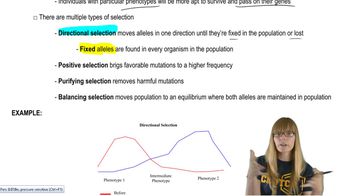
Natural Selection
Controlled Mating and Self-Fertilization
Garden peas can self-fertilize or be cross-pollinated manually, giving Mendel control over breeding. This control enabled precise crosses between plants with specific traits, essential for studying inheritance without external genetic interference.
Recommended video:
Guided course
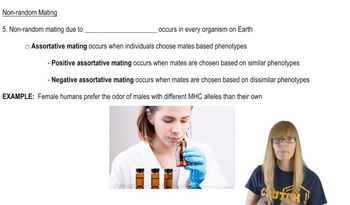
Non-Random Mating
Discrete, Heritable Traits
Peas exhibit clear, contrasting traits (e.g., flower color, seed shape) that are inherited in a predictable manner. These discrete traits allowed Mendel to formulate his laws of inheritance by observing how traits segregated in offspring.
Recommended video:
Guided course
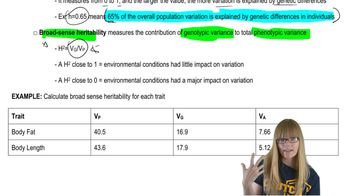
Calculating Heritability
Related Videos
Related Practice
Textbook Question
597
views