What experimental information verifies that certain codons in mRNA specify chain termination during translation?
Table of contents
- 1. Introduction to Genetics51m
- 2. Mendel's Laws of Inheritance3h 37m
- 3. Extensions to Mendelian Inheritance2h 41m
- 4. Genetic Mapping and Linkage2h 28m
- 5. Genetics of Bacteria and Viruses1h 21m
- 6. Chromosomal Variation1h 48m
- 7. DNA and Chromosome Structure56m
- 8. DNA Replication1h 10m
- 9. Mitosis and Meiosis1h 34m
- 10. Transcription1h 0m
- 11. Translation58m
- 12. Gene Regulation in Prokaryotes1h 19m
- 13. Gene Regulation in Eukaryotes44m
- 14. Genetic Control of Development44m
- 15. Genomes and Genomics1h 50m
- 16. Transposable Elements47m
- 17. Mutation, Repair, and Recombination1h 6m
- 18. Molecular Genetic Tools19m
- 19. Cancer Genetics29m
- 20. Quantitative Genetics1h 26m
- 21. Population Genetics50m
- 22. Evolutionary Genetics29m
11. Translation
Translation
Problem 3
Textbook Question
Contrast the roles of tRNA and mRNA during translation, and list all enzymes that participate in the transcription and translation process.
Verified step by step guidance1
Begin by defining the role of mRNA (messenger RNA) in translation: mRNA carries the genetic code transcribed from DNA in the form of codons, which are sequences of three nucleotides that specify particular amino acids.
Next, explain the role of tRNA (transfer RNA): tRNA molecules recognize specific codons on the mRNA through their anticodon region and deliver the corresponding amino acid to the growing polypeptide chain during translation.
Contrast the two by emphasizing that mRNA serves as the template containing the instructions for protein synthesis, while tRNA acts as the adaptor that translates the nucleotide code into amino acids.
List the key enzymes involved in transcription: RNA polymerase (which synthesizes the mRNA strand from the DNA template), helicase (which unwinds the DNA double helix), and topoisomerase (which relieves supercoiling during transcription).
List the enzymes involved in translation: aminoacyl-tRNA synthetase (which charges tRNA molecules with their specific amino acids), peptidyl transferase (a ribozyme activity within the ribosome that forms peptide bonds), and factors such as initiation, elongation, and release factors that assist the translation process.
Verified video answer for a similar problem:This video solution was recommended by our tutors as helpful for the problem above
Video duration:
1mPlay a video:
Was this helpful?
Key Concepts
Here are the essential concepts you must grasp in order to answer the question correctly.
Role of mRNA in Translation
mRNA (messenger RNA) carries the genetic code transcribed from DNA in the form of codons. During translation, ribosomes read the mRNA sequence to assemble amino acids into a polypeptide chain, effectively serving as the template for protein synthesis.
Recommended video:
Guided course
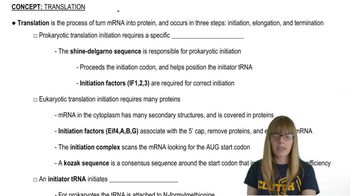
Translation initiation
Role of tRNA in Translation
tRNA (transfer RNA) functions as an adaptor molecule that matches specific amino acids to corresponding codons on the mRNA. Each tRNA has an anticodon region that pairs with the mRNA codon, ensuring the correct amino acid is added to the growing polypeptide chain.
Recommended video:
Guided course
Translation initiation
Enzymes Involved in Transcription and Translation
Key enzymes in transcription include RNA polymerase, which synthesizes mRNA from the DNA template. In translation, enzymes such as aminoacyl-tRNA synthetases charge tRNAs with their respective amino acids, while ribosomal enzymes catalyze peptide bond formation during protein assembly.
Recommended video:
Guided course
Translation initiation
Watch next
Master Translation initiation with a bite sized video explanation from Kylia
Start learningRelated Videos
Related Practice
Textbook Question
643
views